🛏️ Sleeping Bag Temperature Rating Checker
Find the right temperature rating for your sleeping bag based on your camping conditions and sleep style
✅ Your Sleeping Bag Rating Results
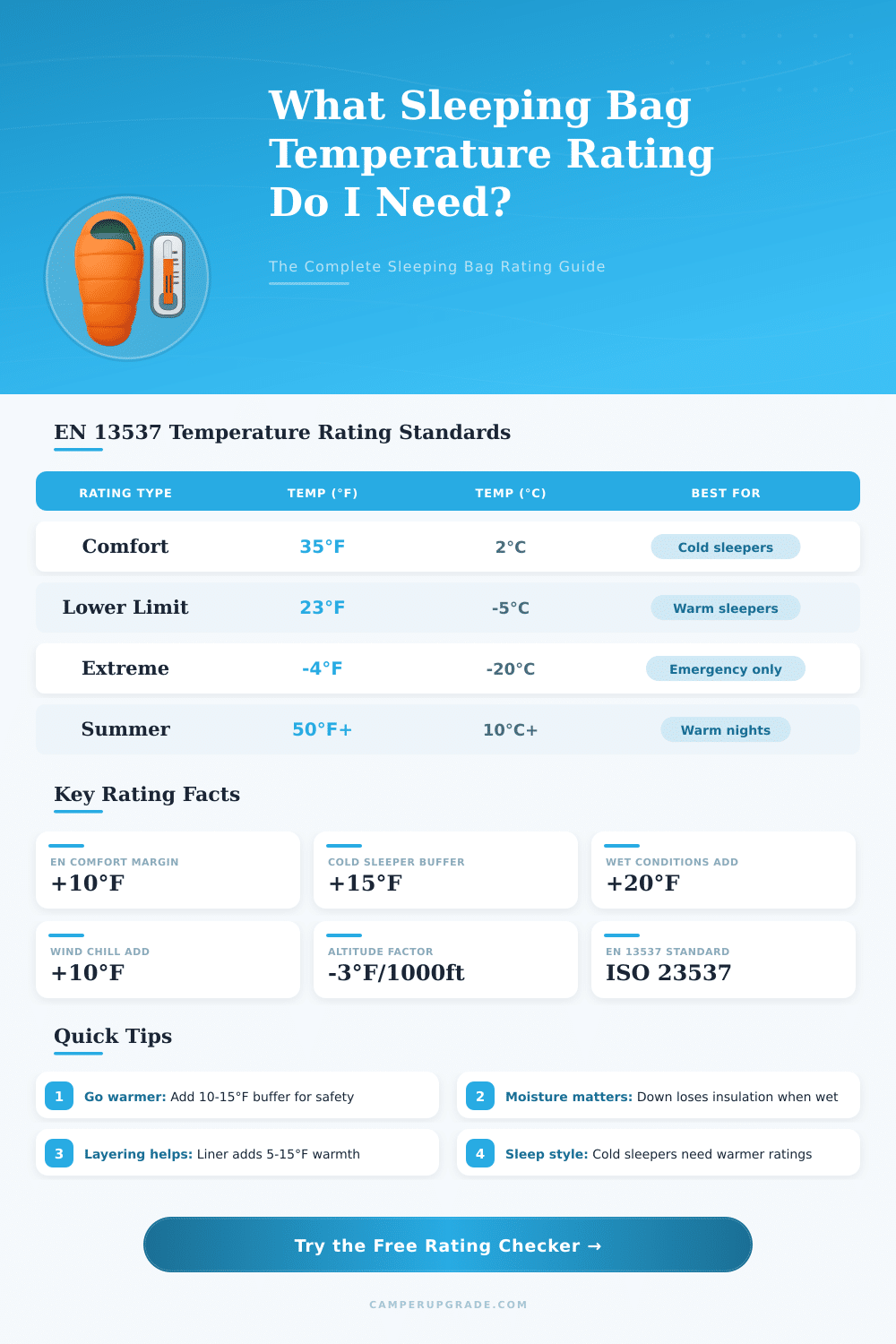
| Season / Type | Rating (°F) | Rating (°C) | Best Use Case | EN Comfort |
|---|---|---|---|---|
| Summer / Ultralight | 40°F – 55°F | 4°C – 13°C | Warm summer nights, car camping | ~50°F / 10°C |
| 3-Season | 20°F – 40°F | -7°C – 4°C | Spring, fall, most backpacking | ~32°F / 0°C |
| Cold Weather / Winter | 0°F – 20°F | -18°C – -7°C | Winter camping, high altitude | ~15°F / -9°C |
| Extreme / Expedition | -20°F and below | -29°C and below | Arctic, alpine expeditions | ~-10°F / -23°C |
| Mummy (3-Season) | 25°F – 35°F | -4°C – 2°C | Backpacking, efficient warmth | ~30°F / -1°C |
| Quilt (3-Season) | 30°F – 45°F | -1°C – 7°C | Ultralight backpacking, warm tents | ~38°F / 3°C |
| Double / Couple | 25°F – 40°F | -4°C – 4°C | Couples, car camping, warmth sharing | ~32°F / 0°C |
| Factor | Condition | Adjust Rating By (°F) | Adjust Rating By (°C) |
|---|---|---|---|
| Sleep Style | Cold sleeper | +10°F to +15°F warmer rating | +6°C to +8°C |
| Sleep Style | Warm sleeper | -5°F to -10°F | -3°C to -6°C |
| Humidity | Wet / humid conditions | +15°F to +20°F warmer rating | +8°C to +11°C |
| Altitude | 5,000–10,000 ft (1,500–3,000 m) | +5°F warmer rating | +3°C |
| Altitude | >10,000 ft (3,000 m) | +10°F to +15°F warmer rating | +6°C to +8°C |
| Liner | Silk or fleece liner | -10°F to -15°F (warmer) | -6°C to -8°C |
| Fill Type | Down in wet conditions | +20°F warmer rating needed | +11°C |
| Camping Style | Expedition / no shelter | +10°F warmer rating | +6°C |
| Fill Power | Type | Warmth-to-Weight | Wet Performance |
|---|---|---|---|
| 550–600 FP Down | Natural Down | Good | Poor — loses loft when wet |
| 650–700 FP Down | Natural Down | Excellent | Poor — loses loft when wet |
| 750–850+ FP Down | Premium Down | Outstanding | Poor — loses loft when wet |
| Hydrophobic Down | Treated Down | Excellent | Fair — resists moisture short-term |
| R-Series Synthetic | Synthetic Fill | Good (heavier) | Excellent — retains warmth when wet |
| PrimaLoft® Gold | Premium Synthetic | Very Good | Excellent — best synthetic wet performance |
A sleeping bag can make or break a whole camping trip. Recall your first night under a tent. Could you hardly sleep?
Did you overheat or get too cold as the night went on? Good sleep matters a lot when the days of camping are full of fun activities. The sleeping bag seriously affects how warm and nice the body stays during the night.
How to Choose the Right Sleeping Bag
Different types deserve thought. Rectangle sleeping bags work well for summer camping because they allow more freedom to move inside. They breathe and weigh little, so they are great for gentle seasons.
There are also mummy bags that are narrower and work better for keeping heat. Some campers like a mixed form between mummy and rectangle especially big people that find mummy bags too tight.
Two-season sleeping bags suit folks for temperatures of 0°C to 5°C. They work well from late spring to early autumn in quite a lot of gentle regions. They balance well between heat and weight, so they are a good choice for campers in cool, but not cold conditions. For less warm journeys, four-season bags help for below zero degrees.
Sleeping bag covers form another option worth knowing. They fill with down feathers just as well as average sleeping bags. Some campers find them more comfortable, especially if the temperatures change a lot during different trips.
Also budget options exist. Rectangle bags with flannel lining cost around thirty dollars and work for spring and summer camping. Only remember that those cheap ones commonly feel more cold then the listed temperature rating limits.
Also, heavy and thick models are hard to easily carry. Some quality sleeping bags please because of the internal flannel material that feels almost like home sheets. Synthetic materials, common in hiking bags, can touch cold at first and do not breathe as well.
During car camping, sleeping bags usually weigh more, but they fill with more feathers and cost less than those for hiking. Some bags can zip two sleeping bags together to create a bigger one, what well serves pairs. One on upper, one bottom, and theyzipup together easily.
But the sleep system does not stop at the bag itself. Also the sleeping pad matters. It keeps the body from the ground.
Without a good pad, even a good sleeping bag will not be enough. Some campers use memory foam or thick foam pads for extra comfort.
Storing sleeping bags right is worth remembering. Long term storage works best in a breathable bag, rather than in a tight plastic bag. And putting your head inside of the bag during cold nights truly causes problems, because the moisture from breathing creates wet insides.