Sleeping Bag Liner Temperature Calculator
Estimate adjusted sleeping bag comfort temperature, lower-limit estimate, actual liner warmth gain, and risk band from liner material, pad R-value, clothing, drafts, humidity, elevation, and safety buffer.
Sleeping bag liner estimate
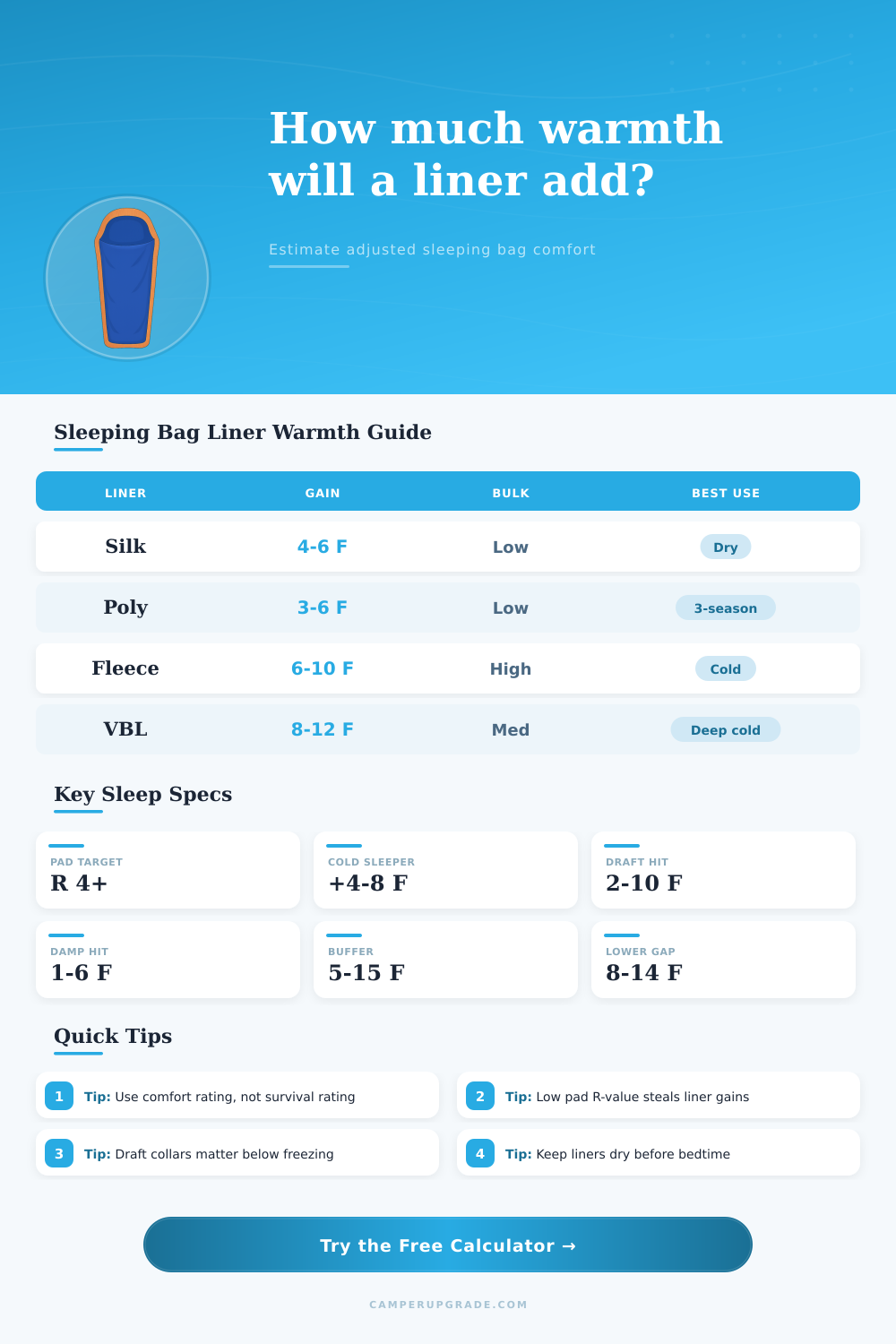
| Liner material | Typical warmth | Damp retention | Best use |
|---|---|---|---|
| No liner | 0°F | not applicable | Known mild forecasts |
| Cotton travel liner | 2–4°F | poor when damp | Hostel, camper, warm trips |
| Silk mummy liner | 4–6°F | fair, dries quickly | Low-bulk backpacking |
| Polyester microfiber | 3–6°F | good synthetic drying | General three-season use |
| Fleece thermal liner | 6–10°F | good but bulky | Car camping and cold snaps |
| Merino wool liner | 5–8°F | strong comfort when damp | Humid shoulder season trips |
| Synthetic thermal reactor | 8–12°F | good if kept ventilated | Cold lightweight systems |
| Vapor barrier liner | 8–12°F | protects loft, clammy feel | Deep cold below freezing |
| Pad R-value | Sleep system effect | Approx adjustment | Planning note |
|---|---|---|---|
| Under R 2.0 | Major ground heat loss | +5 to +8°F | Liner gain may be overwhelmed |
| R 2.0 to 3.4 | Cool shoulder-season floor | +2 to +5°F | Upgrade pad before chasing liner warmth |
| R 3.5 to 4.4 | Near common rating assumption | 0 to +1°F | Good baseline for most bags |
| R 4.5 to 5.9 | Warm ground insulation | -1 to -3°F | Better use of bag loft |
| R 6.0+ | Winter-ready floor insulation | -3 to -5°F | Useful for snow and frozen ground |
| Adjustment source | Typical effect | Why it matters | Calculator treatment |
|---|---|---|---|
| Cold sleeper metabolism | +4 to +8°F | Less internal heat at rest | Raises adjusted comfort temp |
| Warm sleeper metabolism | -3 to -6°F | More personal heat output | Lowers adjusted comfort temp |
| Light sleep clothing | -1 to -3°F | Adds dry insulation inside bag | Counts as warmth credit |
| Drafty shelter or bag gaps | +3 to +10°F | Warm air escapes repeatedly | Raises comfort and risk |
| High humidity | +1 to +6°F | Condensation lowers loft | Reduces liner gain and adds penalty |
| Safety buffer | +5 to +15°F | Protects against forecast error | Added after gear adjustments |
| Sleep setup | Bag comfort | Liner claim | Likely use case |
|---|---|---|---|
| Summer silk boost | 40°F | 5°F | Mild tent camping with low bulk |
| Poly three-season | 30°F | 8°F | General backpacking margin |
| Fleece car-camp liner | 25°F | 12°F | Bulk-tolerant cold front |
| Merino damp night | 32°F | 8°F | Humid coastal or forest camp |
| Vapor barrier cold | 10°F | 12°F | Deep cold with careful moisture control |
A sleeping bag’s rating is often not an accurat description of the sleeping bag’s warmth. Numerous reasons exist for why sleeping bags feels colder than the sleeping bag’s rated warmth. One solution for those sleeping bags that wish to experience more warmth is the use of sleeping bag liners.
A sleeping bag liner calculator can help to show the warmth that a sleeping bag liner will provide to a sleeping bag under certain variable. Sleeping bag liners does not create unlimited warmth for sleeping bag occupants. The sleeping bag liner’s fabric, the loft of the sleeping bag liner, and the sleeping pad used by sleeping bag occupant limit the warmth that a sleeping bag liner provides.
How the Sleeping Bag Liner Calculator Works
For instance, silk sleeping bag liners provide a modest amount of warmth and is lightweight. Fleece sleeping bag liners provide more warmth than silk sleeping bag liners but add more bulks to sleeping bags, which may be a problem for those using small sleeping bags. Vapor barrier sleeping bag liners work by preventing moisture from migrating in or out of sleeping bags, while silk and fleece sleeping bag liners work by adding warmth to sleeping bags.
The sleeping bag liner temperature calculator will use the sleeping bag liner of your selection to calculate the warmth gain that the sleeping bag liner will provide, but will apply caps to that warmth gain to ensure that the calculator will not indicate a sleeping bag liner will provide more warmth then it can. The sleeping bag liner calculator will ask for several pieces of information from sleeping bag enthusiast. One of those pieces of information is the warmth that the sleeping pad in which sleeping bag occupants will sleep provides.
Sleeping bags are often tested using sleeping pads with an R-value of 4. Sleeping bag occupants who use sleeping pads with an R-value lower than 4 will lose more warmth to the ground with each sleeping bag use. Therefore, the sleeping bag liner calculator will adjust the comfort temperature shown to reflect the warmth provided by the sleeping pad.
Another variable that the sleeping bag user will be asked is the elevation at which sleeping bag occupants will sleep. Sleeping bag temperatures drop with reductions in elevation. Therefore, sleeping bag occupants must account for these difference when sleeping bag liner use is being considered.
Cold sleepers typically lose more warmth than warm sleepers because cold sleepers naturaly produce more less body heat. Therefore, the sleeping bag liner calculator will adjust for the sleeping bag user’s sleeping temperature when calculating warmth gain. Conversely, clothing variables will work in the opposite direction of metabolism variables because warm sleeping clothing adds to the warmth of sleeping bags.
Warm clothing recommendations include a dry base layer and a sleeping beanie. The sleeping bag liner calculator will count these. Another factor that sleeping bag liners will counteract is the temperature of the surrounding air.
High humidity levels will reduce the warmth provided by sleeping bags because high humidity reduce the loft of sleeping bag insulation. High humidity also reduces warmth provided by sleeping bag liners, especially cotton sleeping bag liners. Additionally, drafts will reduce warmth provided to sleeping bag occupants.
Warmth will be lost from sleeping bags due to drafts moving warm air out of sleeping bags through the hood or footbox of the sleeping bag. The sleeping bag liner calculator will counter these variables because drafts and high humidity levels will reduce warmth provided to sleeping bag occupants. Two tables are provided on the sleeping bag liner calculator website.
These tables provide examples of the warmth provided by different sleeping bag liners, the number of warmth degrees that will be lost due to high humidity levels, and the number of warmth degrees that will be lost due to exposure to drafts. Additionally, the tables show the effects of sleeping on sleeping pads of certain thickness. These tables allow sleeping bag occupants to decide whether purchasing a sleeping bag liner will provide as much warmth as purchasing a sleeping pad of a higher thickness.
Many sleeping bag occupants will attempt to add sleeping bag liners to sleeping bags without considering the impact of other variable. For example, a sleeping bag liner may claim to provide eight degrees of warmth. Yet, if the sleeping bag occupants are exposed to high humidity and use a poor sleeping pad, the sleeping bag liner may only be able to provide five degrees of warmth.
The sleeping bag liner calculator will account for these interactions so that the comfort temperature provided is accurate to all variable. Additionally, the sleeping bag liner calculator will provide a lower limit to warmth provided by the sleeping bag and sleeping bag liner combination so that sleeping bag occupants can understand the risk of sleeping in temperatures as low as possible. Though the safety buffer is not often utilized in sleeping bag liner calculations, it is important.
Outside variables such as unexpected winds will lower warmth provided to sleeping bag occupants. The same is true of changes in sleeping bag placement. Therefore, sleeping bag occupants may decide on the degree of warmth that will be provided to sleeping bags in the event of these unexpected variable.
For instance, adding a ten-degree safety buffer allows sleeping bag enthusiasts to account for variables that may lower the warmth provided to sleeping bags. Once sleeping bag occupants have calculated the warmth provided by the sleeping bag and sleeping bag liner combination, they can make a decision regarding gear for sleeping. If the overnight temperature to which sleeping bag occupants will sleep is warmer than the comfort temperature of the sleeping bag, sleeping bag liner and sleeping pad combination, they are likely to enjoy good sleep with their sleeping gear.
If the overnight temperature is lower than the comfort temperature of the sleeping bag, sleeping bag liner and sleeping pad combination, sleeping bag occupants will have to adjust their sleeping gear. The sleeping bag liner temperature calculator allows sleeping bag occupants to understand how different variables will interact with sleeping bag liners. With time, sleeping bag occupants will understand the impact of different variable on sleeping bag liner warmth and be able to make better sleeping bag gear decision.