Sleeping Bag Compression Size Calculator
Estimate a sleeping bag's compressed volume, stuff sack cylinder size, compression ratio, and pack compartment fit from bag shape, insulation, temperature rating, and trip conditions.
| Preset | Typical fill | Loose dimensions used | Common packed range |
|---|---|---|---|
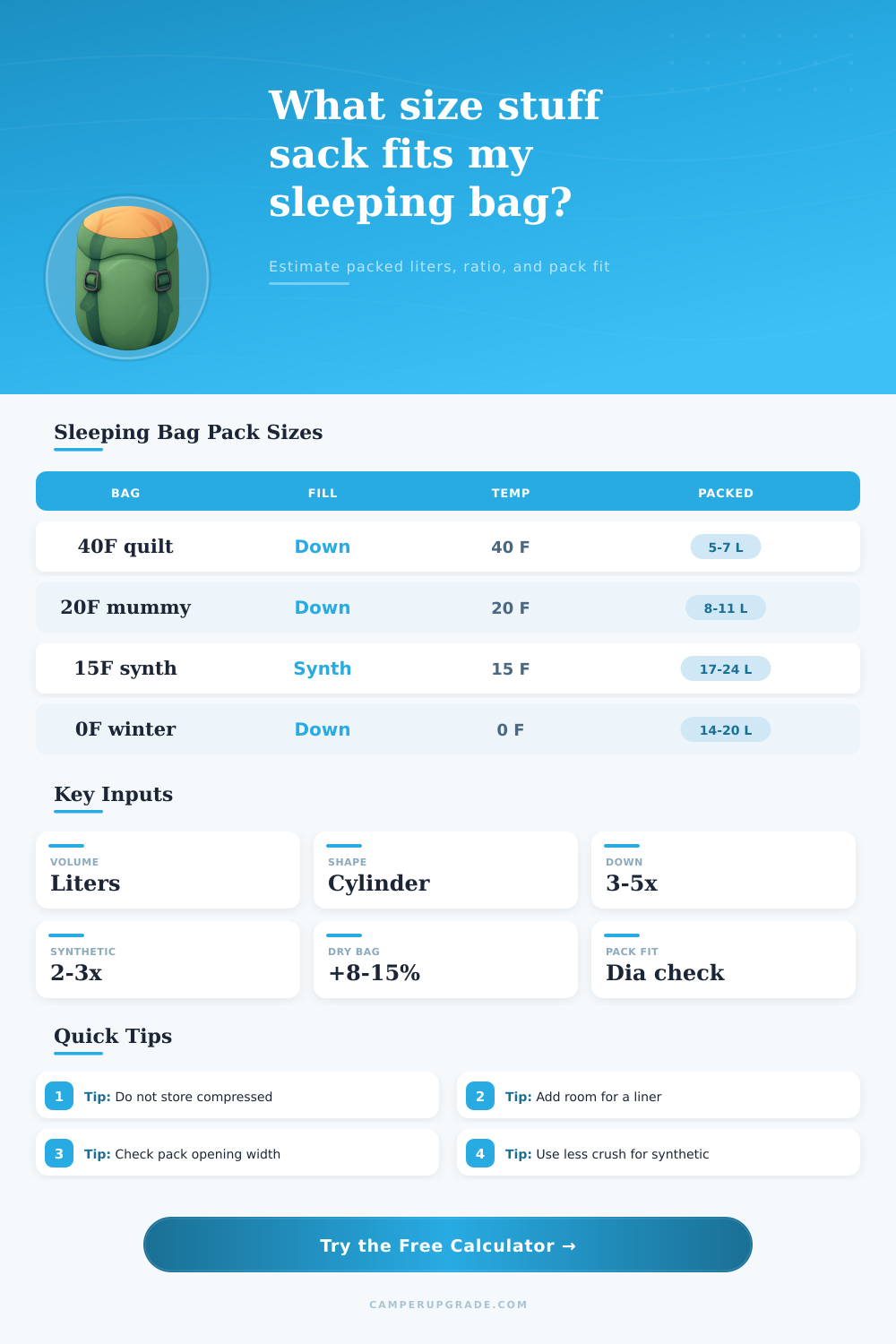
| 40F down quilt | 800-900 FP down | 74 x 52 x 2.0 in | 5-7 liters |
| 30F ultralight mummy | 850-900 FP down | 78 x 60 x 3.0 in | 6-9 liters |
| 20F down mummy | 750-850 FP down | 78 x 62 x 3.8 in | 8-11 liters |
| 20F wide down bag | 650-800 FP down | 80 x 68 x 4.0 in | 10-14 liters |
| 15F synthetic mummy | Continuous synthetic | 78 x 64 x 4.5 in | 17-24 liters |
| 35F rectangular synthetic | Sheet synthetic | 75 x 66 x 3.0 in | 14-22 liters |
| Couples double bag | Synthetic or low FP down | 80 x 86 x 3.5 in | 28-45 liters |
| 0F winter down | 750-850 FP down | 82 x 66 x 6.0 in | 14-20 liters |
| -20F expedition synthetic | Heavy synthetic | 84 x 68 x 8.0 in | 35-55 liters |
| Kids synthetic bag | Light synthetic | 60 x 56 x 2.8 in | 9-15 liters |
| Sack diameter x length | Cylinder volume | Best fit example | Pack fit note |
|---|---|---|---|
| 5 x 10 in | 3.2 liters | Minimal quilt or liner | Fits narrow daypack zones |
| 6 x 11 in | 5.1 liters | Summer down quilt | Small lower compartment |
| 7 x 13 in | 8.2 liters | Three-season down mummy | Common backpacking size |
| 8 x 14 in | 11.5 liters | Wide down or bulky quilt | Check pack opening first |
| 9 x 16 in | 16.7 liters | Light synthetic bag | Better inside larger packs |
| 10 x 18 in | 23.2 liters | Rectangular synthetic bag | Usually not ultralight-pack friendly |
| 12 x 20 in | 37.1 liters | Double or expedition bag | Often needs external duffel space |
| Insulation | Normal trip ratio | Short maximum ratio | Compression behavior |
|---|---|---|---|
| 900 fill-power down | 3.8:1 to 4.8:1 | 5.8:1 | Very compressible, sensitive to moisture |
| 800 fill-power down | 3.4:1 to 4.4:1 | 5.2:1 | Excellent backpacking balance |
| 650 fill-power down | 2.8:1 to 3.7:1 | 4.5:1 | Bulkier down with more feather content |
| Light synthetic fill | 2.2:1 to 2.9:1 | 3.5:1 | Resists moisture but springs back slower |
| Heavy synthetic fill | 1.8:1 to 2.5:1 | 3.0:1 | Bulky, avoid extreme crushing |
| Cotton blend camp bag | 1.5:1 to 2.0:1 | 2.4:1 | Packs large and dries slowly |
| Available pack space | Bag volume target | Typical setup | Practical check |
|---|---|---|---|
| 6-8 liters | Summer quilt or 30F premium down | Fastpacking or compact pack | Use a narrow 5-7 in sack |
| 9-12 liters | 20F down mummy | Three-season backpacking | Good lower compartment size |
| 13-18 liters | Wide down or light synthetic | Cold shoulder season trips | Check food and clothing overlap |
| 19-28 liters | Synthetic rectangular bag | Car-camping bag in backpack | Often easier in a vertical pack shape |
| 29-45 liters | Double or expedition bag | Winter pulk, canoe, or duffel | Backpack fit is usually the constraint |
Question: What is a compression size calculator? Answer: A compression size calculator is a tool that help a person to determine how much volume the sleeping bags will take up when compressed. The volume of a sleeping bag that will be compressed are an important measurement to make certain that the sleeping bag will fit within the backpack that you’ll use to carry the sleeping bag.
The volume of the sleeping bag will determine how much space can remain within the backpack for food and clothing. Should the sleeping bag take up too much space within the backpack, the sleeping bag may become difficult to carrying. Due to these potential difficulties in carrying the sleeping bag, many person use a compression size calculator to help them plan what sleeping bag they will bring on there trips.
What a Sleeping Bag Compression Size Calculator Is
How does a compression size calculator work? A compression size calculator works by taking the sleeping bag and determining the volume that it will take up when compressed. The calculator’s volume calculations account for the type of insulation that is within the sleeping bag.
For instance, sleeping bags with down insulation will take up less space than sleeping bags with synthetic insulation when those bags is compressed; the down insulation can be compressed, but not the synthetic insulation. In addition to these factor, the sleeping bag with a colder temperature rating will have more loft within the sleeping bag to retain warmth for cold temperatures, and sleeping bags with more loft will take up more space within the sleeping bag when it is not compressed. Another factor that a compression size calculator considers is the shape of the sleeping bag.
For example, sleeping bags with a mummy shape will take up less space than sleeping bags with rectangular shapes; mummy shaped sleeping bags are often tapered so that their volume decreases when they are compressed. Additionally, sleeping bags that is quilted will take up less space than sleeping bags that are mummy-shaped or rectangular; quilted sleeping bags do not have a layer of fabric at the bottom of the sleeping bag. In order to determine how many liter of space a sleeping bag will take up within the backpack, the size of the backpack’s compartment is considered.
Beyond the total number of liters of space within the compartment, the width of the opening of the backpack’s compartment is also important. A sleeping bag with a wide opening may not fit within a backpack compartment with a smaller opening. In addition to the factors mentioned above, moisture and the length of time it is compressed can affect a sleeping bag’s loft.
For instance, sleeping bags with down insulation may lose its loft if the sleeping bag become wet. Additionally, long periods of compression may reduce the loft of sleeping bags with down or synthetic insulation. A sleeping bag with down or synthetic insulation would of been best if the sleeping bag is compressed into a sack with a larger size with a percentage provide to it for a buffer; this provides space for the sleeping bag’s insulation to maintain its loft.
Additionally, sleeping bags with down or synthetic insulation must be stored in a loose fashion within the backpack’s compartment. If they are stored within the same compartment in which they are to be stored during sleep, they may lose their loft over time. Thus, the compression size calculator can help an individual to plan their trips with certain, but is not a tool that can indicate the way in which the sleeping bag should be stored within the closet of there bedroom.
In addition to each of these factors, another item that the compression size calculator’s calculations should account for is the volume that items within the sleeping bag will take up. Items within the sleeping bag, such as a sleeping bag liner or a sleeping bag pillow will take up some of the space that is allowed within the backpack. Thus, it is best to provide some allowance within the calculations for these items to ensure that the sleeping bag will not be too full within the backpack.
By using a compression size calculator, an individual can understand the relationship between the sleeping bag’s loft, the ability of the sleeping bag to compress, and the size of the backpack that is to be used to transport the sleeping bag. Through understanding of these factors, an individual can have confidence in the sleeping bag that they packs into their backpack.