Skin Track Angle Calculator
Estimate climbing angle, grade, grip margin, vertical gain rate, and switchback spacing for ski touring and splitboard approaches.
⛷ Touring Presets
📐 Track Inputs
🧪 Skin And Surface Grip Grid
📊 Angle And Grade Reference
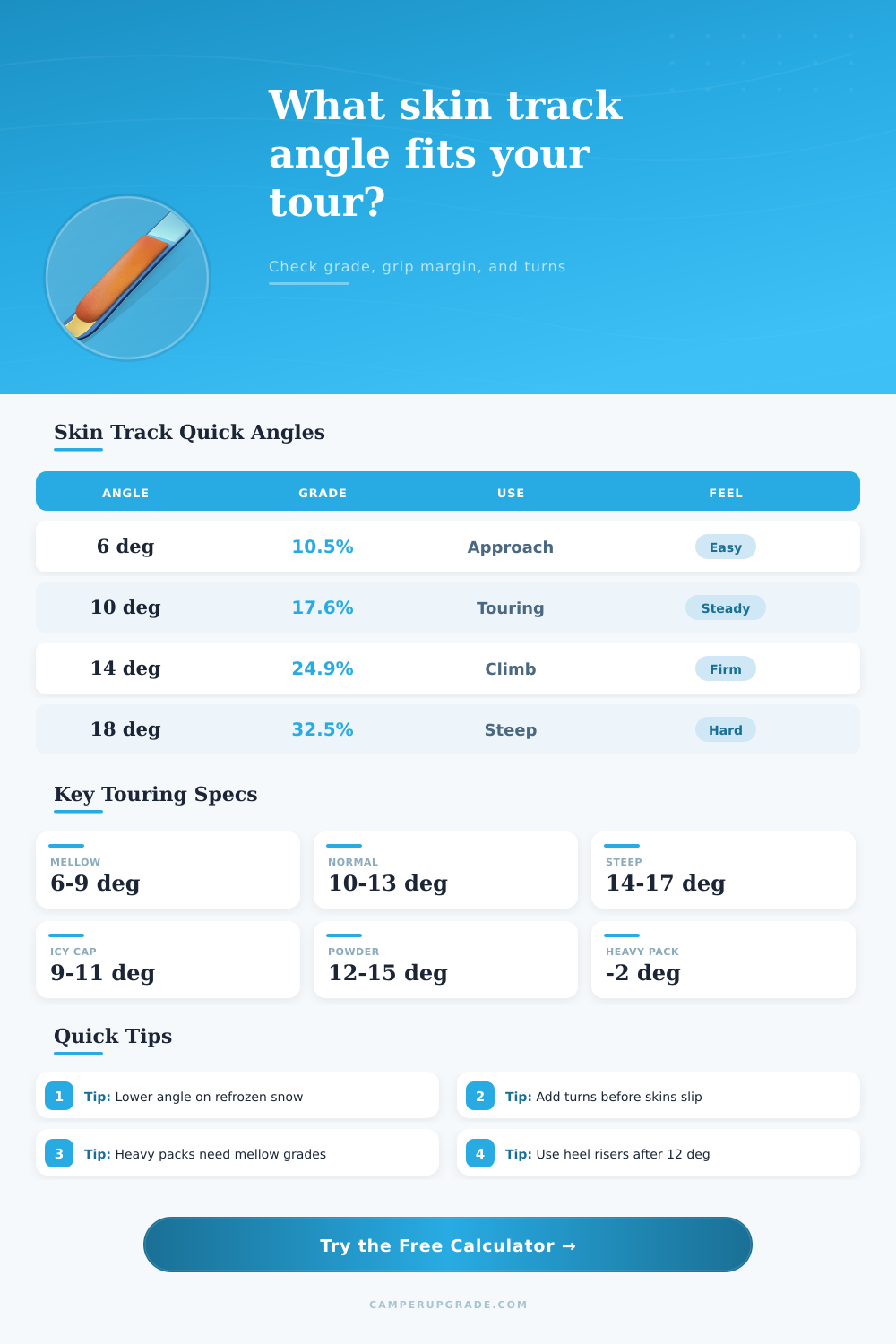
| Track angle | Grade percent | Vertical gain per mile | Typical touring use |
|---|---|---|---|
| 6 deg | 10.5% | 554 ft | Long road approaches, new groups, low-angle meadows |
| 8 deg | 14.1% | 743 ft | Mellow powder laps and efficient rolling exits |
| 10 deg | 17.6% | 931 ft | Common all-day touring angle for mixed groups |
| 12 deg | 21.3% | 1123 ft | Efficient climbing with good skin grip and steady technique |
| 14 deg | 24.9% | 1317 ft | Firm climb that often needs heel risers and clean kick turns |
| 16 deg | 28.7% | 1514 ft | Short strong-party climb in supportive snow |
| 18 deg | 32.5% | 1717 ft | Very steep skinning; slipping risk rises quickly |
🏔 Snow Surface Adjustment Table
| Snow surface | Grip adjustment | Best target angle | Track planning note |
|---|---|---|---|
| Soft powder | +1 deg | 10 to 14 deg | Good grip, but deep trail breaking rewards a smooth low cadence. |
| Packed powder | 0 deg | 9 to 13 deg | Reliable benchmark surface for normal touring calculations. |
| Spring corn | 0 deg | 10 to 14 deg | Supportive when softened; refreeze can change it to icy behavior. |
| Windboard | -2 deg | 8 to 11 deg | Skin contact can be uneven, so add extra switchbacks early. |
| Icy or refrozen | -3 deg | 6 to 10 deg | Keep the track low-angle and consider ski crampons where appropriate. |
| Wet heavy snow | -1 deg | 8 to 12 deg | Heavy skins and heavy packs make steep tracks tiring fast. |
⚙ Skin Material And Setup Comparison
| Setup | Base grip cap | Glide behavior | Best use case |
|---|---|---|---|
| Nylon plush | 18 deg | Slowest glide, strongest grip | Cold powder, loaded approaches, and newer tourers |
| Mohair nylon mix | 16 deg | Balanced grip and glide | General touring where one skin must do most conditions |
| Mohair plush | 14 deg | Fast glide, lower bite | Long approaches, fitness tours, and low-angle rolling terrain |
| Worn or short plush | 12 deg | Variable glide and bite | Conservative angles until the skin is refreshed or replaced |
| Splitboard tail-clipped skins | 15 deg | Good grip, wider platform drag | Powder climbs and moderate switchback tracks |
| Waxless scale approach | 10 deg | No transition skin, limited steep grip | Rolling access roads and very mellow approaches |
🔁 Switchback Planning Reference
| Usable traverse width | 8 deg track | 10 deg track | 12 deg track |
|---|---|---|---|
| 100 ft corridor | 14 ft gain | 18 ft gain | 21 ft gain |
| 150 ft corridor | 21 ft gain | 26 ft gain | 32 ft gain |
| 200 ft corridor | 28 ft gain | 35 ft gain | 43 ft gain |
| 300 ft corridor | 42 ft gain | 53 ft gain | 64 ft gain |
| 500 ft corridor | 70 ft gain | 88 ft gain | 106 ft gain |
📍 Common Tour Segment Examples
| Segment | Rise and distance | Track angle | Planning takeaway |
|---|---|---|---|
| Road approach | 450 ft over 1.2 mi | 4.1 deg | Efficient glide; angle is rarely the limiting factor. |
| Meadow ramp | 700 ft over 0.9 mi | 8.4 deg | Comfortable for mixed groups and soft snow trail breaking. |
| Treed powder lap | 900 ft over 0.8 mi | 12.0 deg | Works well if the track avoids abrupt kick turns. |
| Icy sidehill | 600 ft over 0.6 mi | 10.8 deg | May need a lower angle because grip margin is reduced. |
| Short fitness climb | 1000 ft over 0.65 mi | 16.3 deg | Strong groups only; slipping wastes energy quickly. |
💡 Field Notes
The misery you feel from your lack of energy combined with the angle of the skin tracks exists somewhere between the steepness of those tracks and how much energy you have store. Halfway up a steep pitch, your lungs are on fire when you realize that the hill is steeper then what your gear can hold. Fighting friction won’t cooperate as your skins begins peeling off at their tails and your stride transforms into a shuffle.
That’s where the need for skin track geometry comes in long before you clip in. It’s not simply an issue of fitness but physics meeting the body in a very direct way. When you plug your run and rise into the calculator above, it does all the math so you don’t have to guess if this ridge line’s a climb you can tackle or a climbing disaster just waiting to happen.
How to Pick the Right Slope Angle
But the numbers aren’t the full story. You need to understand what these numbers mean for your feet. The angle are created by your vertical gain over horizontal distance. It is also the angle you must keep under control based off your skin material and snow surface. Charging up a fourteen degree pitch won’t worry you if you’re using nylon plush skins, but the exact same slope will slip out from underneath you on icy or windboard conditions when you’re on glide mohair skins.
Speed versus grip is the central tension in touring equipment design. A loaded backpack shifts your center of gravity and puts additional force on your tail ends. Even with high-traction nylon skins, that means you have less actualy grip. You can go down one or two degrees in max safe climbing angle with a heavily loaded backpack, but you don’t pay attention to that until you’re struggling and everyone ignores it. Carry a three-day food bag, camera batteries, and camping gear, and make sure you consider every angle.
This explains it plainly (the chart is on the page). A little bit on paper makes all the difference when you have to stand near the top of a steep pitch and feel like your ankles is going to cave. Another mistake new tourers make is trying to climb straight up because it looks efficient, which ignores our physical limitations like endurance and grip. Wider switchbacks keeps the angle in your grip range and let you maintain a more steady rhythm. Narrow corridors require constant kick turns, which wastes energy and increases the chance of slipping back as you turn. By considering usable width, the calculator calculates an ideal distance for smooth transitions.
When you’re tired, raw vertical speed don’t matter as much as smooth transitions. Everything else aside, the snow decides. Soft powder offers naturaly grip and cushion so that pushing an angle higher isn’t a question of traction, but a matter of pushing it harder. Conversely, icy or refrozen snow does the exact opposite and makes anything steeper than ten degrees into a potential danger zone for regular old skins. There’s no negotiating with ice. Hard surface means lower angles, specialized gear such as crampons, or sitting on your butt at the bottom.
That’s why it’s important to check the snow profile before committing to a line. This is important not only to avoid avalanches but also to keep your option to go up without sliding down. A second wrinkle comes from group dynamics: A mix of veteran and novice tourers will have trouble on various angles and move up at varying rates. To keep the group happy and safe, plan for the weak link. When leading novices, try to stick to more gentle angles (even if the terrain supports steeper ones). Patience on the ascent pays off on the descent. A well-rested and confident group will go much faster than one rushed on a steep climb. Rushing could of cause mistakes from fatigue or skin failures later in the day.
So, in the end it’s all about matching what you have with the reality of where you’re going and picking an angle that works for you, your fitness level, the condition of your skins, the snow conditions. With the tool, you can visualize this before heading out on the tour. If the numbers mesh with your kit, then the ascent goes by easily. If it doesn’t, then you know why and that becomes part of the feedback loop that gets you better at touring. And that begins with understanding just how steep that hill actualy is.