Ski Wax Interval Calculator
Estimate when to wax skis or a snowboard from snow abrasiveness, glide time, distance, wax type, base condition, and storage age.
Formula Breakdown
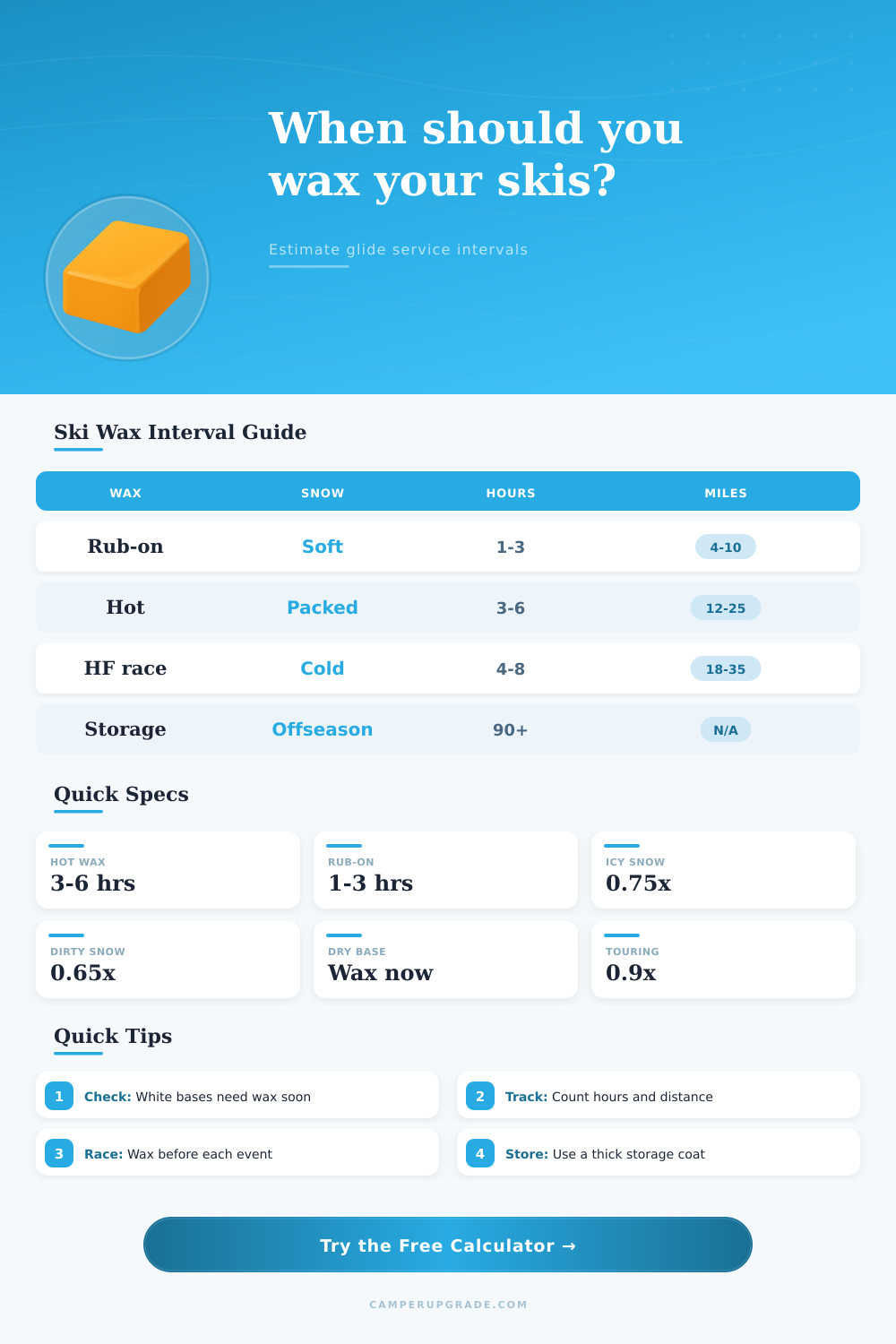
| Wax Type | Baseline Glide Hours | Baseline Miles | Best Use |
|---|---|---|---|
| Rub-on paste or block wax | 1–3 hr | 4–10 mi | Short top-up, emergency glide |
| Liquid glide wax | 2–4 hr | 8–16 mi | Quick day-trip maintenance |
| Universal hot wax | 3–6 hr | 12–25 mi | Normal resort and touring use |
| Temperature-matched hot wax | 4–8 hr | 18–35 mi | Better durability and glide match |
| Race wax layer | 4–8 hr | 15–30 mi | Fast glide with event-focused prep |
| Scraped storage wax | 2–5 hr | 8–20 mi | First outing after storage |
| Snow Condition | Interval Factor | Why It Changes | Typical Sign |
|---|---|---|---|
| Soft powder or fresh corduroy | 1.15× | Lower abrasion and less base burn | Quiet glide, little whitening |
| Packed groomed snow | 1.00× | Normal reference condition | Predictable glide feel |
| Hardpack or icy man-made snow | 0.75× | Sharper crystals abrade wax faster | White edges appear early |
| Dirty, granular, late-season snow | 0.65× | Grit and water pull wax from base | Slow, grabby glide |
| Ski or Board Type | Usage Factor | Normal Wax Rhythm | Reason |
|---|---|---|---|
| Alpine resort skis | 1.00× | Every 3–6 ski days | Baseline lift-served use |
| Snowboard | 0.95× | Every 2–5 ride days | Wide base collects dry patches |
| Backcountry touring skis | 0.90× | Every 2–5 tours | Uphill skins and mixed snow add wear |
| Nordic classic or skate skis | 0.80× | Every 15–30 km for glide focus | Continuous glide without lift breaks |
| Race skis | 0.55× | Before each race or hard session | Performance target is stricter |
| Current Base Look | Condition Factor | Service Meaning | Action |
|---|---|---|---|
| Glossy and slick | 1.10× | Wax still present in base | Keep tracking time and distance |
| Normal glide, no whitening | 1.00× | Average post-wax condition | Use interval estimate |
| White along edges or tips | 0.85× | Edge areas are drying first | Wax soon after next outing |
| Chalky, slow, or fuzzy base | 0.70× | Base is under-waxed now | Wax before riding again |
Ski wax are a sacrificial layer that is meant to protect the ski base; ski wax is spesifically designed to wear away so that the snow will not damage the ski base. If ski wax arent applied to the ski base frequent enough, the ski base will lose its glide ability, and the ski base will begin to experience friction against the snow. However, if an individual apply ski wax to the ski base too frequently, not only will the individual waste time in waxing their skis, but they will also waste money due to the possibility that the ski base is already slick when wax are applied to it.
It is essential to determine the correct timing for apply ski wax to maintain the speed of the skier and to prevent the ski base from burning (base burn). Base burn is the phenomenon that develops when the polyethylene base of the ski begins to oxidize and turn a white color; base burn indicate that the ski wax is no longer performing it’s essential protective role of covering the ski base. The type of snow that is encountered while skiing will impact the rate at which ski wax wears away.
When to Wax Your Skis
Powder snow are soft snow that acts as a lubricant for the ski base, allowing for the ski to slide easy over the snow with minimal friction. In contrast, man-made snow is abrasive to the ski wax due to the minerals contain within such snow; these sharp crystals act similarly to sandpaper against the ski wax, causing it to wear away more quickly then on fresh powder snow. Finally, icy hardpack snow is also abrasive to the ski wax; it creates more friction between the snow and ski base, which shorten the interval between wax applications.
The type of ski wax that is applied will impact the length of time that the ski base experiences a glide movement on the snow. Rub-on waxes and liquid waxes is beneficial to skiers because they can quickly apply the wax to their skis; however, the liquid and rub-on waxes do not penetrate the ski base as deep as other waxes. Hot ski wax is different than the other waxes because it bond with the ski base at a molecular level; thus, it retains its effectiveness for many day of skiing.
Finally, skiers apply race waxes to skis for extreme skiing performance; however, the race wax will wear away more quickly than other waxes because it is designed to work within specific humidity and temperature level of the skiing area. The physical state of the ski base can be inspected to determine if ski wax have worn away. Healthy ski bases has a glossy appearance; however, dry ski bases appear to be white or chalky in color.
If an individual notice white patches on the edges or the tips of their skis, the base of the ski is drying out. In this case, the ski base will appear chalky or fuzzy; the ski base is losing moisture to the snow, indicating that the ski base require a full service. The type of equipment that is used will also impact the frequency with which an individual must apply ski wax to their skis.
For instance, snowboards has a large surface area in comparison to alpine skis; the dry patch that form on the snowboard base differ from those that form on alpine ski bases. Backcountry touring skis experience more friction than alpine skis; the climbing skins that are used to ascend mountains experience friction against snow, as do alpine skis when descending mountains of varying quality. Additionally, Nordic skiing skis experience more friction with the snow than resort skiers skis; Nordic skiers glide with their skis for the entirety of their skiing event, creating more wear on their ski base than resort skiers.
Finally, the storage of the skis can also impact the ski base. Ski bases is made of porous materials. Due to the porosity of ski base materials, the ski base may dry out if the skis are stored in a heated room.
In storage, a storage wax can be applied to the ski base to prevent dryness of the ski base. If the skis are stored for several month, the ski base will dry out; thirsty ski bases will readily soak up ski wax when the ski is first used after storage. By keeping track of the distance that is traveled on skis or the number of hours that is spent on the snow, an individual can manage the friction of the ski base and maintain its glide.