🎿 Ski Length Calculator
Find a practical ski length from your body data, ski category, terrain, and turn style. Compare the recommendation to your current skis before you buy or mount.
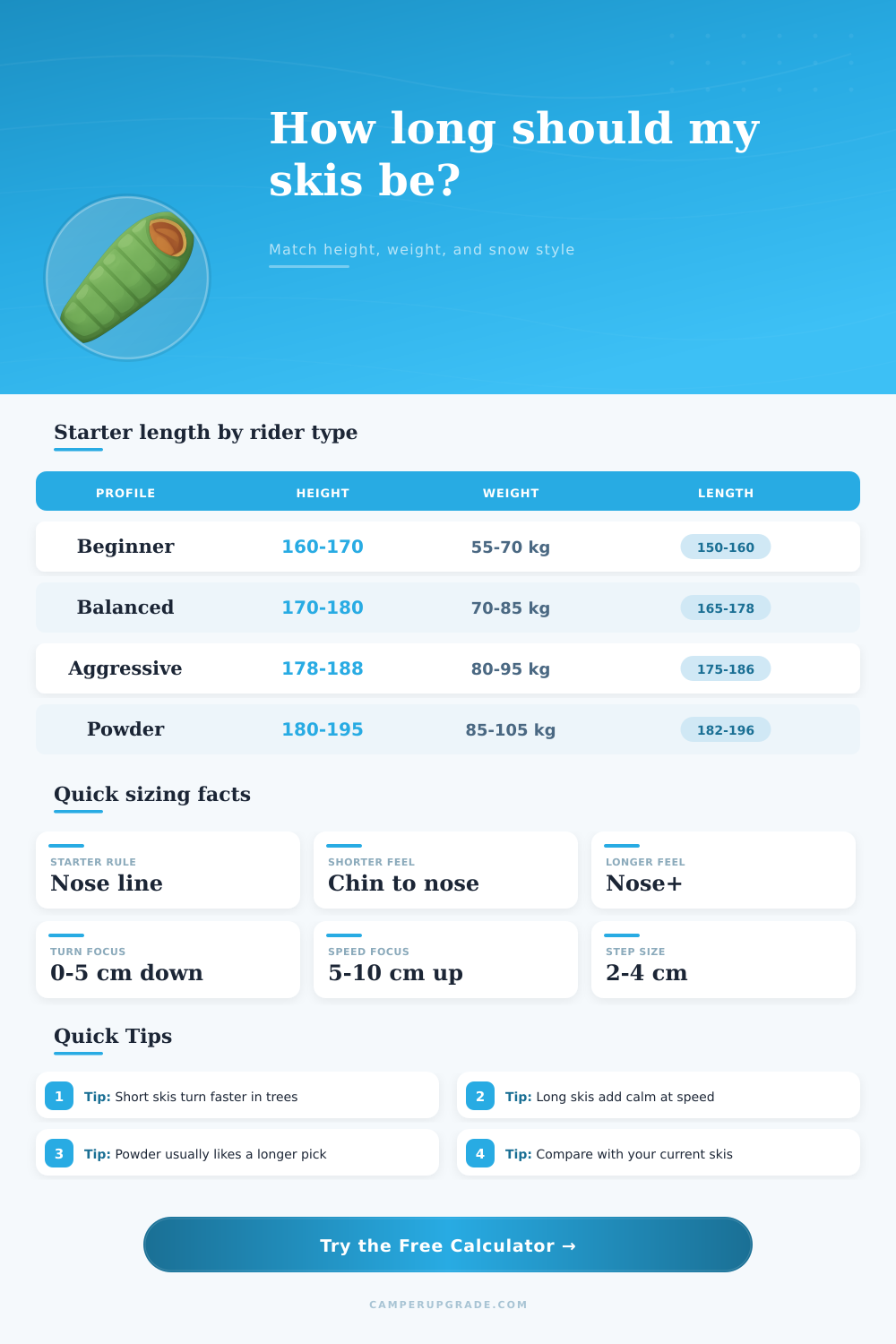
What this does: it blends height, weight, age, ability, terrain, snow, ski category, turn shape, aggression, stability, waist width, and your current ski length into one practical sizing target. It is a starting point, not a replacement for local demo skis or a shop fitting.
Used as the main anchor for the ski length starting point.
Weight helps shift the recommendation shorter or longer.
Younger and older skiers often do better with a calmer pick.
Wider skis often like a slightly longer match.
Use this to compare your present skis to the recommendation.
| Height band | Starter length | Feel | Best for |
|---|---|---|---|
| 150-160 cm | 140-152 cm | Very easy | Learning |
| 160-170 cm | 150-162 cm | Quick | Short turns |
| 170-180 cm | 160-174 cm | Balanced | Daily skiing |
| 180-190 cm | 170-184 cm | Stable | Speed and snow |
| 190+ cm | 180-196 cm | Long | Big mountain |
| Weight band | Adjustment | Result | Note |
|---|---|---|---|
| Under 60 kg | -5 cm | Shorter | Light leverage |
| 60-74 kg | 0 cm | Base pick | Neutral |
| 75-89 kg | +3 cm | Longer | More support |
| 90-104 kg | +6 cm | Longer | Stability gain |
| 105+ kg | +8 cm | Longest | Extra platform |
| Terrain | Snow | Turn shape | Sizing bias |
|---|---|---|---|
| Groomers | Firm | Short | Shorter |
| Mixed resort | Variable | Balanced | Near base |
| Freeride | Soft | Open | Longer |
| Park | Soft | Short | Shorter |
| Touring | Variable | Balanced | Middle |
| Ski category | Default bias | Turn feel | Common choice |
|---|---|---|---|
| Carving | -8 cm | Fast edge | Shorter |
| All-mountain | 0 cm | Versatile | Mid-length |
| Freeride | +6 cm | Stable | Longer |
| Powder | +10 cm | Surfier | Longest |
| Race | +12 cm | Very firm | Longer |
Ski length is one of the primary factor that will help to determine how your pair of skis will perform on the mountain. Ski length affect the way that your skis will turn and how stable they will feel while you are skiing. There are many different factor that you should consider when you are purchasing a new pair of ski boots.
These factors include your height, your weight, the type of terrain on which you will be skiing, and the type of snow that will be on the mountains that you visit. Your height and your weight is two of the baseline measurement for skiing. While many people find that a height based measurement of their body will result in a ski length that reaches from their chin to their forehead, there weight can change the length of skis that they need.
How to Choose the Right Ski Length
For instance, those with a lower body weight may find that they can better control their skis if those skis are shorter in length, while those with a higher body weight may feel more stable on skis of a longer length. Additionally, those with a low body weight may find that the recommended length for their ski skills results in the skis feeling to heavy for the individual, while those of a higher body weight may experience the skis feeling understable if they are too short in length. The terrain on which you ski and the type of snow that is on the mountain will dictate the length of the skis that you should have.
For instance, if you are skiing on groomed snow on the mountain, you will require shorter skis to allow for the ability to turn quick. However, if you are skiing on deep powder, you will require longer skis to allow the individuals to float on top of the snow. Additionally, the terrain will also dictate the length of the skis that are need.
For instance, skiing in tight trees will require shorter skis to allow for quicker pivoting movement, while skiing at high speeds on open slopes will require the use of longer skis to maintain stability. The type of skis that you intend to use and for what category of skiing that you will use them will impact the length of the skis that are produce. For instance, carver skis are often shorter in length to allow for quicker transitions between each edge of the ski.
Powder skis are often longer to allow the skis to plane better on top of deep snow. All-mountain skis are of a middle length and are produced for use in various type of snow. Additionally, the ability level that you have skiing will also impact your ski length.
For instance, beginners may choose shorter skis to gain more control over their skiing, while experts may choose a ski length that best correlate to their skiing styles. While there are mathematical formula that allow for individuals to calculate the length of their skis based off their body measurements, these formulas should not be the only consideration for the length of their skis. For instance, formulas may indicate that 88% of your height is the length that should be used for skiing, but this ignores your weight and the terrain on which you ski.
Tools may allow individuals to input their height and weight, and the tool will return a target length for their skis. However, it is always recommended to compare the new skis to the skis that you currently use; if the current pair of skis are 5 centimeters shorter than the target length for your body, you will notice a difference in your skiing stability if you use skis of a longer length. Finally, it is a good idea to demo or test the skis that you are considering purchasing.
Testing at least three different length of the same ski model will allow you to experience the differences between those models. While skiing on the demo skis, pay special attention to how easily the skis start a turn, how the skis vibrate at high speeds, and how well they exhibit the ability to float in the snow. Ultimately, you should of use your legs to feel which ski length feel the best for yourself and your skiing abilities.