Ski Edge Bevel Calculator
Compare base bevel, side bevel, included edge angle, lift gap, steel set-back, grip feel, and tuning guide match for alpine skis.
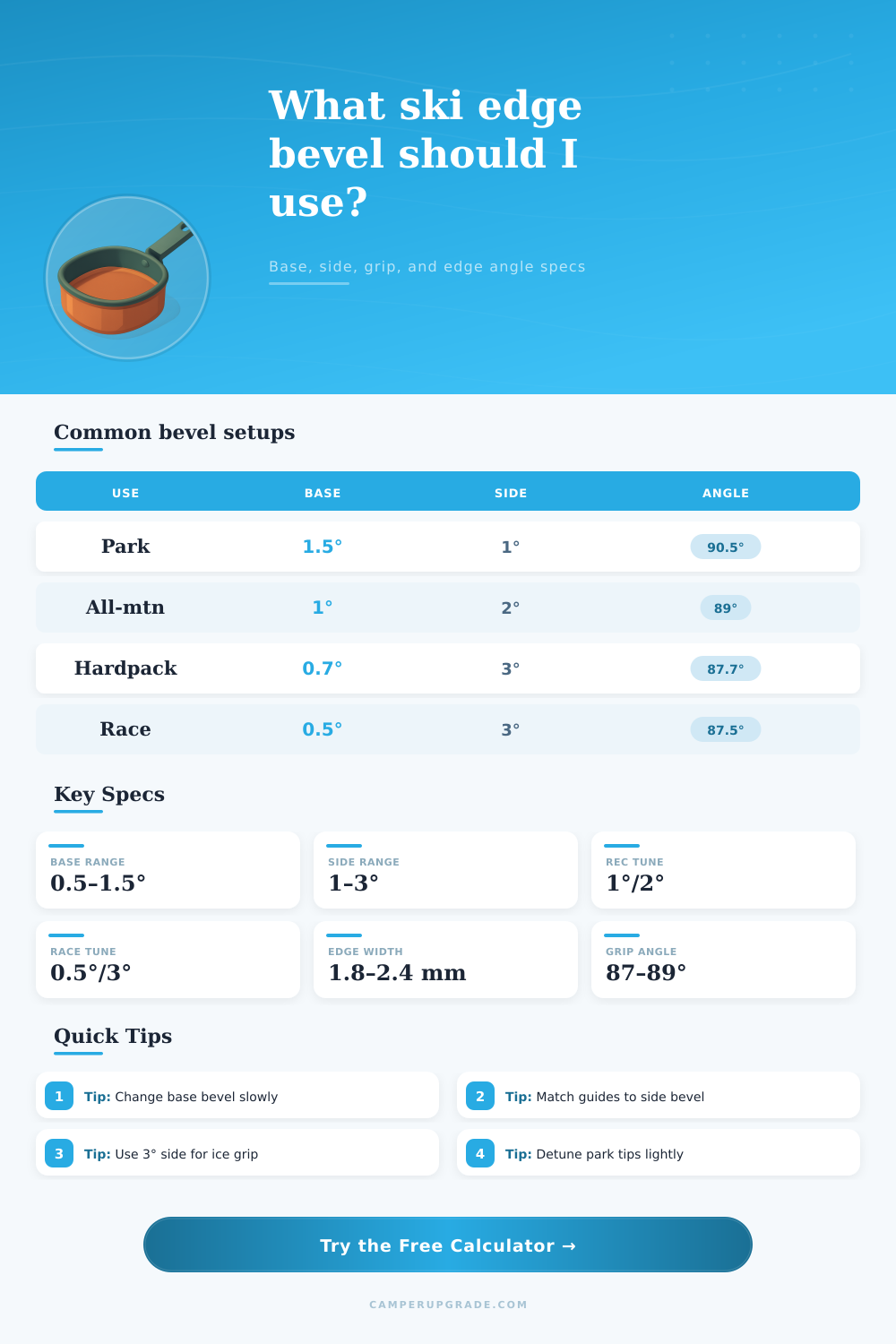
| Ski use | Base bevel | Side bevel | Included edge angle | Typical feel |
|---|---|---|---|---|
| Beginner rental / cruiser | 1.0° to 1.5° | 1.0° to 2.0° | 89.5° to 90.5° | Forgiving, less hooky |
| All-mountain recreational | 0.8° to 1.2° | 1.5° to 2.0° | 88.8° to 89.7° | Balanced grip and release |
| Frontside carving | 0.7° to 1.0° | 2.0° to 3.0° | 87.7° to 89.0° | Quicker edge hold |
| Slalom / race tune | 0.5° to 0.7° | 3.0° to 4.0° | 86.5° to 87.7° | Aggressive bite |
| Freeride / powder | 1.0° to 1.5° | 1.0° to 2.0° | 89.0° to 90.5° | Smooth release in soft snow |
| Park and jib | 1.0° to 2.0° | 0.5° to 1.5° | 90.5° to 91.5° | Less grabby on rails |
| Measurement | Formula | Example input | Example result |
|---|---|---|---|
| Included edge angle | 90° - side bevel + base bevel | 1° base / 2° side | 89.0° |
| Side guide angle | 90° - side bevel | 3° side bevel | 87.0° guide |
| Base lift gap | tan(base bevel) × base-edge width | 1° over 2.0 mm | 0.035 mm |
| Side set-back | tan(side bevel) × side-edge height | 2° over 1.8 mm | 0.063 mm |
| Active sharpened edge | ski length × effective edge percent | 170 cm × 88% | 149.6 cm |
| Base bevel | Lift over 1.8 mm edge | Lift over 2.0 mm edge | Lift over 2.4 mm edge | On-snow behavior |
|---|---|---|---|---|
| 0.5° | 0.016 mm | 0.017 mm | 0.021 mm | Immediate engagement |
| 0.7° | 0.022 mm | 0.024 mm | 0.029 mm | Quick but manageable |
| 1.0° | 0.031 mm | 0.035 mm | 0.042 mm | Standard recreational release |
| 1.5° | 0.047 mm | 0.052 mm | 0.063 mm | Smoother, less catchy |
| 2.0° | 0.063 mm | 0.070 mm | 0.084 mm | Very forgiving, slower bite |
| Side bevel | File guide marking | With 0.5° base | With 1.0° base | Best match |
|---|---|---|---|---|
| 1.0° | 89° | 89.5° edge | 90.0° edge | Soft snow, park, forgiving skis |
| 1.5° | 88.5° | 89.0° edge | 89.5° edge | Junior skis, light carving |
| 2.0° | 88° | 88.5° edge | 89.0° edge | Most all-mountain skis |
| 3.0° | 87° | 87.5° edge | 88.0° edge | Hardpack and race grip |
| 4.0° | 86° | 86.5° edge | 87.0° edge | Specialized slalom tuning |
Ski edge are composed of two different angles. Each of these angle has a specific name and function for the ski edge. The first of these angle is referred to as a base bevel.
The base bevel is the angle of the steel edge of the ski relative to the flatly bottom of the ski. The second of these angle is referred to as an side bevel. The side bevel is the angle of the steel edge of the ski relative to the sidewall of the ski.
Ski Edge Angles and Tuning
These two angles combines to create the included edge angle of the ski. The included edge angle is the total wedge of steel that the ski edge will have in contact with the snow. Furthermore, each of these angle is crucial to understanding how the ski edges will grip the snow; the base bevel and side bevel of the ski will dictate how the ski edges grip the snow.
The base bevel of the ski edge is one of the most important measurement for the ski. The base bevel dictate how the ski edge will engage with the snow. If the base of the ski is perfectly flat, then the ski edge will engage with the snow immediately with the tipping of the ski.
By introducing a base bevel to the ski, however, there is a small gap between the ski edge and the snow while the ski is flat. This gap allow the ski to either slide or pivot slight before the ski edge lock into the snow. However, if the base bevel is too high, the ski will have to tip at a much more greater angle to engage with the snow; this could potentially lead to the loss in the balance of the skier on the snow.
The side bevel of the ski will impact the amount of pressure that the ski edge can hold once the ski edge is in contact with the snow. A steeper side bevel will allow the ski edge to penetrate deep into the snow and even hard surface like ice. For these reason, the side bevel of the ski is one of the main determining factor of the power of the ski edge.
Furthermore, the skier must calculate both the side bevel and the base bevel together to determine the included edge angle; this included edge angle will determine the skiing experience of the skier on the snow. The effective edge of the ski is the length of the steel edge of the ski that is in contact with the snow while the skier is skiing. Not all of the steel edge of a ski is active; many ski have rockered (curved at the tip) or twin tip ski tip.
If a ski has a relatively long ski length but a short effective edge, the ski will have less leverage in relation to holding the skier on they skis. For these reason, it is essential for a skier to calculate the active sharpened edge of the ski; it will help the skier understand how much of the ski edge is performing the task of skiing on the snow. The edge of a ski must be tuned according to the specific kind of snow that the skier will encounter.
If the skier will be skiing on frozen groomers (or flat, even snow), then the skier should tune the ski edges to have a shallow base bevel and an aggressive side bevel. If, however, the skier will be skiing in a terrain park or on metal rail, the ski edges should be tuned to have a larger base bevel; this will allow for the ski edge to be more forgiving of small irregularities in the snow. The larger base bevel will allow the edge to not be as likely to catch on those obstacle.
However, it will reduce the total grip that the ski edge has for the snow. Depending upon how the skis are feeling while skiing, the base and side bevel can be adjust. If the skis feel too twitchy while skiing, increasing the base bevel may help to even out the feeling of the ski.
However, if the skis feel like they are washing out (particularly on steep slope), the side bevel can be increased. Only one of the two bevel angle should be adjusted at a time. If both the base and side bevels were to be adjusted at the same time, it would not be possible to determine which adjustment lead to any change in the performance of the skis.
Finally, it is important to remember that the snow condition will change throughout the skiing season; the skier will have to adjust the base and side bevels to account for these change in the snow.