🎿 Ski Binding Setting Calculator
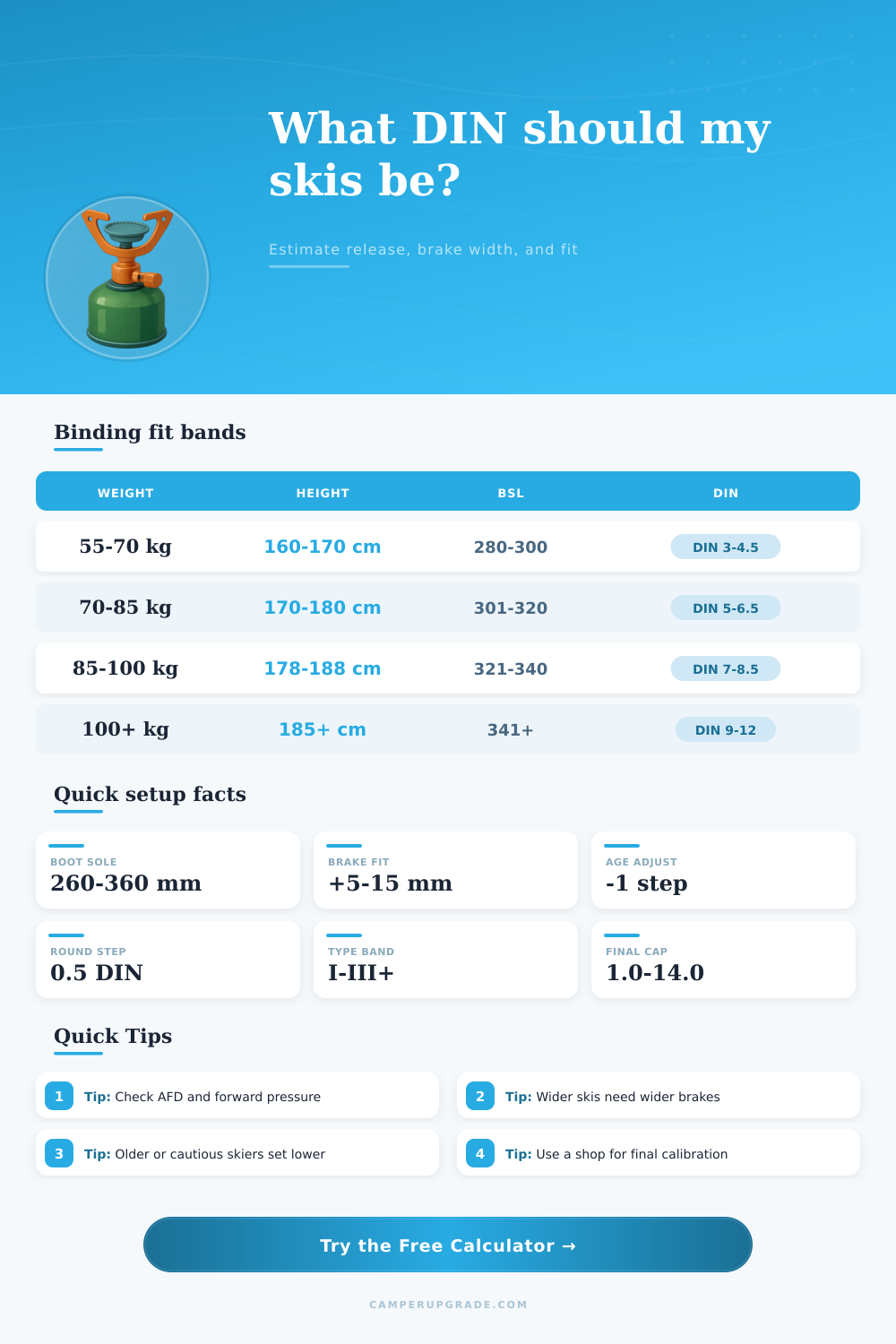
Estimate a practical DIN starting point, brake width fit, and setup notes from skier profile, boot sole length, ski geometry, and terrain style.
What this does: it blends the classic skier chart with boot sole length, age, terrain, speed, jump frequency, ski width, and binding style so you get a practical starting point. Final release settings should still be confirmed by a certified ski technician with a release machine.
This feeds the core chart lookup that anchors the starting DIN.
Height is used alongside weight to avoid over-relying on one number.
Read the printed BSL on the boot shell, not the boot size tag.
Age 9 and under, or 50 and up, typically push the setting lower.
Waist width influences brake width and how much lever arm the ski creates.
Longer skis can justify a slightly firmer setup when the skier is aggressive.
Boot sole norm does not directly change the DIN, but it changes compatibility checks and AFD expectations.
| Skier profile | Weight band | Height band | Starting note |
|---|---|---|---|
| Light beginner | 45-60 kg | 150-165 cm | Low DIN bias |
| Average resort skier | 60-80 kg | 165-178 cm | Middle range |
| Athletic all-mountain | 80-95 kg | 175-188 cm | Middle-high |
| Heavy expert | 95+ kg | 180+ cm | Higher start |
| Park or speed bias | Any fit | Any fit | Increase one step |
| Cautious or older | Any fit | Any fit | Decrease one step |
| Boot sole length | Chart impact | Fit issue | Check |
|---|---|---|---|
| 240-260 mm | Lower band | Short boot shell | AFD contact |
| 261-300 mm | Mid-low band | Common all-mtn | Heel tension |
| 301-330 mm | Middle band | Large resort boot | Toe height |
| 331-360 mm | Higher band | Long touring shell | Brake sweep |
| 360+ mm | Special case | Check model chart | Shop verify |
| Terrain style | Speed | Airtime | Typical move |
|---|---|---|---|
| Groomers | Steady | Low | Near chart start |
| Mixed resort | Fast | Low-med | Small raise |
| Powder | Variable | Medium | Raise one notch |
| Park | Fast | High | Higher hold |
| Touring | Steady | Low-med | Verify boot/bind |
| Race | High | Low | Chart high side |
| Ski waist | Brake width | Mount feel | Note |
|---|---|---|---|
| 70-84 mm | 75-95 mm | Snug | Frontside |
| 85-94 mm | 95-105 mm | Standard | All-mtn |
| 95-104 mm | 105-115 mm | Wide | Freeride |
| 105-114 mm | 115-125 mm | Very wide | Powder |
| 115+ mm | 125-135 mm | Extra wide | Check sweep |
Ski bindings are an mechanical devices that connect a person to a pair of skis. These bindings are necessary to allow a person to remain secure to there skis when skiing normal, but they must also release those boots when the skier suffers a fall. If ski bindings release a person’s boots too early, it can result in a loss of control of the skis.
In contrast, if ski bindings doesnt allow a person’s boots to release during a fall, it can result in injuries to the bone or joints of that person’s legs. To avoid both of these outcomes, the skier must calibrate the tension of the ski bindings correct to each individual. The primary calibration for ski bindings is the DIN setting.
Ski Bindings: What They Do and How to Set Them
The DIN setting is a numerical value that range from 1 to 16. A lower number indicates that the ski bindings will require less force to release a person’s boots, while a higher number within this range indicates that the ski bindings will require more force to release those boots. Several factor influence what the DIN setting should be for each individual.
Factors such as a person’s weight, their height, and the type of skiing that they perform will all play a role in the determination of each person’s DIN setting. For instance, individuals who are learning to ski may have a lower DIN setting than aggressive skiers because the learning skier may experience vibration from the skis that could otherwise result in the boots of the learning skier being released too soon. Beyond these factors, the length of the sole of the ski boot also play a role in the DIN setting for each individual.
The length of the sole of the ski boot is printed on the boot itself, and it influences the way in which the toe and heel of the ski bindings interact with the ski boot. Thus, the length of the ski boot also influences the DIN setting for each individual. Finally, the types of skiing terrain that each individual prefers will influence the DIN setting for each individual.
Those who ski in powder snow will have a different DIN setting then those who ski on groomed skiing terrain. In addition to these factors, the skiing bindings also must be compatible with the width of the skis that each individual uses. The width of the skis will influence the size of the brakes for those skis.
Ski brakes are the mechanism for the bindings that catch the ski when the boot is released. If the brakes are too narrow for the width of the skis that are used, the brakes may rub against the sides of the skis. This rubbing of the brakes against the sides of the skis will inhibit the ability of the skis to glide smooth on the snow.
Therefore, the brakes for a pair of skis should be more wider than the waist width of the skis that each individual uses. Another factor to consider with ski bindings is their need for mechanical maintenance. Ski bindings wear down with frequent crashing into other skiers or ski obstacles.
Because the spring mechanism within the bindings may lose their tension due to these crashes, the DIN setting of the bindings may change. Therefore, each individual should of had their bindings mechanic test with a release tester to ensure that the bindings are still set to the proper DIN setting. Finally, the forward pressure that is applied to the ski bindings should also be checked and adjusted to ensure that the ski bindings will function proper.
If the forward pressure of the boot against the heel piece of the ski bindings is not adjusted to the proper setting, the ski bindings will not function as intended. Additionally, the anti-friction device (AFD) should also be checked to ensure that it is properly making contact with the boot. The AFD is a plate located under the toe of the ski bindings.
It prevents ice and other debris from interfering with the proper functioning of the ski bindings. If the individual change the types of boots that they use while skiing, the forward pressure and DIN setting should be re-adjusted to ensure the proper function of the ski bindings.