⛷ Cross Country Skate Ski Length Calculator
Find a practical skate ski size from height, weight, skill, skate style, snow feel, and flex preference. The result focuses on both length and flex window.
How it works: skate skis are usually sized near skier height plus a small length allowance, then checked against body weight and flex. This calculator blends the length rule with technique, snow, speed, and flex target so the answer is useful on groomed Nordic trails.
The base size starts from body height in centimeters.
Weight drives the flex window more than pure length.
A small leverage check for very short or long boots.
Optional comparison against the recommendation.
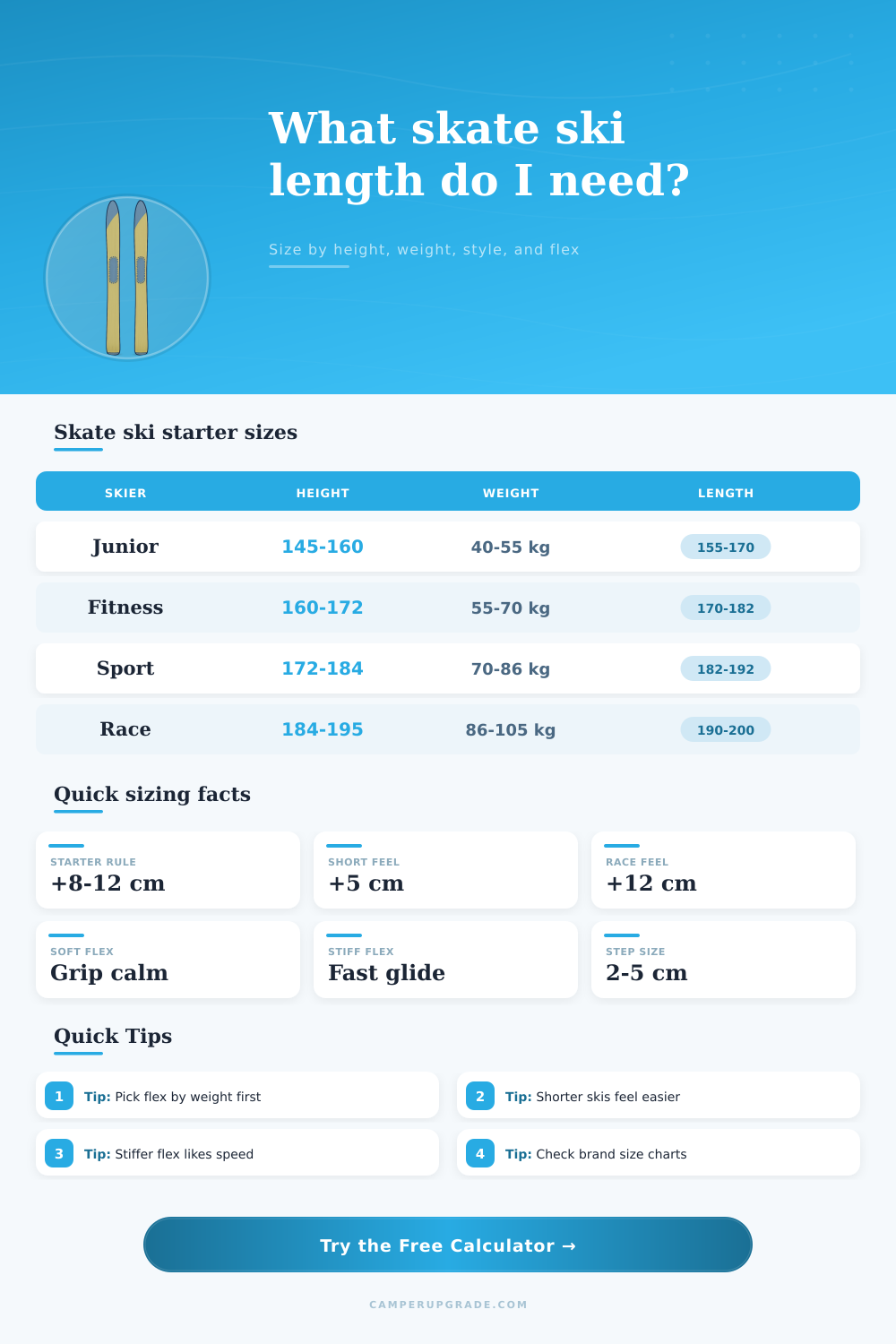
Height starter table
| Skier height | Control length | All-around length | Race length |
|---|---|---|---|
| 150-160 cm | 155-168 cm | 160-172 cm | 165-175 cm |
| 160-170 cm | 168-178 cm | 172-182 cm | 175-185 cm |
| 170-180 cm | 178-188 cm | 182-192 cm | 185-195 cm |
| 180-190 cm | 188-195 cm | 190-200 cm | 195-205 cm |
| 190+ cm | 195-202 cm | 198-207 cm | 202-210 cm |
Weight and flex table
| Skier weight | Flex target | Best feel | Watch for |
|---|---|---|---|
| 45-60 kg | Soft | Easy compression | Too-stiff glide loss |
| 60-75 kg | Medium | Balanced kick-free glide | Oversizing for speed |
| 75-90 kg | Medium-stiff | Stable platform | Soft ski bottoming out |
| 90-105 kg | Stiff | Better support | Short soft models |
| 105+ kg | Extra stiff | Race-like support | Limited model range |
Skate style adjustment table
| Skate style | Length bias | Flex bias | Why it matters |
|---|---|---|---|
| V1 climbing focus | -2 cm | Medium | Quicker weight shift |
| Mixed V1 / V2 | 0 cm | Medium | Best daily blend |
| V2 flats | +2 cm | Medium-stiff | Longer glide phase |
| V2 alternate | +1 cm | Medium | Endurance rhythm |
| Sprint tempo | -1 cm | Stiff | Fast acceleration |
Common model size classes
| Model class | Typical sizes | Skier profile | Flex priority |
|---|---|---|---|
| Junior skate | 150-170 cm | Small or junior skier | Soft enough to load |
| Fitness skate | 170-185 cm | New adult skater | Control and comfort |
| Sport skate | 180-195 cm | Training skier | Medium support |
| Race skate | 185-200 cm | Fast technical skier | Weight-matched stiffness |
| Long race | 195-207 cm | Tall or heavy skier | High camber support |
Choosing the correct length for cross country skate skis requires that you considers a variety of different variables, as the length of a cross country skate ski will affect the performance of the ski on different types of snow. If a cross country skate ski is too short for the snow that is falling, the ski will chatter when the skier is skating on hardpack snow. On the other hand, if the cross country skate ski is too long, the ski will feel sluggish when the cross country skate skier makes turns with the skis, and the long ski will require more strength from the skier to load the ski effectivly.
In order to find the best length for a cross country skate ski, the skier must find a balance between the length of the ski and the flex of the ski. Each skier is different, and variables like the height of the skier, the weight of the skier, the profile of the trail that is to be skied, and the movement style of the cross country skate skier will affect the length of the cross country skate ski that is best for that individual. Many use a general rule of thumb to find the length of cross country skate skis that will be best for themselves.
How to Choose the Right Skate Ski Length
The rule states that the length of the cross country skate ski should be the height of the skier in centimeters plus ten centimeters. This length will place the tip of the ski slightly in front of the skier when the skier holds the ski vertically. Based off the skill level of the cross country skate skier, however, you can make adjustments to that length.
Beginners may require shorter cross country skate skis to allow for better maneuverability on the ski. An advanced cross country skate skier, however, may benefit from a longer ski to allow for better glide over the snow. Additionally, the skiing style that the cross country skate skier uses can have an impact on the length of cross country skate ski that is best for that individual.
Skiers that use the V2 technique while skiing on flat terrain may require longer cross country skate skis then those skiers who use the V1 technique to ski up hills. The weight of the cross country skate skier will impact the flex of the cross country skate ski. For instance, a heavier cross country skate skier will compress the soft cross country skate ski more than a lighter cross country skate skier using an overly stiff cross country skate ski.
If a cross country skate ski’s camber collapses under a cross country skate skier, it will prevent that skier from receiving the kick that that make of cross country skate ski is designed to provide. This calculator will include the height of the skier, the weight of the skier, and the type of snow that will be encountered, as well as the speed that the skier wishes to reach. For soft snow, a softer flex in the cross country skate ski will be required to allow the ski to conform to the snow.
For snowy conditions that are cold and icy, however, a stiffer cross country skate ski will allow for the ski to maintain its camber when the skier skis on that snow. Additionally, the speed goals for the cross country skate skier will impact the length of cross country skate ski that is recommended. For fitness laps at an easy pace, the cross country skate skier will require a more forgiving cross country skate ski.
For training or racing at fast speeds, however, a cross country skate ski with more “snap” will be required. The profile of the trail that will be skied will also impact the length of cross country skate ski that is best for an individual cross country skate skier. For instance, trails that include steep climbs and tight turns may be difficult to ski using a long cross country skate ski.
The long ski’s tip may catch on the trail, and its tail may drag behind the skier. In contrast, wide trails that feature long, straight sections will be better skied with a long cross country skate ski. Therefore, the type of trail that will be skied will impact the type of cross country skate ski that is required of each cross country skate skier.
For instance, cross country skate skiers may require different cross country skate skis based on whether the trail that is to be skied is hilly or flat. Additionally, another factor that must be considered is the length of the sole of the cross country skate ski boot. Cross country skate skis with very short boot soles may be better for an individual with very short cross country skate boots, and vice versa.
The reference tables included on this page will show the relationship between an individual’s height and weight to the length of cross country skate ski that they should use. These tables will also show how different types of skiing styles impact the length of cross country skate ski that the cross country skate skier requires. For instance, cross country skate skiers that use the V1 style to ski up hills may require shorter cross country skate skis than those that use the V2 style to ski on flat terrain.
These tables are not meant to be treated as a single number, but rather as a window of lengths in which the cross country skate skier should seek to place their cross country skate ski, as well as a flex of cross country skate ski that they will use. One of the most common mistakes of cross country skate skiers is to treat the reference tables as a rule or regulation that must be followed, rather than as a starting point from which adjustments can be made. Manufacturers make cross country skate skis in increments of two or three centimeters, so the length that the calculator recommends may need to be rounded to that available ski length.
For example, if the calculator recommends a ski length of 165 cm, but no cross country skate skis of that length are available, the length that is purchased may need to be either 163 or 167 cm. Additionally, the length of cross country skate ski that is purchased can change based upon the trail conditions. For example, cross country skate ski recommendations for technical terrain or soft snow may require that the ski be of a shorter length than do recommendations for flat, fast trails on firm snow.
Therefore, a cross country skate skier should consider the factors described above to make an informed decision about the length that will be best for themselves. It is also possible for a cross country skate skier to choose the length of their cross country skate ski, but to ignore the flex of the cross country skate ski. A cross country skate ski with the proper length but the incorrect flex will feel slow and unstable for the cross country skate skier.
The flex of a cross country skate ski may be soft, medium, medium-stiff, stiff, or extra-stiff. Each flex will affect the way in which the ski loads when the cross country skate skier is moving. The ski will collapse under the cross country skate skier if the flex is too soft, or it will not be able to engage when the flex is too stiff.
Finally, another factor to consider is the changing conditions of the snow that the cross country skate skier will encounter. During the winter months, the weather may be warm and wet, creating slush for the cross country skate skier. In contrast, in the winter, the snow may become icy.
The recommendations provided by the calculator are based upon these conditions. Therefore, the cross country skate skier may need to adjust the cross country skate ski that is purchased as the snow and trails change throughout the cross country skate skiing season.