Simmer Time Fuel Usage Calculator
Estimate camp stove fuel for low, steady cooking with real fuel energy values, burner ratings, wind loss, reserve margin, and container yield.
⛺Named simmer presets
📝Fuel and simmer inputs
Formula breakdown
⚙Fuel material and spec comparison
📊Reference tables
| Fuel type | Calculator unit | Energy value used | Best use |
|---|---|---|---|
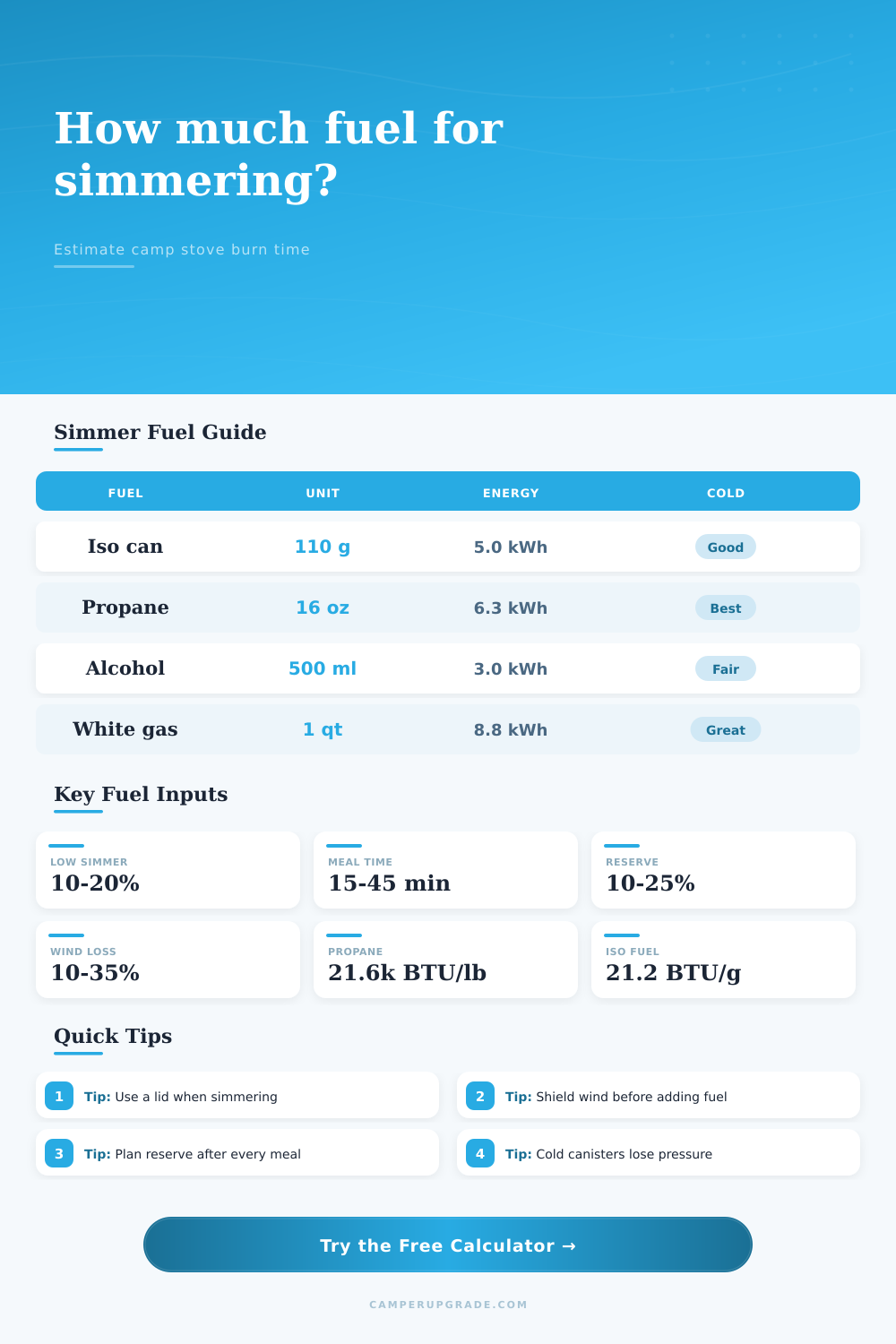
| Isobutane canister mix | grams | 21.2 BTU/g | Backpacking and compact camp kitchens |
| Propane cylinder | ounces | 1,349 BTU/oz | Car camping, RV pads, colder mornings |
| Butane cartridge | grams | 21.3 BTU/g | Tabletop simmering in mild weather |
| White gas / camp fuel | fluid ounces | 930 BTU/fl oz | Long trips, refillable bottles, winter stoves |
| Denatured alcohol | milliliters | 18.8 BTU/ml | Quiet small-pot simmering with lower heat |
| Kerosene | fluid ounces | 996 BTU/fl oz | Expedition pressure stoves |
| Simmer setting | Typical flame | Fuel use effect | Cooking examples |
|---|---|---|---|
| 10-15% of full | Barely rolling | Very low draw | Rice rest, oatmeal, sauce holding |
| 16-25% of full | Steady low flame | Common camp simmer | Noodles, lentils, small stews |
| 26-40% of full | Visible blue ring | Moderate draw | Chili, pasta sauce, two-person meals |
| 41-60% of full | Strong simmer | High draw | Large pots, cold starts, wide pans |
| 61-100% of full | Boil or sear | Not true simmer | Fast boiling, browning, griddle recovery |
| Container or bottle | Fuel amount | Approx BTU stored | Simmer time at 2,000 BTU/hr |
|---|---|---|---|
| Small isobutane canister | 110 g | 2,330 BTU | 70 min before reserve |
| Standard isobutane canister | 230 g | 4,876 BTU | 146 min before reserve |
| Large isobutane canister | 450 g | 9,540 BTU | 286 min before reserve |
| Disposable propane cylinder | 16.4 oz | 22,120 BTU | 664 min before reserve |
| Butane cartridge | 227 g | 4,835 BTU | 145 min before reserve |
| White gas bottle | 20 fl oz | 18,600 BTU | 558 min before reserve |
| Named stove setup | Full rating used | Good simmer range | Planning note |
|---|---|---|---|
| MSR PocketRocket 2 canister stove | 8,200 BTU/hr | 15-30% | Efficient for solo pots with a lid |
| Jetboil MiniMo regulator canister stove | 6,000 BTU/hr | 10-22% | Integrated pot reduces fuel draw |
| Coleman Classic propane camp stove | 10,000 BTU/hr per burner | 20-35% | Plan per burner when both sides run |
| Camp Chef Everest style high-output burner | 20,000 BTU/hr per burner | 12-25% | Low knob settings still burn meaningful fuel |
| Trangia spirit burner | 3,000 BTU/hr estimated | 45-75% | Simmer ring reduces heat but not instantly |
| MSR WhisperLite liquid fuel stove | 9,000 BTU/hr estimated | 20-40% | Strong in cold weather with refillable bottles |
💡Fuel planning notes
That’s why we like the math: the pre-trip giddiness doesn’t prepare you for the unique form of panic that arises when the pasta water begins boiling but the canister are empty. We all pack extra socks for damp mornings, yet we routinely guess at how much fuel it takes to simmer a pot of chili for twenty minutes.
Knowing the math behind the fire; instead of guessing based off how heavy the canister feels in your hand, is what separates a warm meal from cold beans. “Turning the knob down will burn almost no gas,” most folks think. They’re usually mistaken: Even a high-output stove on twenty-percent power can use quite a bit of fuel. Even at low power, they loses the same amount of base heat into the air.
Why You Should Use Math for Camping Fuel
Plugging in the simmer percentage and your burner rating into the calculator above (no need for guessing at conversions and coefficients) allow it to do all that work for you. It makes you focus on the BTU draw instead of visually noting the size of blue ring around the pot.
Energy Density: It’s also important to understand that some types of fuel has much greater energy density (i.e. Burn longer) than others. What burns well in your stove isn’t necessarily what will fit into your pack. If you’re going back packing, isobutane mixes makes great sense. However, once it gets below freezing, the pressure in those same isobutane mixes plummets. So you’ll have low pressure at the worst time.
You’d of been better off with propane cylinders that stand up better to the cold. But propane tanks are heavy. They are super duper heavy. For really long trips, white gas is your best bet if you want solid performance in all conditions over a lower overall pack weight. The chart on the page explains this in detail, so you can match fuel to your environment rather than pick the cheapest thing at the hardware store.
Cooking in a camp can be very inefficient when it’s windy. What seems like a nice breeze against your skin doubles amount of heat that escapes your open pot, which means burning more fuel to keep things at a simmer. It’s not even an option, you have to use a windscreen and a lid, or else you’re cooking inefficiently and wasting fuel.
This calculator takes all those variables into account and allows you to compensate based on how efficiently your cookware retain heat and whether there is a breeze or not. It’ll warn you that a wide skillet might not trap any heat and could leave half the flame exposed to the air. In that case, you’ll require nearly twice the fuel of somebody with an integrated pot system that traps waste heat.
Reserve fuel is the safety net between a fully-cooked meal and a raw stew. It’s like bringing an extra length of rope in your pack, hoping to not need it, but knowing that if anything happens, this will be the difference between coming home with a meal on the table and having to start over from scratch. The 15 percent buffer allows for slower morning starts due to cold temperatures (or just forgetting what time the sun actualy rose), unforeseen snags along the way, or simply the fact that simmer time is an estimate. Better to have some excess weight in fuel for camp than discover you were off by half a bag before dinner’s even started.
For the most part, the tool’s presets serves as a good starting point for typical configurations ranging from boiling water for a single meal to table top set ups where you’re making chili for the whole family. They are more of a guide than a strict rule. They help you understand what it might be like in the field with your chosen setup. Then adjust them according to taste or which stove you have.
At the end of the day, there’s nothing more important to camp cuisine than planning (and a little bit of math). Knowing exactly how much you have removes anxiety during the trip, so you can focus on the scenery instead of staring at the dying flame. It transforms a shot in the dark into a strategy. And what is better then having confidence? Being able to sit back quietly with the knowledge that all that is boiling up is the pot.