Shore Power Amp Budget Calculator
Estimate running amps, average draw, startup surge, breaker margin, and 30A or 50A split-leg balance for common RV shore power loads.
Use watts when known. Leave amps at zero.
Used only when watts is zero.
100 for continuous loads, lower for cycling loads.
Enter combined watts for lights, charger, fridge, TV, and small devices.
Shore power result
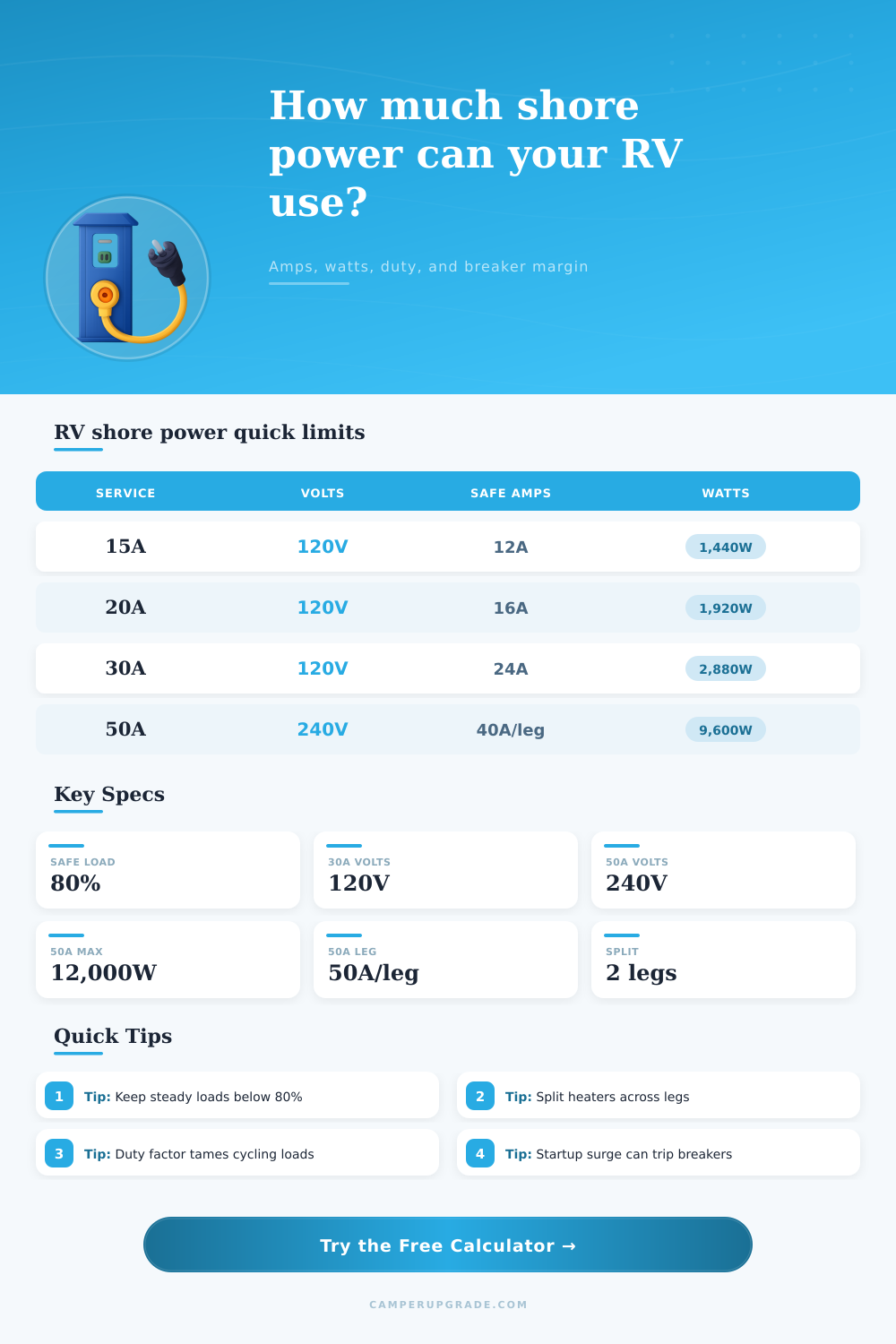
| Shore service | Nominal volts | Breaker amps | 80 percent steady load |
|---|---|---|---|
| 15A household receptacle | 120V | 15A single leg | 12A / 1,440W |
| 20A household receptacle | 120V | 20A single leg | 16A / 1,920W |
| 30A TT-30 RV pedestal | 120V | 30A single leg | 24A / 2,880W |
| 50A 14-50 RV pedestal | 120/240V | 50A on L1 and L2 | 40A per leg / 9,600W total |
| Appliance | Typical running watts | Running amps at 120V | Startup note |
|---|---|---|---|
| 13,500 BTU roof A/C | 1,600W | 13.3A | 2.6x compressor surge |
| 15,000 BTU roof A/C | 1,800W | 15.0A | 2.8x compressor surge |
| RV microwave | 1,500W | 12.5A | Short high draw |
| Converter charger | 900W | 7.5A | Falls as batteries fill |
| Electric water heater | 1,440W | 12.0A | Thermostat cycling |
| Portable space heater | 1,500W | 12.5A | Often continuous |
| Absorption fridge on electric | 325W | 2.7A | Low startup draw |
| Induction cooktop | 1,800W | 15.0A | Power setting varies |
| Formula | Use | Single-leg service | 50A split-leg service |
|---|---|---|---|
| Amps = watts / volts | Convert appliance watts to amps | All load counts on one breaker | Load counts on assigned leg |
| Watts = volts × amps | Convert amp rating to watts | 30A gives 3,600W at 120V | 50A gives 12,000W across both legs |
| Average amps = running amps × duty factor | Estimate cycling load share | Compare to steady-load limit | Compare each leg separately |
| Peak amps = running amps × startup multiplier | Estimate startup surge | Can exceed steady draw briefly | Surge follows assigned leg |
| Load mix | Running watts | Approx amps | 30A status |
|---|---|---|---|
| A/C plus converter | 2,500W | 20.8A | Inside 80 percent limit |
| A/C plus microwave | 3,100W | 25.8A | Above 80 percent limit |
| Heater plus water heater | 2,940W | 24.5A | Near the 30A breaker |
| Fridge, converter, TV, lights | 1,425W | 11.9A | Comfortable margin |
RV shore power budgeting is the understanding of how much electricity your RV can draws from an electrical outlet. Shore power budgeting are necessary to ensure that you do not trip a circuit breaker. For example, if your RV is equipped with both an air conditioner and a water heater, these two appliances may draw electricity at the same time.
In order to prevent the circuit from tripping, you must understand the electricity draws of each appliance. The calculator makes this math easier for you by asking for your appliance and calculating the draw of each. The numbers on the appliances may be compelling to look at, but they are not the number that should be used for shore power budgeting.
How to Budget RV Shore Power
The most important number is the steady load or the amount of electricity that the appliance will draw while in operation. The circuit breaker can handle surges of electricity, but the numbers on the appliances indicate the momentary surge. The calculator also asks for the duty cycle for appliances because appliances such as air conditioners and water heaters will not being continuously on.
This number is also used in the calculation to ensure that the circuit breaker does not exceed the draw of electricity. The 80 percent rule is used to ensure that the RV owner does not overload the electrical wires. The 80 percent rule is used because the circuit breakers are only rated to 80 percent of the total electrical load for continuous use.
Using the 80 percent rule will ensure that the RV owner does not overheat the wires while camping for many hour. For instance, if the RV owner has a 30 amp pedestal, they should only use the 24 amp of that resource. If they use the entire 30 amps the circuit breakers may sag in voltage or continuous have to be reset.
The percentage can be altered in the calculator, but the default will keep the RV within there safety margins for electricity use. Finally, 50 amp service is more complex than 30 amp service. This is because 50 amp service split the electrical load between two different legs of the electrical service.
One leg may be overloaded by a 120 volt appliance, even if the total load of the 50 amp service is within the electrical limits. The calculator will show which leg of the electrical service each appliance is on, so the RV owner can determine if they can move the appliance from one leg to an other to even out the load on each leg. Balancing the load is important because an induction cooktop or an electric water heater can create an imbalance on a fifty amp service.
An RV usually has a base load of items that are always on. Base load items usually includes the converter charging the batteries, the fridge, the lights, or the television. The base load field is used to ensure that the calculation reflect the true electricity being used on the pedestal.
If the base load is not accounted for, one may think that there is enough power for another appliance when the base load has already consumed the majority of the available electricity. Another factor to consider is the startup surge for appliances that contain compressors and motors. These appliances may require the electrician to provide two to three times the amp rating of the motor for a few seconds during the startup cycle.
This startup surge can cause a circuit breaker nuisance trip if the load is too much for the circuit breaker to handles. The user enters the multiplier for startup amperage into the calculator to determine whether the breaker will hold. Some appliances that contain motors will not utilize all of the electricity that pass through the wire.
The power factor allows for the calculation of only the electricity that is use by the appliance. Many appliances will use a power factor of 1.0 but if the appliance is a motor, the factor can be adjusted in the calculation. The result of the calculation is a margin number that takes into account the duty cycle, the base load, and the leg balance.
This number can be used to determine if it is safe to run the microwave while the air conditioner is running or if the addition of a portable space heater will overload the pedestal. This number can be used to test different combinations of appliances to be added to the RV. You can perform this calculation with either a 15 amp household outlet or a 50 amp pedestal to determine the amount of available electricity that can be used without creating electrical problems in the RV.