Shelter Snow Weight Calculator
Estimate roof snow weight, pounds per square foot, support margin, and clear-now status from shelter roof area, snow depth, density, meltwater, pitch, drifting, frame rating, span, and clearing threshold.
Shelter snow weight estimate
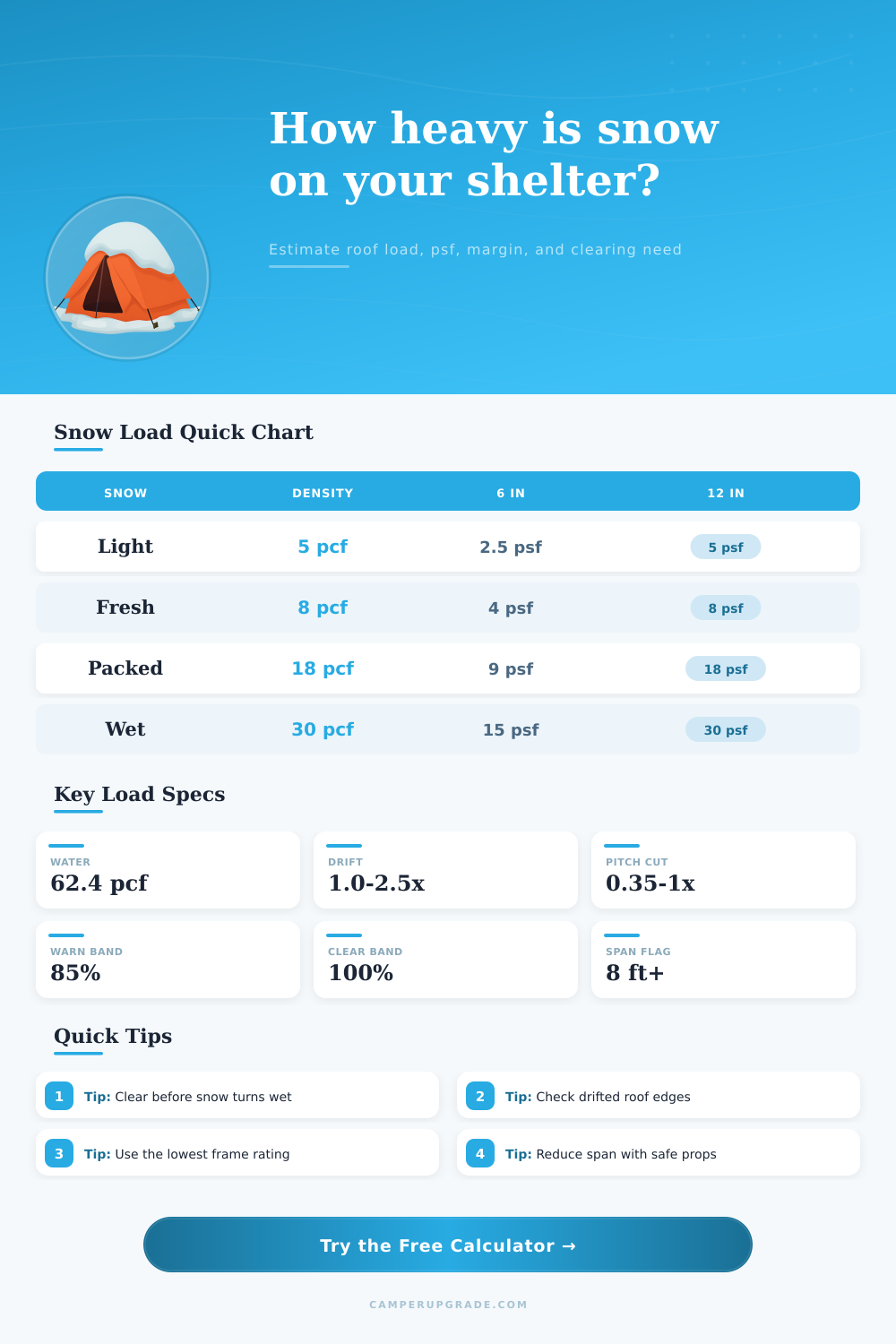
| Snow condition | Planning density | 6 inch roof load | 12 inch roof load |
|---|---|---|---|
| Cold powder snow | 4-6 pcf | 2-3 psf before drift | 4-6 psf before drift |
| Fresh light snow | 6-10 pcf | 3-5 psf before drift | 6-10 psf before drift |
| Settled snow | 10-15 pcf | 5-7.5 psf before drift | 10-15 psf before drift |
| Wind-packed snow | 16-22 pcf | 8-11 psf before drift | 16-22 psf before drift |
| Dense old snow | 22-28 pcf | 11-14 psf before drift | 22-28 psf before drift |
| Wet snow or rain-on-snow | 28-35 pcf | 14-17.5 psf before drift | 28-35 psf before drift |
| Slush or saturated snow | 35-45 pcf | 17.5-22.5 psf before drift | 35-45 psf before drift |
| Roof pitch | Planning retention | Common shelter shape | Use note |
|---|---|---|---|
| 0-10 degrees | 100% retained | Flat canopy, awning, tarp sag | Snow tends to sit until cleared or collapsed by sag |
| 15 degrees | 90-95% retained | Low-frame tent or carport | Use drift multiplier for edge build-up |
| 25 degrees | 75-85% retained | Moderate A-frame or wall tent | Some sliding, but seams still catch snow |
| 35 degrees | 55-70% retained | Steeper tarp or cabin roof | Wet snow can still cling to fabric |
| 45 degrees | 40-55% retained | Steep ridge shelter | Side piles and guyline load still matter |
| 55+ degrees | 35-45% retained | Very steep storm pitch | Usually sheds, but do not ignore anchor loading |
| Shelter setup | Typical rating band | Span concern | Clearing approach |
|---|---|---|---|
| Light tarp or backpacking tent | 3-10 psf | Long fabric sag is the weak point | Clear early and prevent roof pockets |
| Pop-up canopy | 5-15 psf | Scissor frame joints and center sag | Do not leave unattended in snow |
| RV awning | 5-12 psf | Roller tube and arms can twist | Retract before snow whenever possible |
| Canvas wall tent frame | 15-30 psf | Ridge, rafters, and sidewall spread | Clear from outside before fabric bows |
| Portable carport | 20-40 psf | Hoops and purlins over wide bays | Watch drifts along sides and ends |
| Engineered snow shelter | 40+ psf | Connections and anchor points | Follow manufacturer clearing limits |
| Snow pattern | Multiplier | Where it happens | Calculator use |
|---|---|---|---|
| Even roof coverage | 1.00x | Sheltered site, light wind | Use when depth is uniform across the roof |
| Minor drift strips | 1.15-1.30x | Leeward ridge, roof edge, guyline side | Use if one side is visibly thicker |
| Moderate wind loading | 1.35-1.75x | Open campsite or exposed lot | Use for wind-packed shelves or uneven bays |
| Heavy drift pocket | 1.80-2.50x | Valley, wall, tree line, roof-to-roof step | Use for the loaded zone, not the clean zone |
| Cornice or slide pile | 2.50x+ | One roof dumping onto another shelter | Clear immediately and reassess from distance |
Snow weights can turn a shelter into an liability due to the way that snow accumulates on the shelters. The weight of the snow can cause the shelter’s fabric to sag or the shelter’s poles to bend. It is important for those who uses these shelters to understand that the little amount of snow that may be on the shelter can become a heavy amount of snow if the temperature changes or if rain falls to the snow.
Because of this potential change in snow loads, it is important for shelter users to understand the weight of the snow accumulating on those shelters. The weight of the snow that accumulates on a shelter depends upon the depth of that snow and the density of the snow that fall. Fresh powder snow is less dense than wet snow, so shelters that can hold eight inches of dry snow may not be able to hold eight inches of wet snow.
How Snow Weight Affects Shelters
A calculator that estimates the snow load that may fall on a shelter will help to perform the math necessary to calculate the snow load of a shelter if you provide the size of the shelter and the depth of the snow. The pitch of the shelter’s roof will impact the amount of snow that stays on the shelter. A steep pitch will allow snow to slide off of the shelter roof, but does not ensure that the snow will not remain on the shelter.
A modest pitch will allow for the reduction of the snow load on the shelter roof, but a steep pitch will allow for a greater reduction in the snow load on the shelter compared to a modest pitch. Additionally, wind will impact the load that the snow creates on the shelter. The wind may blow snow that may create drifts of snow that may double or triple the load of snow on one section of a shelter roof while other section of that shelter roof may experience little snow load.
The frame rating of a shelter is a number that indicates the shelter’s weight capacity. All shelters have some frame rating because there is a limit to the amount of weight that both the fabric and poles of the shelter can support. The lowest frame rating for any shelter should be used for the safety of the shelter and its occupants.
A low frame rating is created for shelters with long spans between the shelters poles. Long spans of a shelter will place more load upon the shelter middle portion of its roof. The calculator will show the adjusted load of snow that falls on the shelter, in pounds per square foot.
The adjusted load takes into account the meltwater that falls on the shelter from temperature changes in the air, the drifts of snow that fall from strong winds, and the pitch of the shelter’s roof. The adjusted load is more accurate than the mathematical calculation of the snow load because the adjusted load incorporates many of these variables. Additionally, the calculator will show the amount of the shelter’s frame rating that remain after the snow load.
This remaining frame rating will allow the shelters inhabitants to understand if the shelter is safe from the snow load or if some action must be taken to ensure their safety. Because of the danger of snow loads upon shelters, many individuals may wait too long to remove the snow from the shelter. The snow load should be checked early upon the formation of snow upon the shelter, instead of waiting until the fabric of the shelter begins to stretch or the poles begins to bend.
Additionally, the snow load should be checked after any change in the temperature of the air. The snow load should be cleared from the outside of the shelter rather than the inside, and in sections of the shelter to ensure that it remains balanced upon the shelter. Additional factors that may impact snow load upon a shelter includes the age of the shelter fabric, and the strain that the shelter’s fabric have endured over time.
A dry lab environment establishes shelter frame ratings, but the real world is not the same as the dry lab. A safety buffer should be provided for these shelters during the planning phase. While the safety buffer will not increase the strength of the shelter’s frame, it will provide the shelter’s inhabitants with more additional time before the snow load reaches the shelter’s frame rating.
The length of each span of the shelter will impact the way that the snow load is distributed. Loads will be even across the spans if the length of each span is short, but if the span is long, the load will be more concentrated upon the middle of each span. Temporary props can be added under long spans to increase the capacity of the shelter to deal with the increased snow load.
There is a reference table within the calculator that indicates the snow load that may result from various conditions of snow. These tables will allow individuals to understand the snow load that their specific snow depth and snow type may create. These tables are important because snow depth upon a shelter is not uniform.
Temperature changes will change the weight of the snow upon a shelter. A warm afternoon may transform the powder snow upon a shelter to wet snow, which is much heavier than powder snow. The weight of the water within the snow is not visible, so it is important to check the load of the snow after any period of warming temperatures.
Checking the load of the snow after any warming period will prevent any surprises from the weight of the snow that falls upon the shelter. It is important for individuals to understand when the load of the snow is too heavy for the shelter. The goal is for individuals to take action prior to the snow load causing the fabric of the shelter to tear or the shelter’s poles to bend.
By understanding the calculations of the snow load, and by referring to the reference tables that show example snow loads, individuals can make a determination of whether or not the snow needs to be cleared from the shelter or whether support needs to be added to the shelter.