Shade Sail Size Calculator
Convert post spacing into recommended shade sail cut sizes, slope drop, and hardware class for rectangle and triangle sail layouts.
📐Layout Presets
⚙Geometry Inputs
📦Fabric And Hardware Grid
📘Reference Tables
| Corner Plan | Setback | Gap | Total Deduction | Use Case |
|---|---|---|---|---|
| Compact kit | 3 in | 4 in | 7 in | Short patio spans |
| Standard kit | 4 in | 6 in | 10 in | Typical home installs |
| High-load kit | 5 in | 8 in | 13 in | Windy and long spans |
| Marine kit | 6 in | 10 in | 16 in | Coastal exposure |
| Steel-frame kit | 4 in | 5 in | 9 in | Fixed plate anchors |
| Pergola retrofit | 3 in | 6 in | 9 in | Wood beam retrofits |
| Span | Drop At 10% | Drop At 15% | Drop At 20% | Drainage Note |
|---|---|---|---|---|
| 8 ft | 0.8 ft | 1.2 ft | 1.6 ft | Minimum slope range |
| 10 ft | 1.0 ft | 1.5 ft | 2.0 ft | Reliable runoff target |
| 12 ft | 1.2 ft | 1.8 ft | 2.4 ft | Common residential setup |
| 14 ft | 1.4 ft | 2.1 ft | 2.8 ft | Raise high anchors first |
| 16 ft | 1.6 ft | 2.4 ft | 3.2 ft | Watch walk path clearance |
| 20 ft | 2.0 ft | 3.0 ft | 4.0 ft | Heavy hardware needed |
| Rectangle Span | Deduction | Cut Width | Cut Length | Approx Area |
|---|---|---|---|---|
| 10 x 10 ft | 10 in | 8.3 ft | 8.3 ft | 69 sq ft |
| 10 x 14 ft | 10 in | 8.3 ft | 12.3 ft | 102 sq ft |
| 12 x 16 ft | 10 in | 10.3 ft | 14.3 ft | 147 sq ft |
| 12 x 20 ft | 10 in | 10.3 ft | 18.3 ft | 189 sq ft |
| 14 x 20 ft | 10 in | 12.3 ft | 18.3 ft | 225 sq ft |
| 16 x 24 ft | 13 in | 13.8 ft | 21.8 ft | 301 sq ft |
When installing a shade sail, individuals must calculates the dimension of the shade sail that will be installed between the post. Installing a shade sail that is too large will cause the shade sail to sag between the posts. Alternatively, if the shade sail is too small, then it will not cover the desired area.
The dimensions has to be calculated carefuly because the hardware for installing the shade sail will take up some of the area within the shade sail. Additionally, you must slope the shade sail to allow for rainwater to drain off of the shade sail rather than pooling on the shade sails fabric. To determine the size of the shade sail that will be installed, you must measure the distance between the posts.
How to Measure and Install a Shade Sail
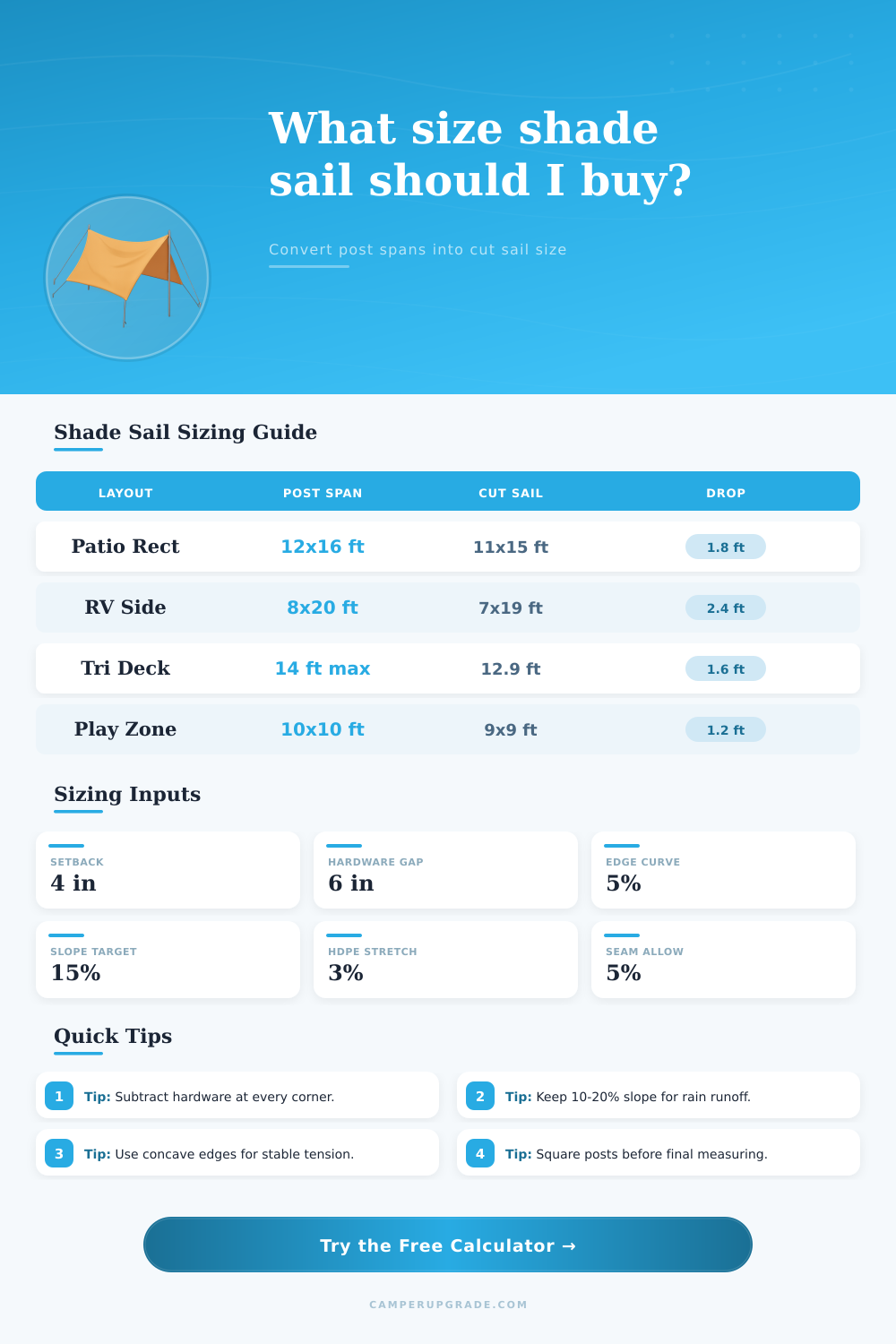
However, the distance between the posts isnt the size of the shade sail that will be purchased. The hardware for the shade sail will take up some of the area within the shade sail. For example, there could be four inch required to allow for the setback from the posts and another six inches for the turnbuckles and eye hardware.
This means that ten inches will have to be deducted from each side of the shade sail. If the patio span is twelve feet by sixteen feet, for example, then the shade sail should be approximately eleven feet by fifteen feet. If this dimension is not accounted for when purchasing the shade sail, the shade sail will not reach the hardware and will not be able to remain tight to the posts.
Another consideration when installing the shade sail is that the shade sail must include a slope to allow for water to drain off of the shade sail. Shade sails that are flat will cause the water to pool in the center of the shade sail. This can lead to the shade sail sag or even tearing.
The slope can be between ten and twenty percent from the high anchor post to the low anchor post. For example, if the shade sail is twelve feet in length, then a fifteen percent slope would require the shade sail to drop eighteen inches from the high anchor post to the low anchor post. Individuals must install the high anchor posts prior to the low anchor posts to ensure that the shade sail does not sag to the point where individuals cant walking under it.
The shape of the shade sail will impact how the shade sail is measured. For instance, if the shade sail is in the shape of a triangle, this could be beneficial for covering odd space. The sides of the shade sail will have to follow the rules of geometry, where no side of the shade sail can be longer than the sum of the other two sides.
The same rule will apply to the dimensions of rectangular shade sails. The type of shade sail fabric that will be used will also have an impact upon the shade sail. For example, HDPE knitted mesh will have approximately three percent stretch in the turnbuckles of the shade sail.
However, PVC coated fabric will hold better to the tension of the shade sail and will be better for areas that receives a great deal of wind. Additionally, HDPE knitted mesh will breathe more than PVC coated fabric. However, the weight of the shade sail will need to be appropriately for the span of the shade sail.
The hardware used will also have to be appropriate for the size of the shade sail. For shade sails that are under twelve feet in span, you can use quarter-inch hardware. However, shade sails that are over twenty-four feet in span will require half-inch hardware.
This ensures that the hardware is capable of handling the working load limits of the shade sail in areas where storms is common. Otherwise, the hardware may not be able to handle the shade sail and the shade sail may fall. Some of the most common mistake when installing a shade sail include not making sure that the shade sail posts are squared prior to installing the shade sail.
Any shade sail installed into skew post will lead to skewed shade sail posts that will limit the movement of the turnbuckles. Additionally, over-tensioning the shade sail will lead to the edge of the shade sail tearing. Finally, another common mistake is not considering the width of the fabric rolls.
If the shade sail is longer than the width of the fabric roll, you will have to join the shade sail panels together at the edges. If these factors are consider when installing the shade sail, the shade sail will be tight to the posts and will effectively provide shade to the area desired.