Shade Sail Hardware Count Calculator
Count turnbuckles, shackles, eye plates, post eyes, cable, clamps, thimbles, and anchor fasteners for RV patios, campsites, decks, and driveway shade sails.
Hardware Count Results
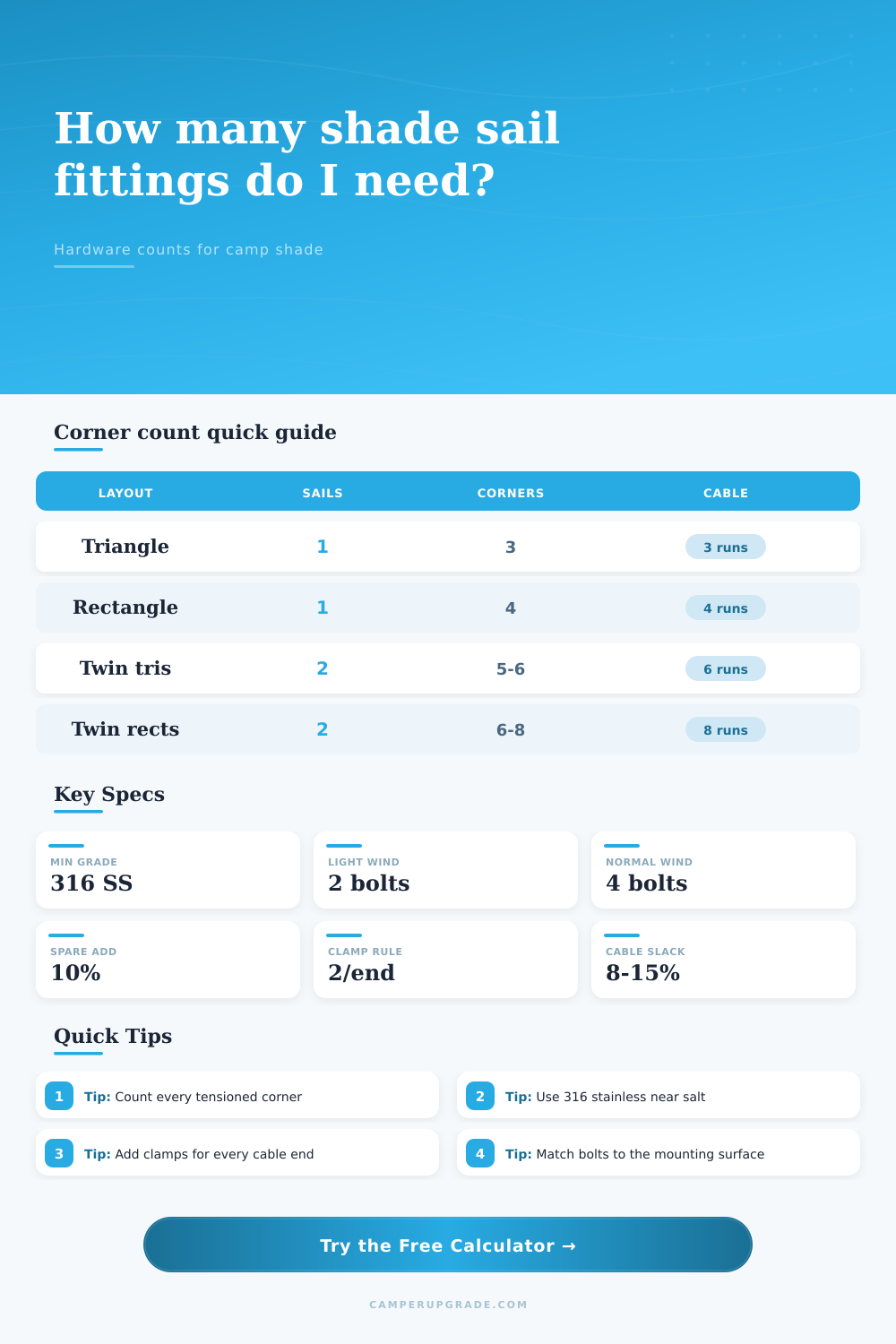
| Layout | Base Formula | Working Corners | Turnbuckle Rule |
|---|---|---|---|
| Single triangle | 3 corners x 1 sail | 3 less shared points | 1 to 3 turnbuckles |
| Single square or rectangle | 4 corners x 1 sail | 4 less shared points | 2 to 4 turnbuckles |
| Twin triangles | 3 corners x 2 sails | Usually 5 to 6 points | 2 to 6 turnbuckles |
| Two rectangles in line | 4 corners x 2 sails | Usually 6 to 8 points | 4 to 8 turnbuckles |
| Mount Type | Wall Plates | Post Eyes | Extra Hardware Counted |
|---|---|---|---|
| All wall or fascia | All attachment points | 0 | Fasteners per plate |
| All posts or poles | 0 | All attachment points | Eye bolts, nuts, washers |
| Wall plus posts | About half the points | Remaining points | Both wall and post hardware |
| Vehicle rail plus posts | One third as rail eyes | Remaining points | Rail links and post eyes |
| Exposure | Fasteners Per Plate | Suggested Material | Calculator Allowance |
|---|---|---|---|
| Sheltered camp | 2 | 304 stainless or galvanized | Base count, lighter spare |
| Standard patio | 4 | 304 or 316 stainless | Recommended default |
| Exposed ridge or desert | 4 | 316 stainless, larger links | Extra shackle buffer |
| Coastal or salt air | 4 | 316 stainless throughout | Corrosion spare buffer |
| Common Sail Size | Perimeter Formula | Approx Cable | Clamp Count |
|---|---|---|---|
| 10 ft triangle | 10 + 10 + 10 | 33 to 36 ft | 12 clamps |
| 12 x 12 x 17 triangle | 12 + 12 + 17 | 45 to 49 ft | 12 clamps |
| 10 x 14 rectangle | 2 x (10 + 14) | 52 to 58 ft | 16 clamps |
| 12 x 20 rectangle | 2 x (12 + 20) | 70 to 77 ft | 16 clamps |
When you plan to hang a shade sail, there is one component that always gets overlooked: hardware. Although actual sail material doesn’t tend to fail much, by the time you get to that out-of-the-way campsite, you realize you’re missing some shackle or a cable isn’t long enough. Hardware estimates are more of a guessing game until you start thinking about it in terms of where the connection points will be rather than how big the sail is going to be.
Enter this page’s calculator. It figures out the math for you as soon as you feed in mounting surface and shape. No more trying to account for common corners vs. You must also account for separate attachment points. Focus on sails, not the holes.
How to Choose the Right Hardware for Your Shade Sail
Everyone counts the number of triangles; nobody remembers the number of cable ends that end properly on each one. Each triangle have three corners, but each edge calls for a perimeter cable with six cable ends. And each needs a thimble or clamp at each end and ideally two clamps (minimum) on each eye to prevent slippage under load. It is not a big deal, unless you are on an exposed ridge and the wind spike. That’s why even though a twin triangle arrangement can be joined at a common point (see table reference), each tension line will need its own distinct hardware.
Picking the right material grade for your environment Material choice is where budgets gets stretched thin without adding much safety. For a patio away from salt spray where it doesn’t rain much (inland), 304 stainless is fine. If you’re right next to ocean, or expect lots of rain, it’ll be pitted in a few months. Go with 316 stainless in either case if leaving the rig up over the winter, or living close enough to salt water to affect it. In real life, the price delta is annoying in the spreadsheet, but replacing rusty bolts hurts more. Galv hardware is cheap and good until it gets rusty; then the rust runs like mad once that zinc layer wear off a shackle. Check it each time you take it down.
Consider the number of turnbuckles and how they distribute tension. Using a maximum of one on each corner give you the most control over how the sail hangs and reduces floppiness in light winds. Using fewer turnbuckles, such as on alternate corners or two per sail, means there is fewer moving parts that could fail or corrode. Standard rectangle setup with solid anchor points usually only requires two or three turnbuckles. Choose between max adjustability vs minimal hardware weight. The calculator will adjust the total number to match the chosen tension plan. Remember to account for cable slack (wire rope stretches when loaded; fabric sags with age). Leave 8-15% extra length to avoid running out of cable during a knot cinch.
How many fasteners is needed? This varies by mounting material. A thick tree trunk or reinforced wooden posts will grip well with less hardware than flimsy metal siding or drywall. Those materials need the extra grab of more screw heads spread across a larger area. For most patio walls, four bolts per plate are a conservative minimum, though double-up those mounts if the location’s out of the wind and otherwise protected. If mounting to trees, use tree straps (see below); these slip right in place and protect bark, but call for specific hardware different than rigid post eyes. The combination of various mounts further complicates the math; never substitute a tree strap shackle for a wall plate bolt unless you’ve planned this.
When I look at a spool of 10 percent spare line it looks like a wasteful luxurios. Until dusk finds me dropping a little nut in tall grass. After that, 10 percent seems a wise safety margin, with enough extra for lost clips or broken-off links. For remote installations, which are never easy, many folks go up to 20 percent because parts aren’t available locally. Make sure your remote kit has enough spare parts to cover any unexpected problems during the field installation.
It’s not sexy. But without hardware, there’s no shade. The trick: make sure to get your count correct. More shade = less fiddling around with zip ties. Pack some spares, check your corners, choose your grade. If you don’t plan well, the sun will shine on your poor planning. You should of planned better.