RV Turning Radius Calculator
Estimate curb-to-curb radius, wall-to-wall clearance, rear tail swing, and trailer swept path from wheelbase, steering angle, overhangs, trailer geometry, and campsite lane width.
Turning envelope estimate
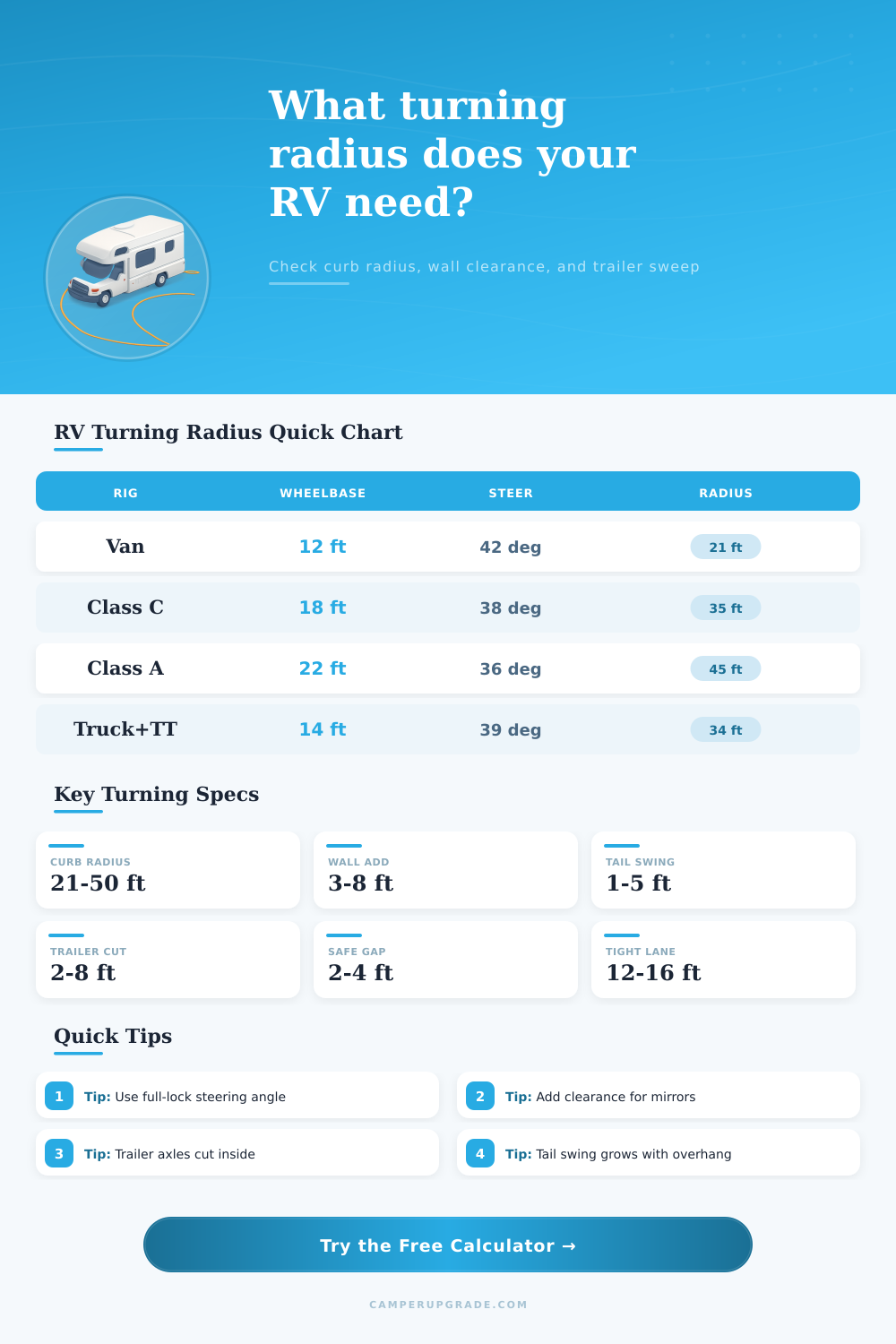
| RV or tow setup | Wheelbase range | Steering angle | Typical curb radius |
|---|---|---|---|
| Short Class B camper van | 11-13 ft | 40-45° | 20-27 ft |
| Extended van conversion | 14-15.5 ft | 38-43° | 27-34 ft |
| 24-26 ft Class C | 14-16 ft | 36-40° | 30-38 ft |
| 30-32 ft Class C | 18-20 ft | 35-39° | 38-48 ft |
| 36 ft gas Class A | 20-23 ft | 34-38° | 44-56 ft |
| 40 ft diesel pusher | 23-26 ft | 35-42° | 46-62 ft |
| Usable width | Turning feel | Best match | Extra caution |
|---|---|---|---|
| 10-12 ft | Very tight | Vans and small trailers | Watch inside cut |
| 12-14 ft | Tight | Class B, short Class C | Use a spotter |
| 14-16 ft | Workable | Most Class C rigs | Protect tail swing |
| 16-20 ft | Comfortable | Class A and trailers | Check posts and trees |
| 20-24 ft | Wide loop road | Long fifth wheels | Mind opposing traffic |
| 24 ft plus | Generous | Large coaches | Still verify overheads |
| Trailer axle distance | Turn radius 30 ft | Turn radius 40 ft | Turn radius 50 ft |
|---|---|---|---|
| 12 ft coupler to axle | 2.4 ft cut-in | 1.8 ft cut-in | 1.4 ft cut-in |
| 16 ft coupler to axle | 4.3 ft cut-in | 3.2 ft cut-in | 2.6 ft cut-in |
| 20 ft coupler to axle | 6.7 ft cut-in | 5.0 ft cut-in | 4.0 ft cut-in |
| 24 ft coupler to axle | 9.6 ft cut-in | 7.2 ft cut-in | 5.8 ft cut-in |
| 28 ft coupler to axle | 13.1 ft cut-in | 9.8 ft cut-in | 7.8 ft cut-in |
| 32 ft coupler to axle | 17.1 ft cut-in | 12.8 ft cut-in | 10.2 ft cut-in |
| Rear overhang | Radius 25 ft | Radius 35 ft | Radius 45 ft |
|---|---|---|---|
| 4 ft | 0.3 ft swing | 0.2 ft swing | 0.2 ft swing |
| 6 ft | 0.7 ft swing | 0.5 ft swing | 0.4 ft swing |
| 8 ft | 1.3 ft swing | 0.9 ft swing | 0.7 ft swing |
| 10 ft | 1.9 ft swing | 1.4 ft swing | 1.1 ft swing |
| 12 ft | 2.7 ft swing | 2.0 ft swing | 1.6 ft swing |
| 14 ft | 3.6 ft swing | 2.7 ft swing | 2.1 ft swing |
When you arrive at a new campground, the entrance road may be narrow and contain tight curves between the trees. You must determine whether your vehicle and trailer will fit through these curve. The total length of your vehicle might seem adequate for the turns the trailer has to make, but that is not the same than the turning radius of your trailer and vehicle.
That is why you need to use a turning radius calculator when tow a trailer. The turning radius problem is a problem of geometry. A motorhome or a truck and trailer do not turn around a central point.
Check Your Vehicle and Trailer Turning Before You Go Camping
The front wheels trace a circle with a different radius than the rear of the trailer and vehicle. Any part of the trailer that is behind the rear axle of the towing vehicle is referred to as an overhang. An overhang will swing out when the towing vehicle make a turn.
If the trailer axles of the trailer that you are towing cut into the turning radius of your towing vehicle, your trailer might hit an obstacle that is invisible to you in your side and rear mirror. You must enter the dimension of your towing vehicle and trailer into the calculator so that the computer can compute the turning radius correctly. The wheelbase of the towing vehicle affects the turning radius of your towing vehicle.
The wheelbase is the distance between the front axle and the rear axle of the towing vehicle. The shorter the distance, the more sharp the towing vehicle can turn. A vehicle with a short wheelbase can turn more sharply to negotiate a tight corner than a tow vehicle with a long wheelbase.
Another dimension that can affect the turning radius is the steering angle of the towing vehicle. The steering angle of the towing vehicle is the angle to which the front wheels of the towing vehicle can turn. Many people use a steering angle that is less than the maximum steering angle that their towing vehicle can achieve.
This is especially true for people who drive over gravel or obstacles. By using a turning radius calculator to enter a smaller steering angle, you can get a more realistic estimation of the turning radius of your towing vehicle. The overhang of the towing vehicle also affects the turning radius of your towing vehicle with a trailer.
The overhang of a towing vehicle is the distance between the rear axle of the towing vehicle and the rear bumper. The longer the overhang, the farther the rear of the towing vehicle will swing out when it makes a turn. This might cause the rear of the towing vehicle to hit an obstacle on the outside of a turn.
Overhangs can also be measured from the front of the towing vehicle. The overhang from the front axle to the front bumper is referred to as the front overhang of the towing vehicle. The longer the front overhang of the towing vehicle, the farther the front of the towing vehicle will swing out when it makes a turn.
This could cause the trailer to hit an obstacle on the outside of a turn. You can also enter the safety clearance for mirror and turning into the turning radius calculator to provide an estimation of the turning radius of your towing vehicle that takes into account your mirrors and driving maneuvering space. If you are towing a trailer, the distance between the hitch that pull the trailer and the trailer axles also affects the turning radius of the trailer.
The trailer will follow a different route than the towing vehicle. The closer the trailer axles are to the hitch that pulls the trailer, the closer the trailer will travel to the towing vehicle’s route. The distance between the trailer hitch and the trailer axles is referred to as the trailer off-tracking.
The farther the trailer axles are from the trailer hitch, the farther the trailer will turn inward during a turn. This is another reason to consider the turning radius of your trailer before arriving at your campground. The calculator will represent the turning radius of your towing vehicle and trailer in the form of the swept width of your trailer and the amount of off-tracking of the trailer axles.
Many campgrounds can be challenging to navigate. Trees might lean in one direction, and obstacles might be at odd angles to the travel route of the campers. The width of the lane that campers use can also change due to drops in the road.
Campers can use the lane width and opening width fields in the turning radius calculator to enter the actual width of the lane that campers will use in the campground. Many people will assume that the lane width are sufficient for their camping trip, but the lane might not be wide enough once the trailer off-tracking and the tail of the towing vehicle are considered. People often make mistakes when they consider the turning radius of their towing vehicle.
A common mistake is to think in straight lines when navigating the turning radius of the trailer. People might use the total length of their towing vehicle and trailer as the turning radius. This fails to consider the overhang of the trailer.
People also might consider their trailer as an extension of the towing vehicle. This ignores the turning radius of the trailer. These mistake cause the trailer to require a three-point correction to navigate tight spaces.
The reference tables on the turning radius calculator page can give you a context for the turning radius for your trailer. However, the reference tables are only approximation and not exact measurements. These tables will provide a reference for the change in curb radius given the change in the wheelbase and the steering angle of the towing vehicle.
The reference tables will allow you to understand how lane width and trailer axle placement interact with the turning radius of your towing vehicle. You dont have to memorize the numbers in these reference tables. However, they can be used to give you a general idea of how the different vehicles turn.
Prior to the arrival at the campground, you should ask yourself if you have a spotter for your towing vehicle and trailer. A spotter can see the trailers tail and the turn of the trailer over the side of the towing vehicle. Another thing to consider before arriving at the campground is whether you are willing to use the full width of the road.
This is the best way to negotiate tight turns at the campground. The turning radius calculator can provide you with the turning radius and dimension of your towing vehicle and trailer. However, no calculator can provide you with a feeling of whether or not you will feel comfortablely driving your trailer and towing vehicle at the edges of the turning radius provided by the calculator.
It is a good idea to calculate the turning radius of your towing vehicle and trailer before you arrive at the campground. You can measure the wheelbase and the overhangs of your towing vehicle. Have these dimension memorized or written down in a place where you can find them easily.
You should also measure the lane width and the opening of the road that you will use at the campground before you leave home. It is faster to enter these measurement in the turning radius calculator before you leave than to perform a three-point correction at the campground when you arrive.