RV Tongue Jack Capacity Calculator
Estimate the minimum tongue jack rating, lift margin, usable stroke, and coupler-height fit from your trailer weight, tongue weight, and hitch setup.
🎛Quick Presets
📏Tongue Jack Inputs
This calculator estimates static tongue jack sizing for bumper-pull trailers. It is not a substitute for axle scale readings, manufacturer limits, or inspection of bent, worn, or corroded jack parts.
🔧Jack / Spec Grid
📊Jack Rating Table
| Rated capacity | Best fit | Typical tongue weight | Practical note |
|---|---|---|---|
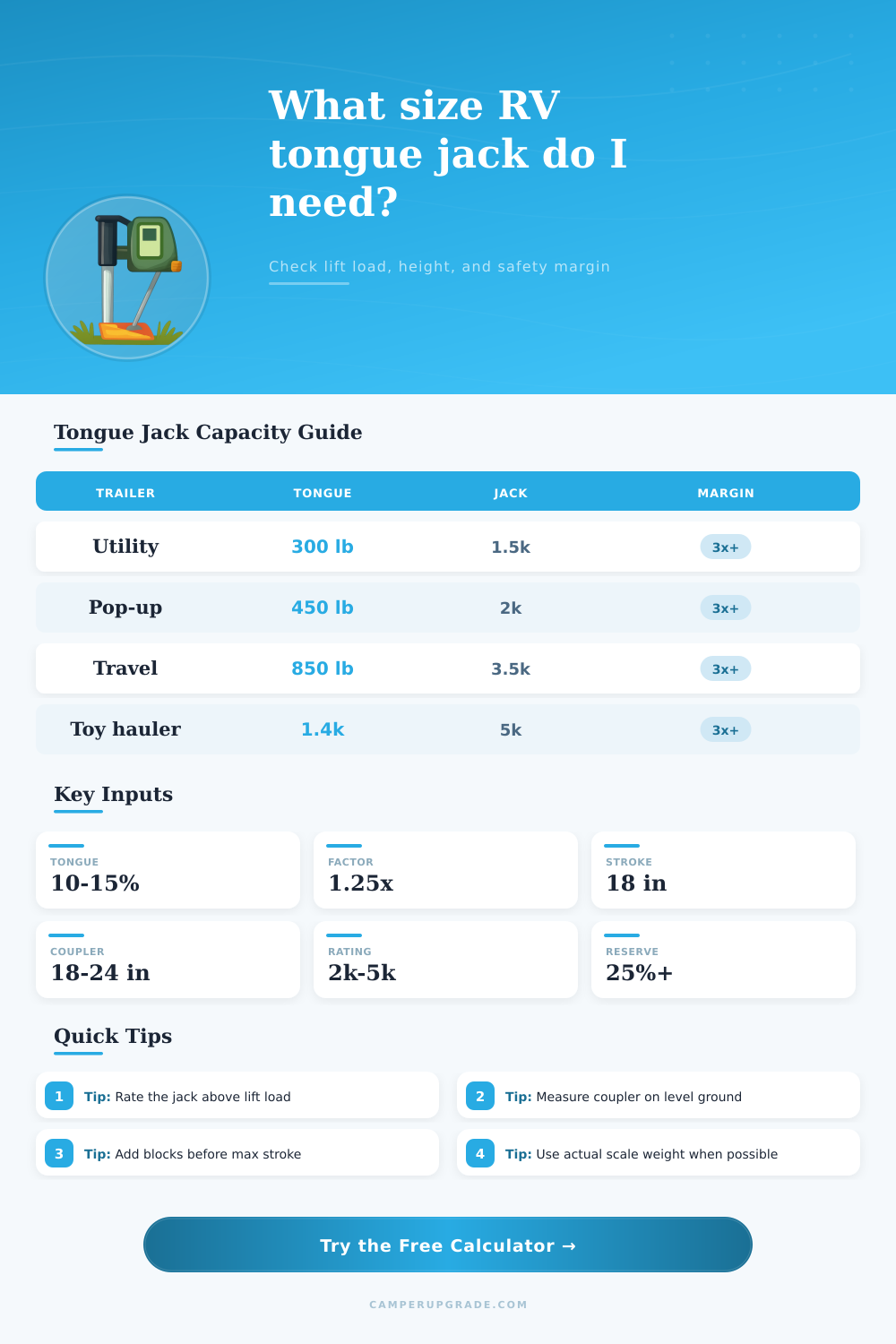
| 1,000 to 1,500 lb | Small utility and micro campers | 150 to 400 lb | Usually manual; check wheel and foot limits. |
| 2,000 lb | Pop-up campers, teardrops, light cargo campers | 300 to 650 lb | Good when tongue load is known and low. |
| 3,500 lb | Most travel trailers and A-frame RVs | 600 to 1,100 lb | Common electric choice with healthy reserve. |
| 4,000 to 4,500 lb | Large travel trailers and loaded front storage | 900 to 1,400 lb | Useful for weight-distribution hitch work. |
| 5,000 lb or more | Toy haulers and heavy tongue loads | 1,200 lb and up | Choose when loads vary or terrain is uneven. |
📐Tongue Weight Reference
| Loaded trailer weight | 10% tongue | 13% tongue | 15% tongue |
|---|---|---|---|
| 2,000 lb | 200 lb | 260 lb | 300 lb |
| 4,000 lb | 400 lb | 520 lb | 600 lb |
| 6,000 lb | 600 lb | 780 lb | 900 lb |
| 8,000 lb | 800 lb | 1,040 lb | 1,200 lb |
| 10,000 lb | 1,000 lb | 1,300 lb | 1,500 lb |
↕Coupler Height And Stroke Table
| Level coupler height | Retracted jack height | Clearance allowance | Suggested stroke |
|---|---|---|---|
| 14 to 16 in | 7 to 9 in | 2 to 3 in | 10 to 14 in |
| 17 to 19 in | 8 to 10 in | 3 in | 14 to 18 in |
| 20 to 23 in | 9 to 12 in | 3 to 4 in | 18 to 22 in |
| 24 to 28 in | 10 to 14 in | 4 to 6 in | 22 to 24 in or drop leg |
🛻Common RV Setup Table
| Setup | Loaded weight | Tongue load | Suggested jack class |
|---|---|---|---|
| Teardrop with front box | 1,800 to 2,800 lb | 220 to 420 lb | 1,500 to 2,000 lb |
| Pop-up camper | 2,000 to 3,500 lb | 250 to 525 lb | 2,000 lb |
| Single-axle travel trailer | 3,500 to 5,500 lb | 450 to 825 lb | 3,500 lb |
| Family bunkhouse | 6,000 to 8,500 lb | 780 to 1,275 lb | 3,500 to 4,500 lb |
| Toy hauler with garage load | 8,000 to 11,000 lb | 900 to 1,650 lb | 4,500 to 5,000+ lb |
💡Capacity Tips
When selecting a tongue jack, you must consider both the weight of the trailer and the height requirement of the trailer. A tongue jack has to hold the front end of the trailer steady while you adjust the trailer to level it properly. If the tongue jack is too small for the trailer or if it cant reach the necessary height to elevate the trailer, the trailer will be in an unstable position.
The weight of the trailer can be a challenging quantity to determine because it is often listed in the trailer brochure. However, this weight can change based on the amounts of fuel, water, batteries, and any other item that are stored in the trailer. To ensure that the trailer’s tongue jack is of the appropriate size, it is essential to calculate the actual tongue weight of the trailer.
How to Choose the Right Tongue Jack
The calculator helps to determine the needed tongue jack rating by taking your trailer weight and tongue weight. It also compares those measurement to the tongue jack’s rating and apply a safety factor to the number. A safety factor is applied because there may be additional stress on the tongue jack when the trailer is on an incline or when you need to raise the trailer to clear the hitch ball.
For trailers that will be driven on standard roads, a safety factor of 1.5 will be sufficient. However, if you will be traveling on rough roads, a safety factor of 1.75 will be better. This safety factor prevents the tongue jack from being used at its absolute maximum loading capacity.
Tongue weight is a primary measurement that must be taken for the trailer. The listed weight of the trailers tongue may read 12 percent. However, that number may go up to 15 percent if the trailer has propane tanks and water on board.
An increased tongue weight require a larger class of tongue jack. The calculator allows the user to input either the weight or the percentage to determine the rating for the tongue jack. The height requirements of the trailer are also important.
You must measure the trailer to ensure that the tongue jack can reach the trailer coupler. It is also necessary to add in extra inches for hitch clearance as well as the amount of ground pads that will need to be placed on uneven ground. If most of the stroke of the tongue jack is taken up by the height requirement, the tongue jack will not have a margin for the screw mechanism of the tongue jack.
If the tongue jack cannot reach the height of the trailer, a drop-leg tongue jack will be required or you will have to perform additional blocking. The type of tongue jack that you will use can also affect the operation of the tongue jack. The manual A-frame tongue jack and the electric tongue jack can both handle the same amount of weight.
However, the physical effort required for each type of tongue jack can be different. For trailers that will be on an incline, a tongue jack with drop legs will be helpful as it will allow the tongue jack to maintain its stroke. For trailers and towed vehicles that are relatively light in weight, you can use a side-wind utility jack for the towed vehicle.
However, if a heavy box is placed on the trailer, there is a chance that a side-wind utility jack will twist. Many people make mistake when purchasing a tongue jack. For example, some individuals may purchase a tongue jack for the trailers paper weight but may find that the tongue jack cannot handle the weight of the trailer with the water tank filled with water.
Other people may purchase a tongue jack that is too large for the trailer and find that the tongue jack cannot reach the ground. The tongue jack calculator will help to avoid these mistake since the calculator will provide an idea of the total lift that the tongue jack will need to raise the trailer. Beyond the measurements of the trailers tongue and trailer weight, there are also other real-world conditions that may impact the performance of the tongue jack.
For example, a soft gravel pad may compress under the trailers tongue jacks foot. The driveway on which the trailer is to be parked may have a crown that will tilt the trailer when loaded. In these situations, the safety factor will prevent the tongue jack from binding or the foot of the tongue jack from sinking into the ground.
The reference tables provides starting points for the different trailer classes. However, a trailer may have a maximum tongue weight requirement from the tables but may need more weight capacity due to the items that may be loaded into the trailer. For example, a trailer used to transport sporting equipment like a toy hauler may only require a 3,500-pound tongue jack when there is no equipment in the trailer.
However, when the trailer is full of sporting equipment, it may require a larger tongue jack. You can use the calculator to test the different scenarios of tongue weight to determine what tongue jack will be best for the trailer. The proper tongue jack will have a little extra capacity in case of the actual weight of the trailer and the height of the trailers coupler.
Using a tongue jack with a little extra capacity will ensure that the tongue jack remains steady when towing the trailer and that the tongue jacks mechanism does not work at its limit when towing the trailer.