RV Tire Age Calculator
Decode the DOT date, compare current age, and adjust the result for miles, storage, UV exposure, load, and visible tire condition.
🚗 RV Tire Presets
📅 Tire Date, Use, and Exposure
Age and Condition Breakdown
🛞 Tire Condition and Spec Grid
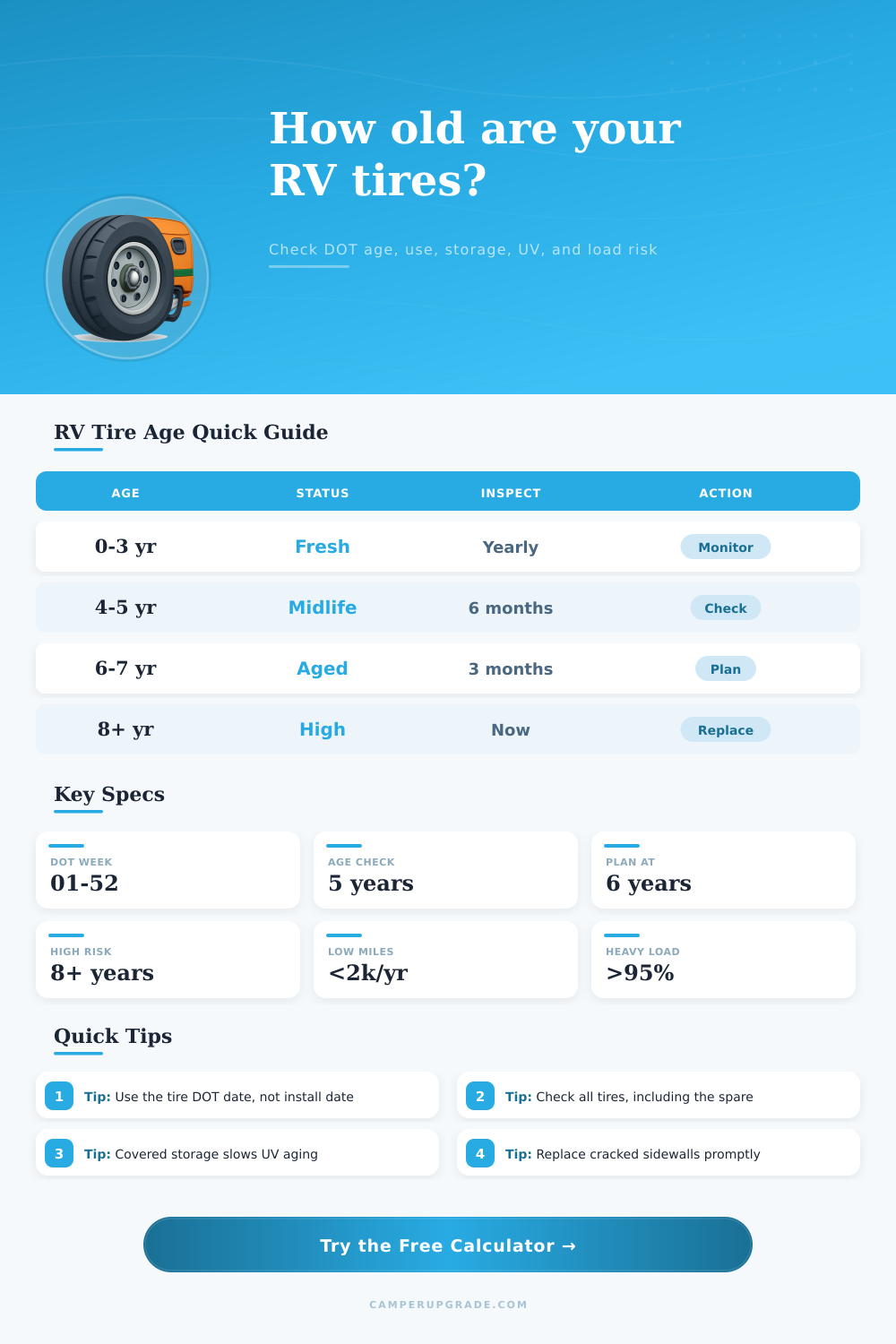
📊 RV Tire Age Reference Table
| Tire age | Typical status | Inspection rhythm | Planning action |
|---|---|---|---|
| 0 to 3 years | Early service life when properly stored and loaded | Before trips and yearly detailed check | Track pressure, load, tread, and sidewalls |
| 4 to 5 years | Midlife age range for many RV tires | Detailed check at least every 6 months | Watch for weather checking, uneven wear, and heat history |
| 6 to 7 years | Aged tire range even with good tread depth | Detailed check every 3 months or before long trips | Plan replacement, especially for trailers, steer tires, sun exposure, or heavy loads |
| 8 years or older | High age risk for many RV applications | Inspect now before any highway travel | Replacement is often the prudent choice even if tread remains |
🔢 DOT Date Code Examples
| DOT ending | Week | Year | Manufacture estimate |
|---|---|---|---|
| 0420 | 4 | 2020 | Late January 2020 |
| 1821 | 18 | 2021 | Early May 2021 |
| 3522 | 35 | 2022 | Late August 2022 |
| 5023 | 50 | 2023 | Mid December 2023 |
☀ Storage, UV, and Load Adjusters
| Factor | Lower risk | Higher risk | Why it matters |
|---|---|---|---|
| Storage | Indoor, covered, dry surface | Uncovered, parked long term on bare ground | Ozone, moisture, and flat spotting can accelerate visible aging |
| UV and heat | Mild climate, shaded sidewalls | Desert sun, coastal sun, no covers | Heat and sunlight harden sidewall rubber over time |
| Load margin | Under 85% of tire rating | Near or over rated capacity | Heat builds faster when capacity margin is small |
| Use pattern | Regular movement and correct pressure | Very low miles with long parked periods | Low mileage does not stop aging and may hide weathering |
🔍 Condition Clues and Tire Position
| Observation | Age impact | Position concern | Suggested response |
|---|---|---|---|
| No cracks, even tread, no repair history | Age remains the main driver | All positions | Continue pressure checks and scheduled inspection |
| Minor sidewall weather checking | Adds moderate risk | Trailer and spare tires often show this first | Inspect closely before long highway travel |
| Deep cracks, bulges, or separation | Adds urgent risk regardless of age | Steer and trailer axle tires are critical | Do not rely on tread depth as the deciding factor |
| Uneven wear or repeated low pressure | Suggests heat or alignment stress | Duals, tag axles, and tandem trailers | Check axle weights, inflation, and tire rating |
💡 Two RV Tire Age Tips
Tires is a critical component of an RV. Even if the tire tread is in good condition, tires can degrade over time. It is easy for an individual to make the assumption that the tires is in good condition if the tread depth on the tire is deep.
However, the age of the rubber of the tire can be a determining factor as to whether or not the tire are safe to be used on an RV. Rubber can change over time due to sunlight, heat, and the weight that is place upon the tire. A tire that is stored in a mild climate will typically last more longer than a tire that is stored in a desert climate due to the extra amount of sunlight and heat that can negatively impact the tire.
How to Tell If Your RV Tires Are Too Old
The rubber can degrade to the point where crack form in the sidewalls of the tire. In order to determine the age of the tire, an individual must use the DOT date code that is printed on the tire. This date code will reveal to an individual the date that the tire were manufactured.
However, the DOT date code will not reveal the date that the tire was installed onto the RV. The manufacturer’s tire may have been manufactured many month prior to its installation on the RV. In this situation, an individual can use the calculator included on this page to enter the DOT date code of their tire to determine the age of that tire.
In addition to the type of tire that is manufactured, there are storage conditions for the tire that can impact the rate at which the tire age. Storage conditions include the amount of sunlight that falls upon the tire, and if the tire is stored off the ground. If the tire is stored on the ground for extended periods, the tire may form flat spot on the tire, as well as the rubber of the tire can harden from exposure to moisture.
To protect the tire from degradation, store the tire away from direct sunlight, as well as store the RV and tire off the ground when the RV is parked. These storage conditions can be entered into the tire calculator to reflect the impact that they may have upon the tire. The load that a tire endures will also impact the aging of that tire.
The heavier the load that is placed upon the tire, the more the tire will heat up. Trailer RVs are typically loaded with more weight than a conventional RV, as well as move at slower speed. The slower travel of the RV will cause the heat generated by the tire to remain in the tire instead of being released with the movement of the RV.
The weight that the RV carries can be entered into the calculator to determine how fast the tire ages as a result of the load. In addition to using a tire age calculator, an individual must also visually inspect the tire. A close look should be taken at the rubber of the tire for cracks, bulges, or any sign of heat damage to the RV tire.
These visual indicators are typically a sign that the aging of the rubber has compromised the internal structure of the tire. Using the visual inspection tool included in this tire age calculator will allow an individual to mark the visual condition of the tire. The pattern in which an RV travels can also impact the tire.
Even with low miles for an RV, the tire may still degrade over time. Additionally, if an individual accumulates many miles with an older tire, the internal belts of the tire may degrade from performing such a heavy load. The miles that the RV drives can be entered into the calculator to determine the impact that the tire has endured as a result of the travel of the RV.
Not all tires are the same, and the position of the tire on the RV may indicate a need for additional inspection of those tires. For instance, special trailer tires may degrade to the point of reaching the end of their useful life prior to the tread depth reaching the minimum allowed level. Additionally, the tires of a light truck that is used as a motorhome may experience different wear and tear than the other tires of the RV.
Additionally, the spare tire of the RV also ages at the same rate as the other tires. If an individual does not routinely inspect the spare tire, they may not be aware of the age of that tire. The reference table included with this tire calculator will help an individual to understand when to replace their RV tire.
The table includes information about how often the individual should inspect their tires, based upon their age and condition. This reference table is not created to instill fear into the owner of an RV, but instead to provide a clear understanding of the risk that is associated with the age of their tires. An individual should not rely upon the tread depth of the tire to indicate when the tire should be replaced.
The tread depth and the age of the rubber are separate factors of the tire that should be considered together when making a decision about the safety of those tires. After utilizing the tire age calculator, an individual will know if the tires for their RV are in a higher risk state of degradation. If the tires are in a higher risk state, then those tires should be inspected and replaced at a later date.
If the tires are in a lower risk state, then the tire pressure and sidewalls should still be inspected prior to every trip that is taken with the RV. Additionally, the age of a tire should not be guessed based upon the tread depth of the tire. The manufacture date of the tire and the conditions under which it has been stored will allow an individual to accurately determine the age of the tire.