RV Slide-Out Clearance Calculator
Check slide depth, awning reach, trees, utility pedestals, site width, and safety buffer before you extend the room.
Slide-Out Clearance Result
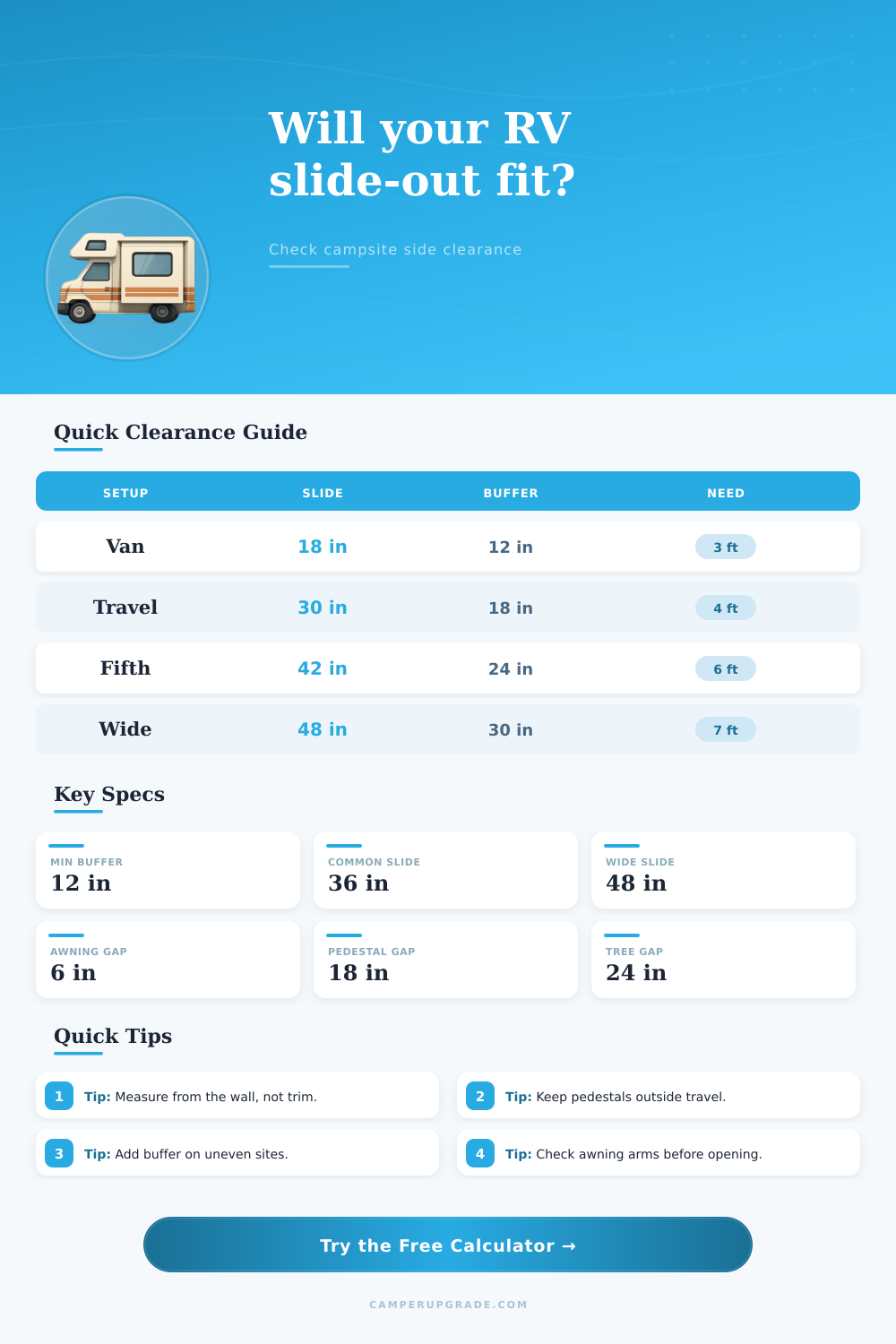
| Slide depth | Add 12 in buffer | Add 18 in buffer | Add 24 in buffer |
|---|---|---|---|
| 18 in compact wardrobe slide | 30 in required | 36 in required | 42 in required |
| 24 in dinette slide | 36 in required | 42 in required | 48 in required |
| 30 in sofa slide | 42 in required | 48 in required | 54 in required |
| 36 in common living slide | 48 in required | 54 in required | 60 in required |
| 42 in fifth wheel slide | 54 in required | 60 in required | 66 in required |
| 48 in deep full-wall slide | 60 in required | 66 in required | 72 in required |
| Obstacle | Measure from | Suggested gap | Calculator input |
|---|---|---|---|
| Power pedestal | RV wall to pedestal face | Slide depth plus 18 in | Pedestal gap |
| Water riser or sewer post | RV wall to closest cap | Slide depth plus 18 in | Pedestal gap |
| Tree trunk | RV wall to bark edge | Slide depth plus 24 in | Tree gap |
| Fence or retaining wall | RV wall to hard face | Slide depth plus 12 in | Tree gap |
| Awning arm | RV wall to arm path | Slide depth plus 6 in | Awning reach |
| RV width | Slide depth | Walking lane | Minimum site width |
|---|---|---|---|
| 8.0 ft | 24 in | 3.0 ft | 13.0 ft plus buffer |
| 8.5 ft | 30 in | 3.0 ft | 14.0 ft plus buffer |
| 8.5 ft | 36 in | 3.0 ft | 14.5 ft plus buffer |
| 8.5 ft | 42 in | 3.5 ft | 15.5 ft plus buffer |
| 8.5 ft | 48 in | 4.0 ft | 16.5 ft plus buffer |
| Setup | Common slide | Primary risk | Practical target |
|---|---|---|---|
| Small travel trailer | 18 to 30 in | Picnic table or post | 4 ft clear side |
| Large travel trailer | 30 to 36 in | Pedestal placement | 5 ft clear side |
| Fifth wheel | 36 to 42 in | Tree trunks and hookups | 6 ft clear side |
| Class A motorhome | 36 to 48 in | Awning arm conflict | 6 to 7 ft clear side |
| Dual slide layout | 30 to 48 in | Site width consumed | Check both sides |
Slide-out clearance are the distance between the RV slide-out and other object. The slide-out clearance is essential for the traveler to understands. When an RV dont have enough slide-out clearance, the RV will hit a tree, a utility pedestal, or some other objects.
If the RV hits another object with its slide-out, then the slide-out may fail to open, and it may damage the RV. Before parking the RV at a campsite, the traveler should measure the slide-out clearance. To calculate the slide-out clearance, a traveler should consider a few different factor.
How to Check RV Slide-Out Space Before You Park
The depth of the RV’s slide-out is one factor. The depth of a slide-out are the distance the slide-out will travel when the RV moves the slide-out outward from the RV. Another factor to consider is the width of the campsite.
A third factor is the location of obstacle in the campsite. Campsites often have trees or utility pedestals that encroach upon the space that the RV’s slide-out will take up. The presence of these obstacle will limit the extent to which the RV’s slide-out can extend outward from the RV.
Many travelers makes mistakes when determining slide-out clearance if they do not account for the RV’s awning arm. The awning arm on an RV is located on the same side of the RV as the RV’s slide-out. When the traveler extend the awning on the RV, the awning arm extends outward from the RV.
When determining the slide-out clearance, a traveler must account for the space that the awning arm will take up when extended. If the traveler does not account for this space, the awning may hit a tree or an utility pedestal. In addition to the width of the campsite and the depth of the slide-out, the traveler should consider the shape of the obstacles in the campsite and the slope of the ground at that campsite.
For example, the trunk of a tree is not a straight vertical line; a tree’s trunk has roots that extend outward and branches that hang down from the tree. When measuring the distance between the RV and a tree, the traveler must take into account the space that will be occupied by the branches or roots. Similarly, if the ground at the campsite features a slope in either the uphill or downhill direction, when the RV is parked at the campsite, the RV will tilt in either the uphill or downhill direction when the traveler levels the RV.
The tilt of the RV will impact the slide-out clearance that the RV has. For these reasons, it is necessary to account for this tilt when determining the slide-out clearance. To account for the tilt, the traveler should include in the determination of the slide-out clearance a buffer.
To include a buffer in the calculation of the slide-out clearance means that the RV should be given extra space beyond the measurements of the slide-out. A buffer is included in the measurements of the slide-out clearance to provide the RV with extra space in case of leveling the RV or if the RV moves slight within the campsite. Without the buffer, the RV may scrape against another object or the slide-out may become bound in its movement.
By including a buffer in the calculation of the slide-out space, the RV will have enough room for the slide-out to open and close without scraping against another object. When calculating the total space the RV will require at the campsite, the RV’s total site width must be sufficient to account for the RV, the RV’s slide-out, and a walking lane on the opposite side of the RV from the slide-out. If there is no walking lane on the opposite side of the RV from the slide-out, the RV may not have enough space for a traveler to walk around the RV or to use the entry door of the RV.
Therefore, even if the total site width of the campsite is sufficient for the RV to park, it may not be sufficient for both the RV and the RV’s slide-out. When making a determination about where to park the RV, a traveler should compare the available space at the campsite to the space that the RV require. The RV’s required space is equal to the slide-out depth plus the awning reach plus the buffer.
If the available space is greater than the required space, the RV will have a comfortable margin of space to provide for its slide-out. If the available space is equal to the required space, the RV will have a thinner margin of space for the slide-out. If the available space at the campsite is less than the required space for the RV’s slide-out, then the RV will have a negative margin of space for its slide-out.
When the RV has a negative margin of space for its slide-out, it means that the slide-out will hit an object at the campsite and will not be able to function correct. For these reasons, if the RV has a thin margin or a negative margin of space for the slide-out, the RV should either be repositioned within the campsite or the traveler should drive the RV to another campsite. It’s better to check this base off the actual space available.
The RV’s size matters alot. Most travelers dont realize that the awning arm can be a problem too. If they dont check, they could of damaged there equipment.
The space is more important then it looks. You should of checked the ground slope first. Its a common mistake.