RV Site Length by Rig Calculator
Estimate the minimum usable pad, safer booking length, tow vehicle fit, and clearance margin for back-in and pull-through RV sites.
🚙Named Rig Presets
📏Rig And Site Inputs
Calculation Breakdown
⚙Site Fit Specification Grid
📋Reference Tables
| Site Style | Length Allowance | Best Use | Watch Point |
|---|---|---|---|
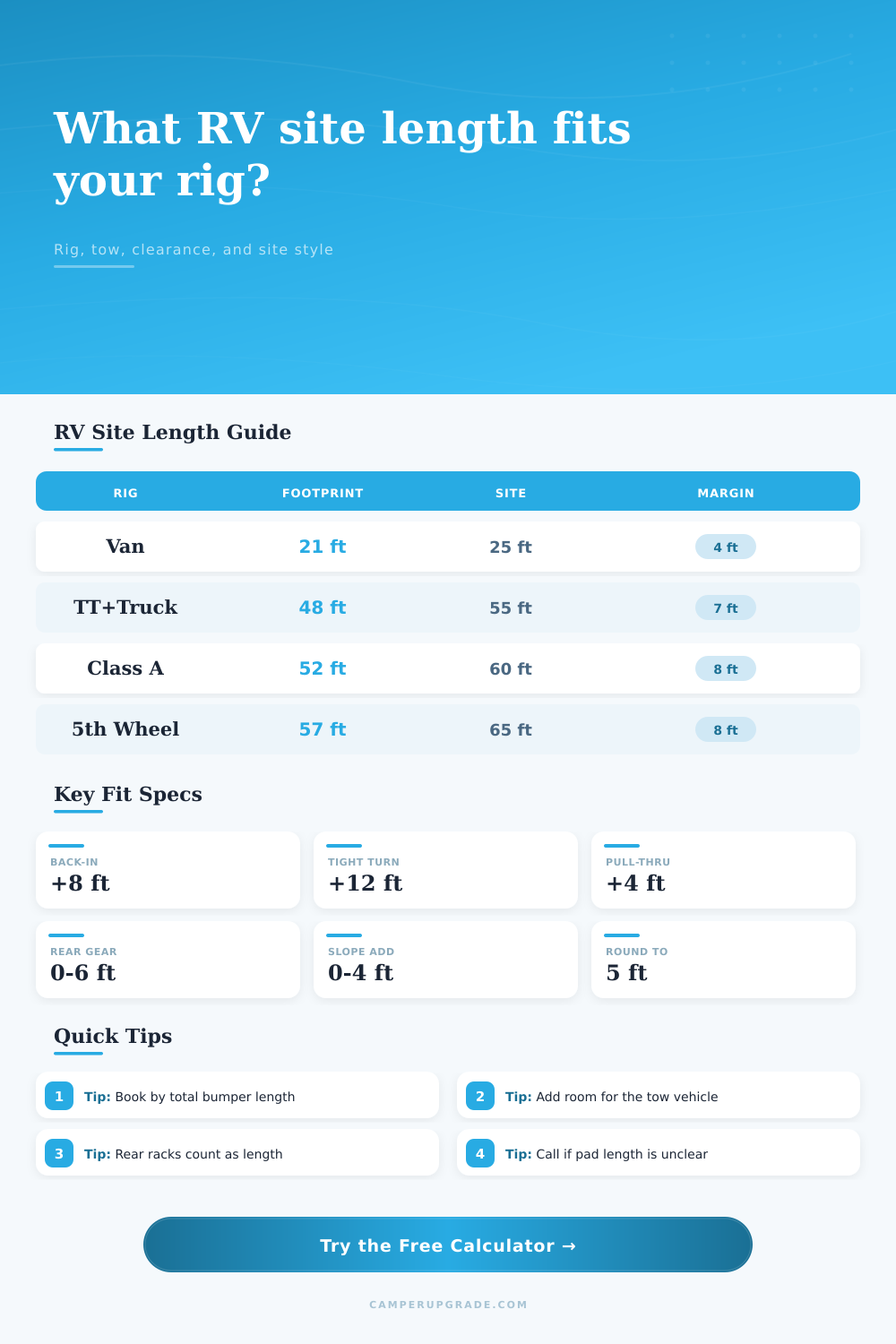
| Straight pull-through | +4 ft | Long motorhomes and towables | Exit angle and trees |
| Wide back-in | +6 ft | Open loops with broad roads | Rear wheel stop location |
| Standard back-in | +8 ft | Most private and state park pads | Front swing while backing |
| Tight back-in | +12 ft | Older wooded campgrounds | Posts, trunks, and drop-offs |
| Angled spur | +10 ft | One-way loops and diagonal pads | Advertised length may be diagonal |
| Parallel roadside | +16 ft | Road shoulder or curbside camping | Needs extra entry and exit space |
| Rig Configuration | Count In Footprint | Typical Hitch Gap | Calculator Note |
|---|---|---|---|
| Van or single motorhome | RV body + rear gear | 0 ft | Vehicle length field can stay 0 |
| Motorhome with toad | Coach + towbar + car | 4-5 ft | Use full hitched mode if car stays attached |
| Travel trailer | Truck + tongue + trailer | 3-4 ft | Unhitched front mode may reduce pad need |
| Fifth wheel | Truck + bed overlap + trailer | Use 0-1 ft | Calculator applies pickup bed overlap |
| Truck camper + trailer | Truck camper + drawbar + trailer | 2-4 ft | Rear camper overhang should be included |
| Destination trailer | Trailer body only unless tow remains | 3-4 ft | Verify actual pad, not just site category |
| Common Rig | Realistic Footprint | Minimum Pad | Safer Listing |
|---|---|---|---|
| 21 ft camper van | 22 ft with rear box | 28 ft | 30 ft site |
| 25 ft trailer + half-ton | 48 ft hitched | 54 ft | 60 ft site |
| 31 ft Class C + Jeep | 53 ft hitched | 59 ft | 65 ft site |
| 34 ft fifth wheel + crew cab | 52 ft with bed overlap | 58 ft | 65 ft site |
| 40 ft diesel pusher + crossover | 62 ft hitched | 68 ft | 75 ft site |
| 38 ft toy hauler + dually | 59 ft with bed overlap | 65 ft | 75 ft site |
| Listing Phrase | Usually Means | Ask For | Risk Level |
|---|---|---|---|
| Fits up to 35 ft | Often RV body length only | Usable pad length | Medium |
| 35 ft pad | Measured hard surface | Wheel stop and overhang room | Low |
| Big rig friendly | Access roads and turns are easier | Exact pad and tree clearance | Medium |
| Pull-through 60 ft | Total lane length may include apron | Level usable length | Low |
| Back-in 40 ft | May exclude tow vehicle parking | Front vehicle space | High |
| Max trailer 30 ft | Towable box length limit | Combined truck length policy | Medium |
💡Practical Fit Notes
This calculator estimates length fit for planning. Always follow posted campground limits, local rules, and staff instructions for backing, parking, and tow vehicle placement.
The listing says it’s suitable for fifty-five foot rigs, so on paper, the length of your truck plus your travel trailer fits. So you pull in on a Tuesday evening, unhitch and go unloading your gear. But then you notice that the paved pad stop at forty feet. The next fifteen feet are just gravel (or slope, or empty air) leading up to a giant oak tree. This, friends, is the old RV camping trap.
The usable length is seldom as long than the advertised length. Whether you spend a relaxing evening or a stressful session backing up and moving around depend entirely on who you ask about actual space available. You enter the physical constraints of the site and then the dimensions of your rig into the calculator above, and it do the math for you. It removes sales talk and boils down the issue to simple geometry of parking a heavy thing.
Why RV Sites Fit Differently Than Advertised
Most campgrounds will tell you either that their pads is long enough to hold your entire RV (the diagonal measure) or they’ll tell you how wide their loops are (not useful). But what you want to know is how long the continuous, level surface are from your front bumper to the rear cap. The moment that surface take a turn, a dip, an interruption for a drain pipe, that’s when your effective space starts shrinking fast.
The trick here is knowing about the hitch gap. That three or four foot area between the trailer tongue and your truck bumper are useless parking-wise when towing a trailer. If you’re leaving it hooked up, it doesn’t fit on the pad. A lot of RVers think only the length of their trailer matter, so they don’t include this gap when figuring out how much space they need. But if you’re backing into a normal sized spot, that gap will move your truck forward, moving your front tires either in the grass or completely off the gravel. By allowing you to indicate if you’re hitched or unhitched, the tool factors this in and makes a huge difference in how long a pad you’ll need.
Then there is the issue of rear overhang. A couple more feet gets tacked on by a spare tire, ladder rack or bike carrier. While they aren’t in the brochure, they sure exist once you’re opening the door with one hand and trying not to scratch up your bike rack on the tree trunk or wheel stop. Having a little more space behind you allow you to open hatches and deploy stabilizers without scratching paint, plus it give you some wiggle room if you need to get under something. It’s just a little bit, but it would of saved you from expensive repair bills.
Length is one thing, but the type of site is also important. Pull-throughs let you drive in a straight line so they require less space to maneuver. This is easier than back-in sites, where you have to reverse in and then out. Back-ins require considerably more maneuvering space since you must make room for your tow vehicle’s front end when backing in. That alone might take an additional 10-12 feet of length, space that isn’t even on the pad, in a narrow campground in the woods where your tow car have to swing around trees.
For those towing a fifth wheel, it gets even trickier because the truck bed overlap with the trailer. It’s not just about parking a trailer but getting a cab aligned to a pin box. Pure length measurements also don’t account for slope. For example, if you have a sloping site you’ll require additional space to build level stair steps and leveling blocks. What works on a flat site with a fifty-foot rig may in effect reduce that by as much as four or six feet because you can’t park all the way out on the edge of the pad or else your living quarters will be tilted at an unsafe angle. The calculator accounts for this by including a safety margin based off the terrain.
In conclusion: Booking an RV site is always a gamble, one where you’re wagering that what’s online matches what’s out on the ground. Figuring out how much your vehicle (and hitch) take up removes all guesswork from the equation, so you go from “will it fit?” to “yes, I know it’ll fit.” That peace of mind transforms a possible migraine into a weekend of chillaxation.
It isn’t about fitting the rig. It’s about fitting your sense of comfortablly.