RV Shore Power Amp Calculator
Estimate 30A or 50A hookup load, leg balance, startup surge margin, converter draw, continuous-load headroom, and extension-cord voltage drop before plugging in.
🔌Shore Power Presets
⚙Pedestal, Service, Appliance, and Cord Inputs
Formula Breakdown
🔋Service and Cord Spec Grid
📊RV Shore Service Reference
| Service | Voltage legs | Rated capacity | 80% planning load | Typical connector |
|---|---|---|---|---|
| 15A adapter | 120V one leg | 15A / 1,800 W | 12A / 1,440 W | NEMA 5-15 |
| 20A pedestal | 120V one leg | 20A / 2,400 W | 16A / 1,920 W | NEMA 5-20 |
| 30A RV | 120V one leg | 30A / 3,600 W | 24A / 2,880 W | TT-30 |
| 50A RV | Two 120V legs | 50A per leg / 12,000 W total | 40A per leg / 9,600 W total | 14-50 |
⚡Common RV Appliance Amp Table
| Appliance | Running watts | Running amps at 120V | Startup behavior |
|---|---|---|---|
| 13.5k roof air conditioner | 1,300-1,800 W | 11-15A | compressor surge can be 2-3x |
| 15k roof air conditioner | 1,500-2,000 W | 13-17A | soft start lowers peak draw |
| Microwave | 1,000-1,500 W | 8-13A | usually brief steady load |
| Electric water heater | 1,200-1,500 W | 10-13A | continuous while heating |
| Converter charger | 300-1,200 W | 3-10A | depends on battery state |
| Space heater | 750-1,500 W | 6-13A | resistive, power factor near 1.0 |
📏Extension Cord Voltage Drop Table
| Cord gauge | Ohms per 1000 ft | Common RV use | Planning note |
|---|---|---|---|
| 6 AWG copper | 0.395 | 50A shore cord legs | best for high loads and long runs |
| 8 AWG copper | 0.628 | heavy short adapters | watch rating and connector heat |
| 10 AWG copper | 0.999 | 30A RV cord | common TT-30 shore cord size |
| 12 AWG copper | 1.588 | 20A adapter cord | short, modest loads only |
| 14 AWG copper | 2.525 | light household extension | not for air conditioner loads |
🧮30A vs 50A Load Balance Examples
| Scenario | Leg 1 | Leg 2 | Result |
|---|---|---|---|
| 30A one AC plus microwave | AC 14A + microwave 12A | not used | tight at 26A before converter |
| 30A AC plus converter | AC 14A + converter 5A + fridge 3A | not used | comfortable near 22A |
| 50A dual AC balanced | AC 14A + converter 6A | AC 14A + microwave 12A | both legs below 40A target |
| 50A winter heat | heater 12A + charger 7A | heater 12A + water heater 12A | leg balance matters |
💡Shore Power Planning Tips
When you arrive at your campground and are ready to park your RV, you must determine whether the shore power pedestal can support the electrical loads of your RV. Not all of the electrical load of your RV are the same. For instance, you may have an air conditioner that draws power while it is on, but it will also draw a much more larger amount of power when it starts up.
Appliances like a battery charger or a converter will also add to the electrical load of your RV, but many individuals dont consider this when performing their load calculations. RVs also have appliances like a microwave or water heater that may cycle on and off, which could lead to your electrical load being too greatly for the pedestal. One way to determine whether your RV electrical load will be safe is through an amp calculation, which will help you avoid tripping a breaker.
How to Calculate and Check Your RV Electrical Load
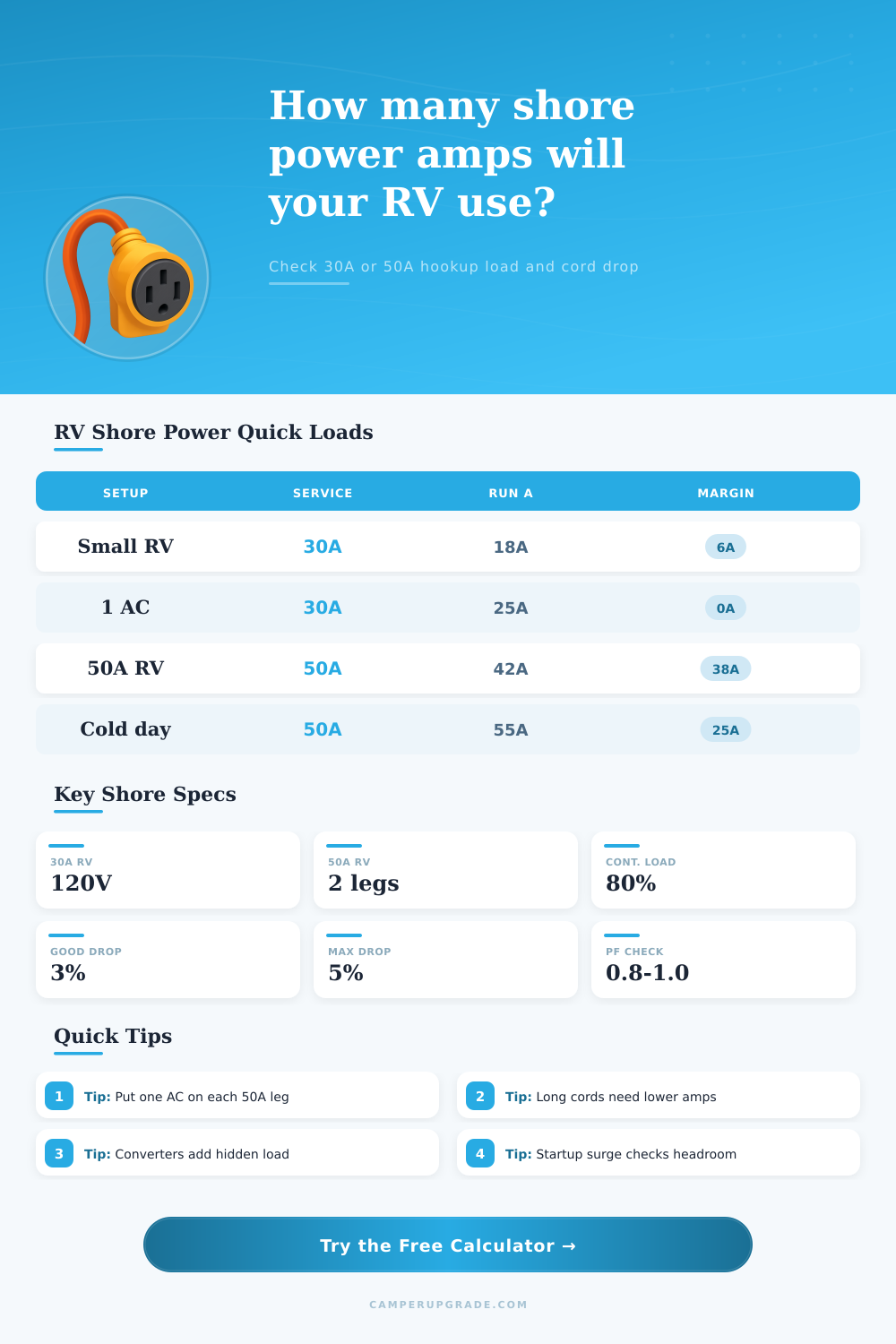
The type of electrical service that you use is also important to understand. 30 amp service use only one 120 volt power leg to supply power to all of your appliances. 50 amp services, however, have two 120 volt power legs, which can each provide power to your appliances independently.
Placing air conditioners on one 120 volt power leg could overload that power leg. Knowing on which power leg your appliances are connected is half the battle in calculating your amp load. Another thing to consider in calculating the electrical load of your RV is the continuous load rules.
Most pedestals is rated to allow for a certain number of amps. However, RV load calculation should only use 80% of that amperage if the RV is to use that power for more than a few hours. For instance, with a 30 amp pedestal, it is recommended that an RV use only 24 amps for continuous loads.
By calculating for 24 amps, you prevent the breaker from warming up or tripping when the RV is in use for long periods of time. Another problem cause by electrical loads connected to an RV pedestal is the voltage drop caused by extension cords. This voltage drop could cause various electrical issues.
For instance, if the extension cord is too long or too thin, the voltage will drop before it reaches your RVs power inlet. This could cause issues with air conditioners starting or batteries overheating. By checking the extension cord to ensure that the voltage drop is within an acceptable amount (between 3% and 5%), you can ensure that your RV’s electrical load remains within a safe amount.
Using a shorter or thicker extension cord will fix the voltage drop problem. Another important factor is the startup surge of the RV’s appliances. An RV’s air conditioner and other appliances may draw more power when they start up than while they are in operation.
This initial surge of power could potentially create a trip of the RV’s breaker. By knowing your electrical margin, you can avoid this problem by either purchasing a soft start kit for your RV’s appliances or by adjusting the time that you start those appliances. Other external factor to consider at the campground include the voltage of the pedestal, the age of the pedestal, and the weather.
The voltage may sag if many other RVs are in use at the same time. Additionally, many older pedestal setups may have loose connection that create heat when in use. The weather can impact how much power is use by your RV, as well.
For instance, electric heat strips may be one of your largest electrical load if it is a cold morning, or if the batteries in your RV are cold, the battery converter will have to work harder. It is important to calculate your electrical load before you set up to establish a baseline, but it is even more important to monitor the voltage at the pedestal while you are using your RV’s appliances. It is important to perform an RV electrical load calculation each time you plan to travel to a campground.
By entering the electrical loads of your RV into a calculator in advance, you can not only remember the total amount of amps that your RV will use, but you can also store that information on your phone. By looking at the specifications of the shore power pedestal and comparing it to your calculated electrical load, you can determine whether or not you should turn off one of your appliances. By performing these calculation in advance, you will have a better understanding of your electrical margin.
This will ensure that you do not trip a breaker or overheat any extension cords.