RV Roof Load Capacity Calculator
Estimate total roof load, local pressure in lb per sq ft, remaining roof capacity, and a safer work-zone size from roof rating, worker weight, tools, snow or water load, fixed equipment, contact area, joist spacing, safety factor, and dynamic movement.
RV roof load estimate
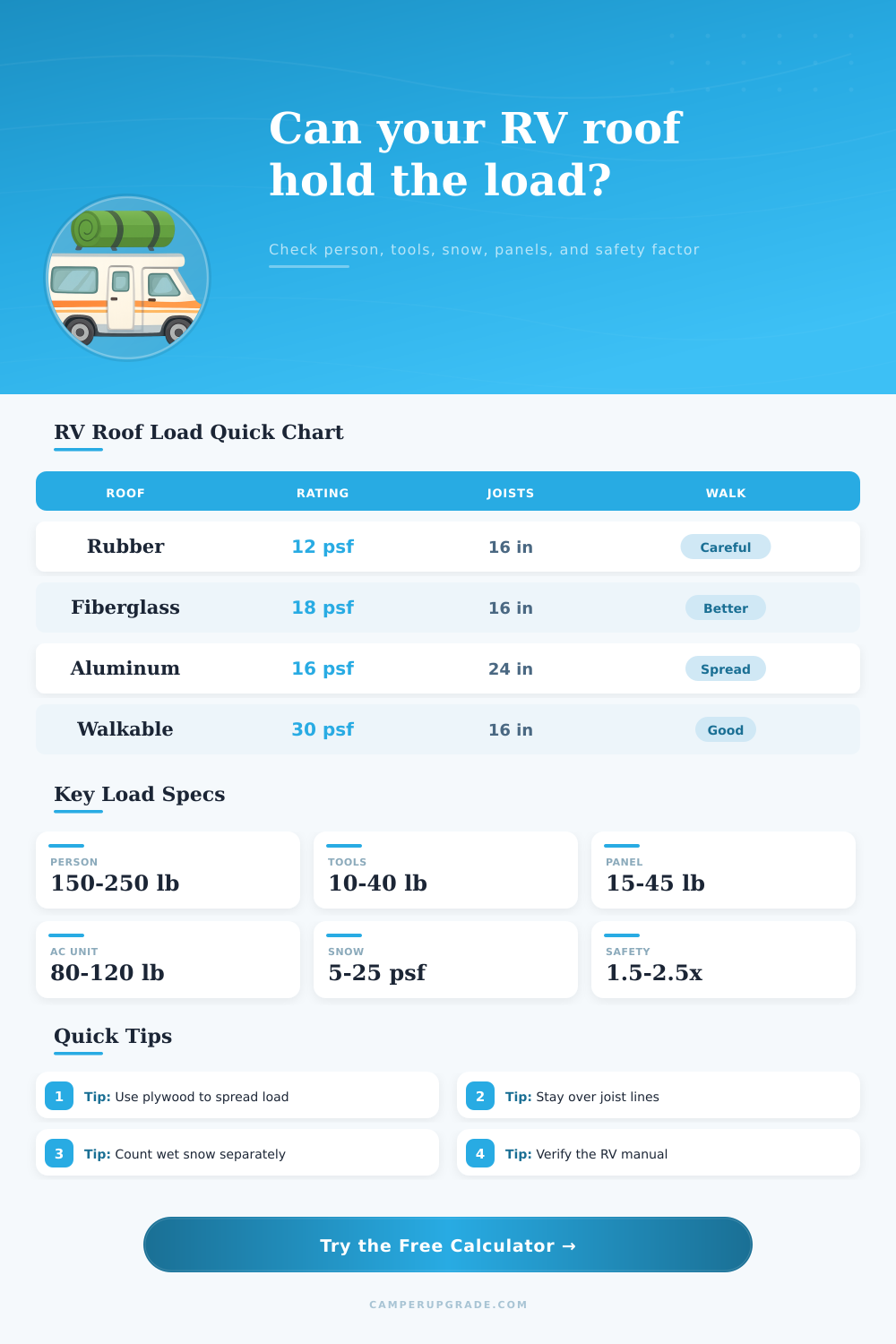
| Roof type | Planning rating | Common joist spacing | Load-spread note |
|---|---|---|---|
| Light EPDM or TPO roof over thin deck | 10-14 lb/sq ft | 16-24 in | Use crawling boards and avoid unsupported spans |
| Decked rubber membrane roof | 14-20 lb/sq ft | 16 in | Often workable for careful service when dry and supported |
| Molded fiberglass roof | 18-28 lb/sq ft | 16-24 in | Usually spreads load better, but still check soft spots |
| Aluminum trailer roof | 12-18 lb/sq ft | 16-24 in | Thin skin can dent; bridge load over ribs where possible |
| Factory walkable motorhome roof | 25-40 lb/sq ft | 16 in | Best candidate for standing work, subject to manual limits |
| Older unknown camper roof | 8-12 lb/sq ft | Unknown | Use conservative derate and inspect from a ladder first |
| Roof condition | Planning load | What it represents | Use in calculator |
|---|---|---|---|
| Dry roof | 0 lb/sq ft | No pooled water, snow, ice, or soaked debris | Use zero when the roof is clean and dry |
| Light damp debris or water film | 1-3 lb/sq ft | Wet leaves, minor standing water, damp cover residue | Use before washing or resealing |
| Light snow | 4-8 lb/sq ft | Fluffy or shallow snow, partly settled | Use before climbing to clear snow |
| Wet snow / slush | 10-20 lb/sq ft | Heavy wet snow, slush, or ice layers | Clear from a ladder when practical |
| Pooled water near sag | 5-15 lb/sq ft | Water trapped around an AC, vent, or low roof bay | Investigate drainage and roof deflection |
| Support method | Typical contact area | Dynamic multiplier | Best use |
|---|---|---|---|
| Two feet only | 0.7-1.2 sq ft | 1.20-1.50 | Avoid on non-walkable roofs unless over framing |
| Kneeling on pads | 1.5-3 sq ft | 1.00-1.20 | Better than standing for sealing and vent work |
| Foam pad plus knees and hands | 3-5 sq ft | 1.00-1.15 | Good for inspection and gentle cleaning |
| Half sheet plywood | 16 sq ft | 1.00-1.20 | Spreads weight across several joists |
| Full sheet plywood | 32 sq ft | 1.00-1.20 | Best for service work if roof shape allows it |
| Scenario | Typical added load | Pressure concern | Planning response |
|---|---|---|---|
| Sealant inspection | Person plus 5-15 lb tools | Foot or knee contact can exceed local psf | Crawl, use pads, and stay near framing |
| Solar panel installation | Person, tools, 15-45 lb panel | Temporary panel staging adds concentrated weight | Stage panel on a board or keep it off roof until placed |
| AC service | Person, 20-50 lb tools, 80-120 lb unit nearby | AC weight is often framed, worker load may not be | Work from boards around the framed opening |
| Snow clearing | Person, tool, existing snow load | Roof already carries load before worker climbs | Clear from a ladder first when possible |
| Roof washing | Person, hose, water, bucket or sprayer | Slips increase dynamic load and soft spots hide under water | Reduce water staging and use low movement |
RV roof weight capacity is a critical factor for every RV owner to consider before they step onto there RV roof. When RV owners see their RV roofs, they may feel uncertain about whether the RV roof can support a person or whether it can support another specific piece of equipment. This uncertainty commonly occur when performing a reseal or installing panels on an RV roof.
Additionally, uncertainty may arise after experiencing heavy snowfall on the RV roof. Even though an RV roof may appear strong from the ground, the roof may not be able to handle the weight of the individual stepping on the RV roof if the weight isnt distribute correctly across the RV roof. The weight capacity of an RV roof is not a permanent number.
How Much Weight Can Your RV Roof Hold
Several variables can affect the weight capacity of an RV roof. The material of the RV roof, the decking on the RV roof, and the joist spacing on the RV roof all play a critical role in determining the weight capacity of the RV roof. Additionally, the age of the RV roof also plays a vital role in the weight capacity of the RV roof.
For example, RV roofs with molded fiberglass contribute to a more even distribution of weight than thin rubber membrane material for RV roofs. Therefore, an RV roof with molded fiberglass will likely feel safer to an individual than an RV roof with a rubber membrane. The most critical variable is not the total weight placed on the RV roof.
Instead, it is the weight concentration on the RV roof at the specific point of contact between the RV roof and the individual stepping on the RV roof. The weight concentration on an RV roof that an individual creates by standing on two foot is more than an individual that kneels on a foam pad or a sheet of plywood. Additionally, the total movement that the individual makes on the RV roof will increase the weight concentration on the RV roof.
Furthermore, the placement of a tool bag or the addition of wet snow to the RV will increase the weight concentration on the RV roof. Even if the total weight on the RV roof seems safe, the weight concentration on the point of contact between the individual and the RV roof may be too much for the decking of the RV roof to handle. The calculator provided can help manage these variables.
The calculator will ask for the size of the RV roof, the contact area between the individual and the RV roof, and the level of movement that the individual will make on the RV roof while on the RV roof. The factors of snow and water on the RV roof prior to any individual stepping on the RV roof are also critical variables. Dry snow weighs very little on the RV roof.
However, wet snow will add ten to twenty pounds per square foot of snow to the RV roof. Additionally, the presence of pooled water around the air conditioner or vent of the RV will add to the total load of the RV roof. The calculator allows an individual to enter the weight of the snow on the RV roof or the weight of the pooled water on the RV roof.
The capacity remaining for the RV roof as the calculator calculates already accounts for the weight of the snow and the water on the RV roof. RV roof safety factor are used to account for any hidden variables on the RV roof. Safety factors are not utilized for RV roofs because RV roofs fail constantly.
However, safety factors are used on RV roofs to account for any hidden issues on the RV roof, such as moisture or the age of the RV roof. If an RV roof is exposed to moisture or has a soft spot in the decking material, the strength of the roof may be less than the published rating. In this situation, a safety margin of 1.8 or 2.0 can be used to allow for these unknown variable on the RV roof.
If an individual is uncertain of the condition of the RV roof, a larger safety margin should of been used. The calculator allows for an individual to account for the condition of the RV roof by using the condition derate feature of the calculator. Another critical variable that affects the weight capacity of an RV roof is the spacing of the joists on the RV roof.
The wider the spacing of the joists on an RV roof, the less weight the decking can handle. The calculator will automatically adjust for the spacing of the RV roof joists because the spacing of the joists will change the weight capacity of the RV roof. For example, an RV roof with 24-inch joist spacing can handle less weight than an RV roof where the joist spacing is 16 inches.
The calculator will provide an individual with numerical results from the calculation of the weight capacity of the RV roof. However, the calculator will not provide an individual with a pass or fail verdict for the weight capacity of the RV roof. If the results of the calculator show that there is a remaining capacity for the RV roof but with a narrow margin, then the individual should make an adjustment to the contact area with the RV roof or move to an area of the RV roof that can better handle the weight of the individual.
However, if the margin for the RV roof diminishes to zero, then the individual should not step on the RV roof. Instead, they can use a ladder or scaffolding to perform the required work. An individual can reduce the peak loads on an RV roof by changing the way they perform their job on the RV roof.
For instance, staging the roof panels on the ground will reduce the load on the RV roof. Additionally, placing tool bags on the RV roof in an even spread will reduce the load on the RV roof as compared to placing all the tool bags in one spot on the RV roof. Furthermore, making a deliberate movement on an RV roof will allow for more even distribution of the individuals weight on the RV roof.
The RV roof will not be able to distinguish between a careful plan and an impulsive plan for the work site. The tables included in the calculator will provide an individual with a reference for the numbers that are required to be entered into the calculator. These tables will allow an individual to become more familiar with the performance of the different types of RV roofs and support methods.
These tables will help an individual understand the weight capacities of the RV roof as stated in the RV owner’s manual. While not strict rule, the reference tables will allow an individual to more deeply understand the numbers that the RV roof manufacturer has published. Finally, the RV roof weight capacity calculator is a planning instrument for an RV owner.
These calculations should be run prior to any individual stepping onto the RV roof. The RV roof will not tell an individual if it will fail when the load is already placed onto the RV roof.