RV Refrigerator Size Calculator
Estimate recommended fresh-food capacity, freezer capacity, daily cold-storage capacity, and RV fridge size class from people, trip days, meals, beverage space, leftover buffer, door clearance, and power type.
RV refrigerator capacity estimate
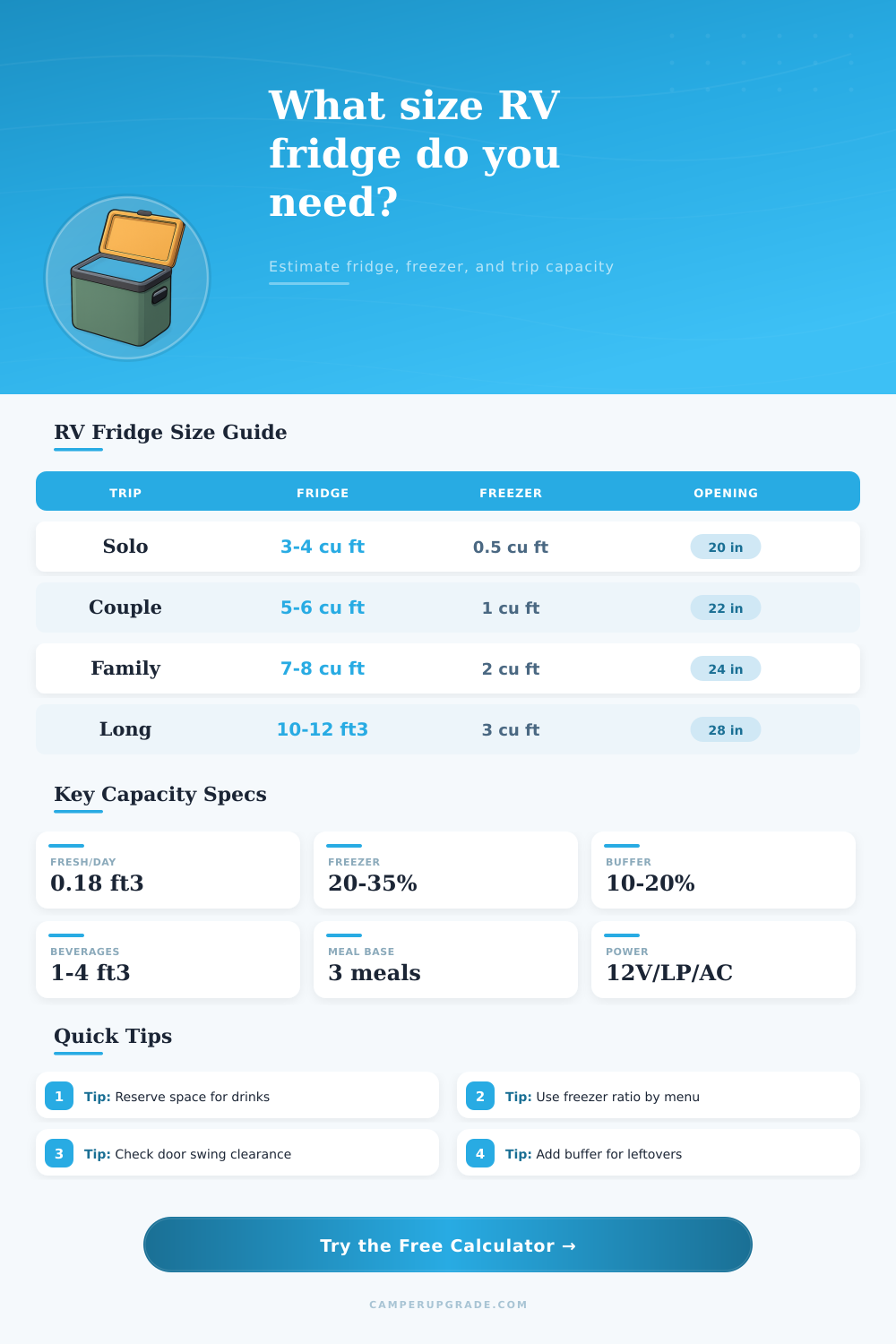
| Preset | People and days | Food profile | Likely size class |
|---|---|---|---|
| Solo weekend | 1 person, 3 days | Simple fresh meals, small freezer | Compact 3-4 cu ft |
| Couple long weekend | 2 people, 4 days | Mixed groceries and drinks | Small 5-6 cu ft |
| Class B compact | 2 people, 5 days | Careful packing, low beverage load | Small 5-6 cu ft |
| Family week | 4 people, 7 days | Full meals, produce, beverages | Large 9-10 cu ft |
| Boondock absorption | 3 people, 6 days | LP fridge with airflow headroom | Mid to large 7-10 cu ft |
| Freezer-heavy trip | 3 people, 8 days | Frozen meat and prepared meals | Large 9-12 cu ft |
| Beverage-heavy camp | 5 people, 4 days | Cold drinks use major shelf space | Large 9-10 cu ft |
| Full-timer week | 2 people, 7 days | Residential-style restock rhythm | Mid 7-8 cu ft |
| Hot-weather family | 4 people, 6 days | Extra drinks and leftover buffer | Large 10-12 cu ft |
| Food planning style | Fresh cu ft/person/day | Meal pattern | Use when |
|---|---|---|---|
| Minimal cooler-style packing | 0.08-0.12 | One chilled meal plus snacks | Dry pantry meals or daily restock |
| Light RV meals | 0.12-0.16 | Two chilled meals | Short trips with compact packaging |
| Balanced groceries | 0.16-0.22 | Three regular meals | Typical RV menu with produce |
| Bulkier fresh menu | 0.22-0.30 | Full meals and larger containers | Families, salads, milk, and leftovers |
| High-volume fresh food | 0.30-0.40 | Large produce or prepared trays | Group camping or long remote stops |
| Freezer ratio | Freezer pattern | Typical contents | Planning note |
|---|---|---|---|
| 0-10% | Mostly fresh food | Ice packs or small treats | Works for daily grocery access |
| 15-25% | Balanced RV use | Meat, vegetables, ice cream, leftovers | Good default for mixed menus |
| 30-40% | Freezer-forward trip | Prepared meals and frozen proteins | Useful for longer boondocking |
| 45-60% | Heavy frozen storage | Meat, fish, frozen batch meals | Consider a dual-zone or chest freezer |
| 60%+ | Specialized frozen load | Bulk frozen food or harvest storage | Separate freezer may fit better |
| Power type | Capacity factor | Best use | Sizing note |
|---|---|---|---|
| 12V compressor | 1.00x | Solar and battery travel | Good usable shelf capacity |
| 12V dual-zone compressor | 1.02x | Separate fridge and freezer zones | Useful when freezer ratio is high |
| Residential AC refrigerator | 1.03x | Shore power and inverter rigs | Large doors need route clearance |
| 2-way absorption LP / AC | 1.08x | Propane camping and shore power | Leave airflow room on shelves |
| 3-way absorption LP / AC / DC | 1.10x | Classic RV systems | Extra headroom helps temperature recovery |
| Size class | Total cold capacity | Typical clear opening | Common RV fit |
|---|---|---|---|
| Compact | 2.5-4.5 cu ft | 18-20 in | Teardrops, truck campers, vans |
| Small RV | 4.6-6.5 cu ft | 21-22 in | Class B, small trailers, weekend rigs |
| Mid RV | 6.6-8.5 cu ft | 23-24 in | Couples and small families |
| Large RV | 8.6-10.5 cu ft | 25-26 in | Family trailers and fifth wheels |
| Residential style | 10.6-14.0 cu ft | 27-30 in | Large RVs with inverter support |
| Split cold storage | 14.0+ cu ft | Measure each unit | Fridge plus separate freezer or cooler |
Choosing the right size for an RV refrigerator require you to consider the cooking and eating requirement of the individual traveler. For instance, a person who is traveling for the weekend only needs a refrigerator that can hold a small amount of milk, meal, and drinks. However, a family of four on a week-long trip requires a refrigerator that have the capacity to hold more produce, meals, and drink.
A refrigerator that is too small for an individuals cooking and eating requirements will be difficult to packing and will interfere with the preparation of dinner. Another factor to consider when determining refrigerator size are the number of meals that the individual will eat during the trip. Most people dont consider that the three meal per person calculation does not account for the additional space that is required for fresh food and milk.
How to Choose the Right RV Refrigerator Size
Using a capacity calculator will allow the individual to account for these variable. The number of meals can be adjusted for instances in which an individual plan to eat at restaurants during the trip. An additional variable to consider is the amount of beverage that will be consumed during the trip.
An individual might require only a small amount of space for beverages, but a group of individual will need more space to accommodate their drinking needs on a warm trip. It is important to consider the requirement for beverages as a separate category different than the food requirement. The space for beverages will not be available for fresh food if you dont account for it in the purchase of the refrigerator.
Another factor to consider is the ratio of the freezer space to the refrigerator space. Individuals who will be traveling with a large amount of frozen food will need a refrigerator that contain a large amount of freezer space. An individual who plans to carry only ice packs, however, will need a refrigerator with a much smaller amount of freezer space.
The refrigerator capacity calculator can account for this variable. The last factor to consider is the type of cooling system that the refrigerator will use. Absorption refrigerators require more clearly space to allow air to cool the refrigerators units.
Absorption refrigerators also take longer to cool if the refrigerator door is opened. Compressor refrigerators are more forgiving of the type of food that is placed in the refrigerator but will benefit from the same refrigerator estimation calculator. Refrigerator capacity calculators often account for cooling system type.
It is also important to measure the clearance that will be available for the refrigerator. The clearance for an RV refrigerator is the path that the refrigerator will need to take to the designated spot in the recreational vehicle. The path through the doors and through the aisles need to be measured, as some areas might be more small than others.
If you dont measure the correct clearance prior to purchase of the refrigerator, it is possible that the refrigerator will be too large for the RV and difficult to return. The condition in which the refrigerator will be used might not be the same as the specifications sheet for the refrigerator. When first purchasing a refrigerator, individuals might want to include a buffer for additional space for half-used jar, additional sodas, and other food that might accumulate during the trip.
This buffer for extra space is a necessity to account for the imperfections of food packaging. An individual might have to decide between buying one large refrigerator versus two smaller refrigerators, such as a refrigerator and a separate freezer. If an individual has high demands of food and beverage, it might be easier to buy two smaller unit of refrigerators.
The capacity calculator will provide a total capacity number that can be used to compare refrigerator option. The purpose of determining refrigerator size is to avoid two problems. The first problem that should of been avoided is running out of space for meals during the trip, which would force emergency grocery trip.
The second problem is to avoid having to carry a refrigerator that is too large for the individuals need. It is recommended that the capacity refrigerator calculator is run with the actual variable of the individuals trip. The recommended capacity and clearance of the refrigerator should be reviewed.
If the clearance is tight, the dimension of the RV need to be measured again. If the refrigerator capacity requirement is higher than the individuals need, the beverage allowance in the refrigerator calculator can be reduced. By ensuring that the refrigerator has enough space for meals, enough space for drinks, and enough space for other necessary item, the refrigerator will function as an effective piece of cooking and eating equipment during the individuals trip.