RV Payload Capacity Calculator
Compare GVWR, curb or UVW, water, propane, passengers, hitch load, cargo, and reserve to estimate remaining payload before travel.
| Fluid or Item | Weight Factor | Common Load | Payload Impact |
|---|---|---|---|
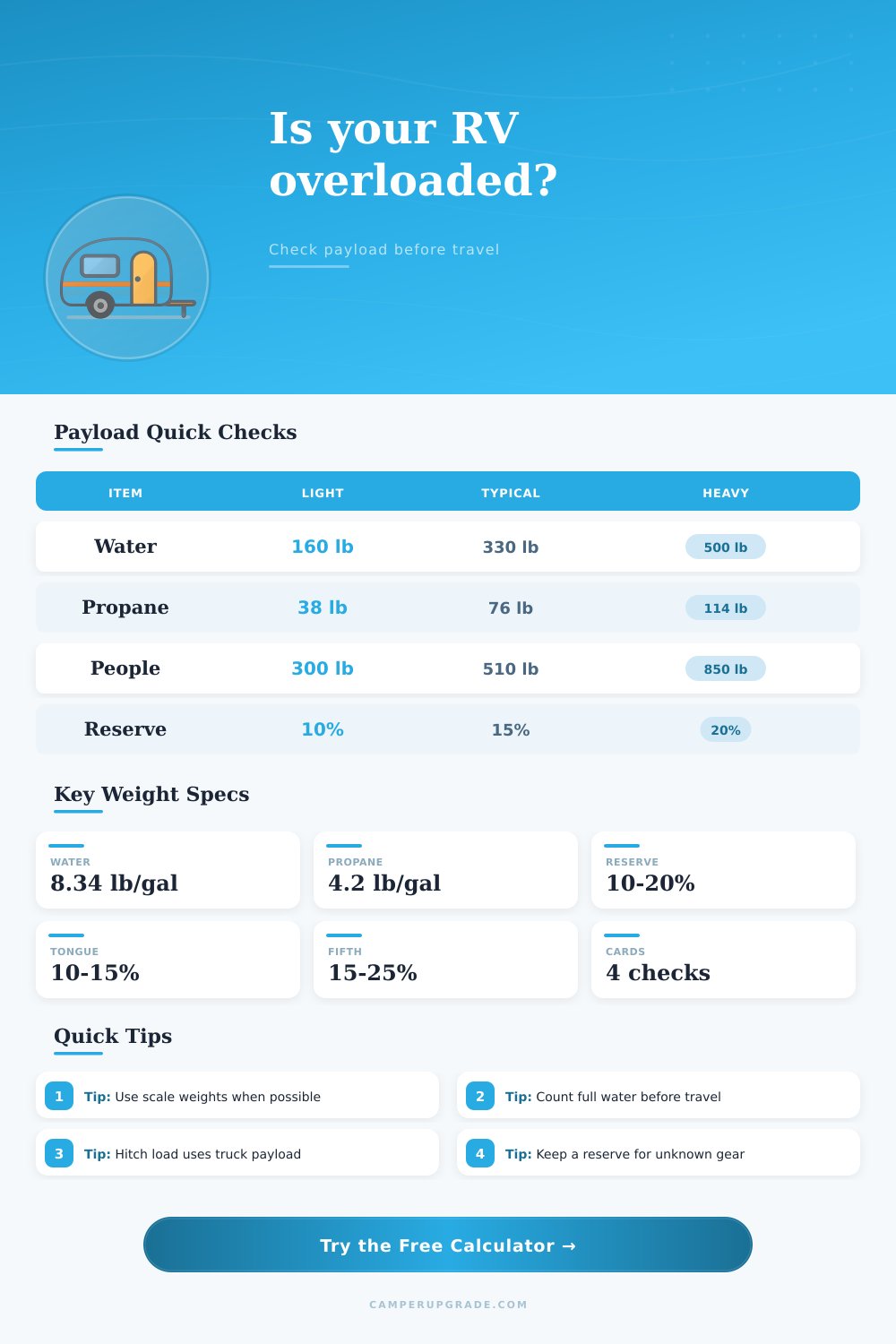
| Fresh water | 8.34 lb per gal | 20 to 60 gal | 167 to 500 lb |
| Propane | 4.2 lb per gal | 4.7 to 14.1 gal | 20 to 59 lb |
| Gasoline | 6.1 lb per gal | 20 to 55 gal | 122 to 336 lb |
| Diesel fuel | 7.1 lb per gal | 25 to 100 gal | 178 to 710 lb |
| RV Type | Typical GVWR Range | Typical Payload Range | Watch Closely |
|---|---|---|---|
| Class B van | 8,550 to 11,030 lb | 900 to 2,000 lb | Water, bikes, batteries |
| Class C motorhome | 12,500 to 14,500 lb | 1,200 to 3,000 lb | Rear axle and passengers |
| Travel trailer | 3,500 to 10,000 lb | 800 to 2,500 lb | Cargo and tongue weight |
| Fifth wheel | 12,000 to 20,000 lb | 2,000 to 4,500 lb | Pin weight and truck payload |
| Hitch Type | Usual Loaded Share | Example Trailer | Truck Payload Used |
|---|---|---|---|
| Travel trailer tongue | 10% to 15% | 7,000 lb | 700 to 1,050 lb |
| Fifth wheel pin | 15% to 25% | 14,000 lb | 2,100 to 3,500 lb |
| Weight distributing hitch | Hardware still counts | 90 lb hitch | Add full hitch weight |
| Truck camper tie-downs | Installed gear counts | 100 lb hardware | Add full hardware weight |
| Reserve Target | Meaning | Use When | Example on 10,000 lb GVWR |
|---|---|---|---|
| 0% | No planned cushion | Scale-confirmed short move | 0 lb held back |
| 5% | Small cushion | Known light packing | 500 lb held back |
| 10% | Practical cushion | Normal RV travel | 1,000 lb held back |
| 15% to 20% | Larger cushion | Boondocking, toys, upgrades | 1,500 to 2,000 lb held back |
Payload capacity determine the amount of weight that an RV can carry. Payload capacity is the difference between the maximum weight that the RV is rated to carry and the weight of the RV before any item are added to the RV. The payload capacity is state on a sticker near the driver’s door or on the trailer tongue.
This rating state the maximum load that the RV’s frame, suspension, and tires can support. If the total weight of the items in the RV exceed this weight, the RV can be damage or lose control while driving. Many items will reduce the payload capacity.
What Is RV Payload Capacity
Items like water are heavy and stored in tanks that is visible from the outside of the RV. A full water tank can add hundreds of pound to the RV. That same weight take from the payload capacity of the RV.
Propane also reduce the payload capacity but weigh less than water. Since propane are a liquid, the weight of the propane must also be account for. Another group of items that can reduce the payload capacity is passengers.
The weights of the passengers will be more than what is show in the RV brochures. The weight of passengers can be subtract from the payload capacity. The weight of cargo also reduce payload capacity.
Items like generators and batteries can add to the total weight. Items in the basement or on the roof also reduce payload capacity. Any cargo add to the weight of the RV.
Finally, when towing an RV, the weight of the trailer also affect the tow vehicle’s payload capacity. The weight of the trailer tongue or fifth wheel pin is subtract from the payload capacity of the tow vehicle. Thus, the weight of the trailer reduce the payload capacity of the towing truck.
Many trailer owners focus on the weight of the trailer. However, the weight of the trailer do affect the truck. The truck is carrying the hitch hardware, the fuel, and the driver.
Thus, the weight of the trailer and the supplies on the truck reduce the payload capacity of the truck. Use the real weight from the scale to determine the payload capacity of the trailer. The sticker on the trailer will provide a starting point for the payload capacity.
However, the sticker will not factor in the weight of the aftermarket items that you may have add to the RV. Use a public scale or an CAT scale to determine the actual weight of the trailer on each axle. Knowing the weight on each axle will allow you to see if any axle are overloaded.
This information is important to know to ensure that the RV remain in good working condition. Leave some room for safety. A safety reserve allow the RV to remain within the payload capacity.
For instance, you can leave ten percent of the payload capacity unweight for safety. This reserve provide some weight to account for any items that you may have forget to include in the payload. Additionally, if you plan to boondock, this will provide some weight for the extra fuel and water that you will need for camping.
People often make mistake when determining the payload capacity. For instance, many people will add solar panels, bike racks, and other boxes for storage. However, most people will not recheck the payload sticker for these item.
Weigh the RV at the beginning of the season when the trailer is loaded with typical item. Knowing the weight of the RV at the beginning of the season allow for the user to make decision about the water levels and where to place the cargo on the RV. Proper management of the payload will ensure that the suspension, the brakes, and the tires remain in good working order.