RV Park Sewer Line Slope Calculator
Calculate sewer pipe fall, target outlet elevation, cleanout count, fixture/site load, and estimated trench depth for RV park laterals and mains.
Calculated sewer line layout
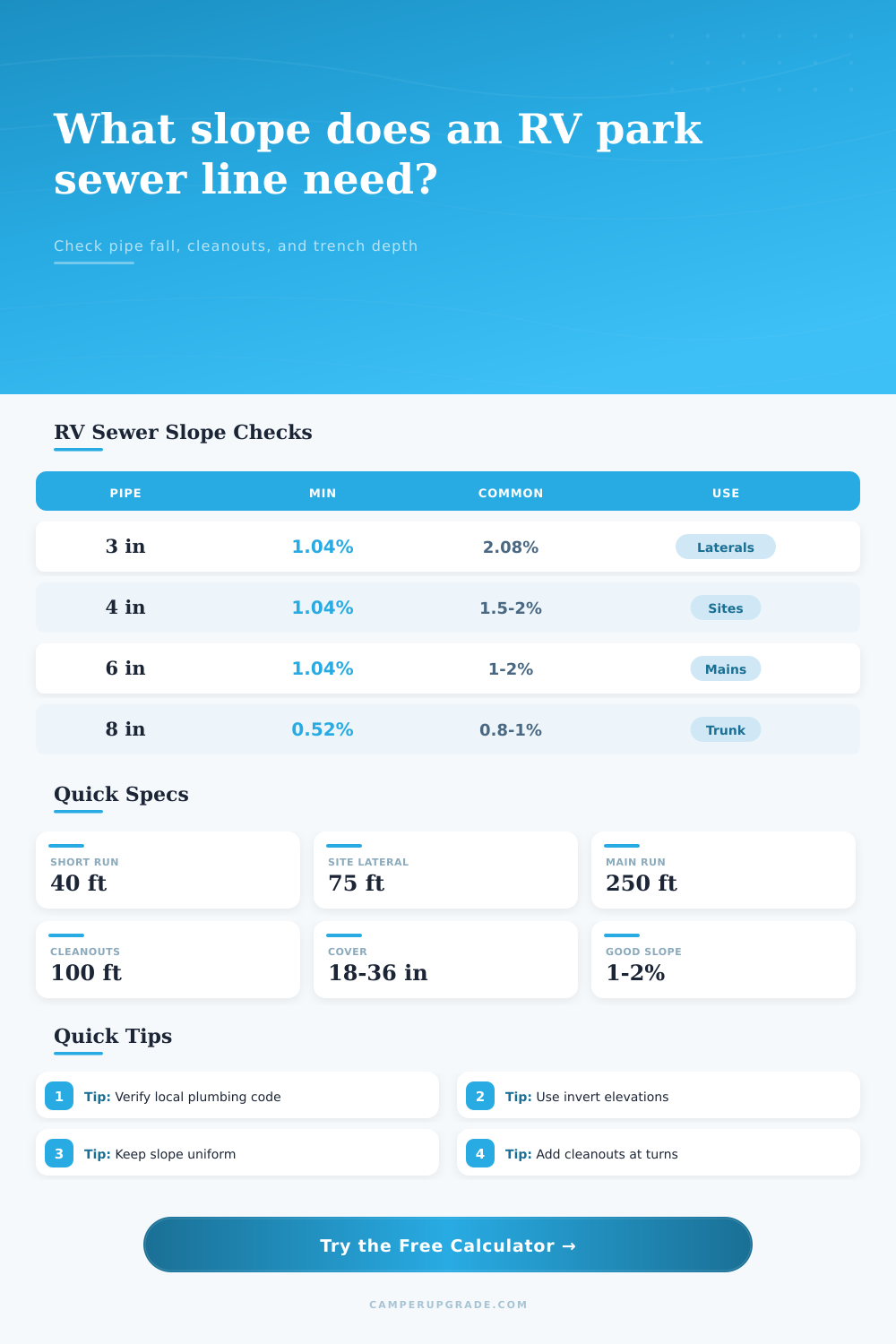
| Slope target | Fall per foot | Fall per 100 ft | Best use |
|---|---|---|---|
| 0.52% | 1/16 in | 6.25 in | Large trunk pipe only where allowed |
| 1.04% | 1/8 in | 12.5 in | 3-6 in pipe minimum in many IPC layouts |
| 1.50% | 0.18 in | 18 in | Long RV park mains with more grade |
| 2.08% | 1/4 in | 25 in | Conservative laterals and short branches |
| 4.00% | 0.48 in | 48 in | Steep short tie-in that needs review |
| Diameter | Minimum slope reference | Typical RV park use | Layout note |
|---|---|---|---|
| 3 in | 1/8 to 1/4 in per ft | Single site or short lateral | Many designers still use 2% for solids movement |
| 4 in | 1/8 in per ft | Site branch or small row | Check fixture unit loading and local amendments |
| 6 in | 1/8 in per ft | Small park main | Often paired with manholes or accessible cleanouts |
| 8 in | 1/16 in per ft | Main trunk or municipal lead | Usually needs engineered hydraulic review |
| Layout condition | Planning spacing | Add access at | Calculator use |
|---|---|---|---|
| Short site lateral | 50 ft | Termination and direction changes | Use closer spacing for shallow service laterals |
| Standard branch | 75-100 ft | Base of risers and long sweeps | Default calculator setting is 100 ft |
| Long park main | 100 ft | Each major bend or junction | Round up by run length, then add bends |
| Lift station lead | By design | Valves, wet well, and transition points | Use calculator only for gravity portions |
| Layout | Pipe length | Target slope | Target fall |
|---|---|---|---|
| Single RV site lateral | 40 ft | 2.08% | 10 in |
| Four-site branch | 90 ft | 2.00% | 21.6 in |
| Ten-site row main | 220 ft | 1.50% | 39.6 in |
| Shallow retrofit run | 75 ft | 1.04% | 9.4 in |
| Large trunk line | 400 ft | 0.80% | 38.4 in |
There you are, standing on a gravel parking spot, laser level in one hand, a roll of plans in another. Will my sewer line actualy drain? That’s a question only gravity-fed plumbing has. And yes, sometimes inches (and even fractions) make all the difference. Is this line sloped enough so it works…or too little slope and the whole park shut down for the season due to backups?
Why does waste flow out of campground? It is because of the slope of the RV park sewer line. And when done correctly, the pipe self-cleans. But do it incorrectly and the solids settle out and clog up the line, clogged lines cause expensive headaches. And that is where people make mistakes.
How to Design RV Park Sewer Lines
When you plug your invert elevations into the calculator (above) it will do the math for you, no need to guess at conversions or coefficients. While you’re hitting buttons, you may be wondering: What do these numbers mean?
A two percent slope is the goal most designers shoot for, which equates to approximately one-quarter inch of fall for each foot of pipe. That’s a sweet spot where gravity flow work. There’s just enough velocity to move solids through. But the slope isn’t so steep that water rushes past waste. When water rushes past waste, the pipes goes dry. Dry pipes are prone to deterioration and odor issues.
That steeper pitch can be forgiving if you’re laying down a short lateral to a single site. But if that same slope would of take you digging a trench deeper than allowed by the frost line on your foundation, you’ve got a problem.
The key entry here is the invert elevation. It is not the outside ground surface. It is not the inside crown of the pipe. The invert are the inside bottom of the pipe. It is the very surface that wastewater will contact. Measuring slope by ground surface around the pipe or by the top of the pipe is lying to yourself about what the actual flow path is going to be. The geometry inside change with pipe fittings and couplings and even minimal differences in pipe diameters. Entering the inlet and outlet invert elevations into the tool defines the actual hydraulic path. From there, the calculator informs you whether your actual grade is at least as great as the minimum required for the pipe diameter you chose. An eight-inch trunk line require a different minimum than a four-inch pipe, for example.
That said, using a larger pipe isn’t necessarily going to allow a lesser slope. But it will change the flow speed and capacity.
The other ignored variable is spacing for cleanout. The tool offers spacing suggestions based off linear distance to help you decide where to place your cleanouts. The tool offers spacing suggestion.
Think also about access: Every time there’s a hard turn of more than forty-five degrees, or a run underneath a paved surface that will never be reopened again, it’s time for a cleanout. If there’s a long run of pipe horizontally and then it makes three quick sharp bends, that’s a nightmare when it come time to snake it. Cleanouts cost up front, but save huge amounts of labor down the road.
That’s laid out nicely in the reference table on the page. It shows that although you may be able to go one-hundred feet between cleanout on a main line, you want closer access points for easier maintenance.
Trench depth is the silent killer of schedule and budget. When we say that your trench depth will be more than your frost line, you aren’t digging a hole; you’re probably purchasing a sump pump system, insulation, or heat tape. The calculator consider average trench depth using your ground elevations. That means you get a heads up before you swing that first shovel. Knowing that you’ll require additional cover now is better than knowing when the backhoe’s already half a foot in.
So how do you design a sewer line in an RV park? Ultimately, with gravity, geometry, and access.
How much slope do I need? You need enough slope to get the water flowing.
How big of a pipe should I use? Use a pipe big enough not to clog up.
Where are my cleanouts located? They should be placed to ensure serviceability and access. They should be somewhere accessible but not necessarily easy.
Tweak the numbers and make the math work. Don’t let the ground fool you. Check your invert elevations. Don’t mess around on minimum slopes based off pipe size. Design for someone having to clean that pipe through a cleanout one day.
If the water flows easily and the solids follow along, then you did it right. Mostly, you just have to understand what you’re really measuring. Make sure your design follows the basic physics of falling water.