RV Paint Coverage Calculator
Estimate exterior paint, primer, clear coat, and rounding needs from RV surface dimensions, coat counts, coverage rates, openings, texture, and overspray waste.
| Product Layer | Typical Coverage | Best Use | Calculator Note |
|---|---|---|---|
| Epoxy primer | 180-240 sq ft/gal | Bare metal, fiberglass repair | Use 220 for mixed prep |
| High-build primer | 225-275 sq ft/gal | Blocked, sanded RV panels | Use 250 when uncertain |
| Single-stage paint | 275-350 sq ft/gal | Older trailers and utility shells | Count color coats only |
| Basecoat color | 300-400 sq ft/gal | Base/clear refinishing | Lower for color changes |
| Urethane clear | 400-500 sq ft/gal | Gloss and UV protection | Usually 2 wet coats |
| Elastomeric roof coating | 75-125 sq ft/gal | RV roof membranes and seams | Use only for roof percent |
| Project | Painted Area | Base Paint at 320 sq ft/gal | With 15% Buffer |
|---|---|---|---|
| Class B van sides | 230 sq ft | 1.44 gal | 1.66 gal |
| Truck camper shell | 310 sq ft | 1.94 gal | 2.23 gal |
| 18 ft trailer exterior | 440 sq ft | 2.75 gal | 3.16 gal |
| 25 ft trailer exterior | 620 sq ft | 3.88 gal | 4.46 gal |
| 30 ft fifth-wheel exterior | 820 sq ft | 5.13 gal | 5.90 gal |
| 36 ft Class A exterior | 1080 sq ft | 6.75 gal | 7.76 gal |
| System | Primer Coats | Color Coats | Clear Coats |
|---|---|---|---|
| Spot repair blend | 0-1 | 2 | 2 |
| Same-color refresh | 0-1 | 2 | 0-2 |
| Color change | 1-2 | 2-3 | 2 |
| Oxidized fiberglass | 1 | 2 | 2 |
| Roof coating | 0 | 2 | 0 |
| Accent stripes | 0-1 | 2 | 1-2 |
| Condition | Factor | Why It Matters | Rounding Rule |
|---|---|---|---|
| Smooth gelcoat | 1.00x | Best coverage | Round to quart |
| Light sanding | 1.08x | Extra tooth | Round to quart |
| Oxidized fiberglass | 1.15x | Soaks primer | Round upward |
| Chalky siding | 1.22x | Uneven absorption | Add buffer |
| Textured roof | 1.30x | More film build | Round to gallon |
When most people think of refinishing their RVs they grab a paint brush and begin to paint over the dingy looking fiberglass. Unfortunately, it doesn’t always work that way. A new coat of paint isn’t necessarily the issue with refinishing a travel trailer or motorhome. It is more like the rate of coverage on products compared to the amount of surface area.
Underestimate? You will run out of product before you know it! Out of product before you know it! Did you underestimate? Don’t forget to account for waste when spraying. That’s a recipe for having to re-buy product. You then have to hope your new material is the same as the old material.
How to Calculate How Much Paint You Need for Your RV
This page contains an RV paint coverage calculator. It addresses the math (algebra) for you while you handle the prep work (geometry).
The problem: An RV isn’t just a flat wall. It has rounded caps. It has complex trim. It also has different textured surfaces. Some will hold paint well because they’re smooth gelcoat. Others (oxidized fiberglass) soak up primer like a sponge. This reduce your effective spread rate. So the tool adjusts for this too. You can input the surface condition. If you choose chalky or oxidized siding, the system uses a multiplier to reflect the fact that porous surfaces requires more. This helps you get a good film build. This small adjustment prevents thin final coats.
Secondly, consider what you’re not painting, things like large windows and roof vents reduce your overall wet area. Door openings into storage areas also count. Your exterior square footage doesn’t equal just length x height. Enter those openings specifically so that the calculator reduces your estimate.
Why? Buying a bit too much paint isn’t as bad as running out of it mid-job. Leftover urethane can always be stored for touch-ups later. Running short stops everything in its tracks. Make sure your window dimensions are accurate before you enter them.
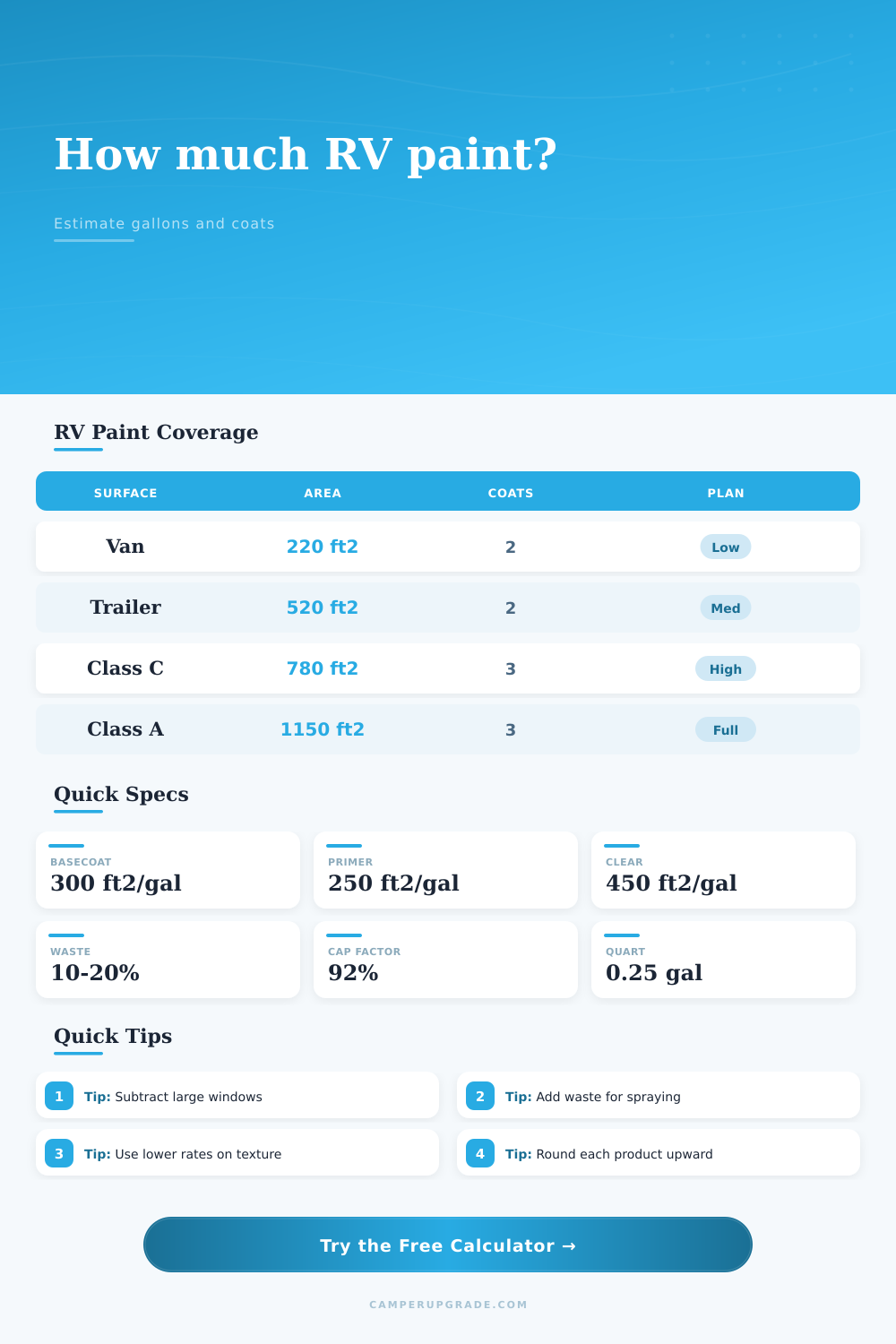
The distinction between primer, basecoat, and clear coat is where most estimates fail. What few people realize is that the amount they cover varies by product. Primers tend to be thick and don’t cover as much (about two hundred and fifty square feet). Clear coats tend to be thin and thus stretch further (sometimes covering up to four hundred and fifty square feet).
This calculator breaks those down. For example, you may only need a gallon of clear for the same surface area you’d want two gallons of primer. Without accounting for this, you’re going to end up with half full cans of clear and left over primer. The calculator will help you figure out exactly how many of each product you’ll need to order. It does this based off the coat system you’re working with.
There’s also a variable with overspray loss when applying with a sprayer. That’s where some of your product doesn’t actually go onto the surface, it floats off into space. Some will land on your masked parts. How much? That depends on your skill level and how hard the job is. Overspray loss can be anywhere between ten percent to twenty percent. The calculator has an option to add in a buffer for loss.
If it’s just basic side panels, maybe a ten percent buffer would do it. If there are complex trim jobs and rounded front caps, then bump it up to fifteen or twenty percent. It is better to have too much than not enough at the back bumper.
Measure up before you spend one quart. How long, wide and tall is your rig? If applying a specialty product, how much does the manufacturer specify as normal coverage rate? Standard benchmarks are found in the reference tables on the page. They explain the price difference between products. For example, high-build primer coats fewer square feet but hides bumps and divots more effective than a standard coat. It’s a tradeoff: quantity vs. Quality.
Plug it into the calculator to experiment with various scenarios. Run the numbers through both a 3-coat system and a 2-coat system. Watch the total gallons change, you’ll have a sense of what the investment will be.
Painting an RV takes both money and time. The math frees you from worrying about being short on materials. It turns what could be a crazy project into doable steps. Prep, then take measurements for the actual surfaces. Shop based off the math. A great paint job starts well before that first spray-gun stroke.