Inverter Size Calculator
Estimate inverter continuous rating, surge headroom, DC current, fuse size, and cable gauge from real RV/off-grid load assumptions.
⚡Quick Scenario Presets
⚙Inverter and DC Bus Inputs
📋Planning Summary Cards
| Appliance Type | Typical Run Watts | Startup Multiplier | Sizing Note |
|---|---|---|---|
| Compressor fridge | 60-180 W | 2.0x to 3.0x | Use real startup if available |
| Roof A/C with soft-start | 1200-1800 W | 1.8x to 2.3x | Soft-start reduces peak surge |
| Roof A/C without soft-start | 1200-1800 W | 3.0x to 5.0x | Often forces oversized inverter |
| Microwave oven | 1000-1500 W | 1.2x to 1.5x | Short duty, high AC draw |
| Induction cooktop | 900-1800 W | 1.1x to 1.3x | Low surge but high steady load |
| Power tools (corded) | 600-1800 W | 2.0x to 3.5x | Motor tools vary by material load |
| Compressor freezer | 100-260 W | 2.5x to 3.8x | Cold starts are harder |
| Water pump | 120-500 W | 2.0x to 3.0x | Pressure spike on start |
| Inverter Class | 12V @ 90% | 24V @ 90% | 48V @ 90% |
|---|---|---|---|
| 600 W | 56 A | 28 A | 14 A |
| 800 W | 74 A | 37 A | 19 A |
| 1000 W | 93 A | 46 A | 23 A |
| 1200 W | 111 A | 56 A | 28 A |
| 1500 W | 139 A | 69 A | 35 A |
| 2000 W | 185 A | 93 A | 46 A |
| 3000 W | 278 A | 139 A | 69 A |
| 4000 W | 370 A | 185 A | 93 A |
| 5000 W | 463 A | 231 A | 116 A |
| 6000 W | 556 A | 278 A | 139 A |
| Copper Cable | Practical Amp Range | Ohms / 1000 ft | Use Case |
|---|---|---|---|
| 8 AWG | Up to 80 A | 0.6282 | Small 12V inverter circuits |
| 6 AWG | Up to 120 A | 0.3951 | 1000W class at short runs |
| 4 AWG | Up to 160 A | 0.2485 | 1500W class and low drop |
| 2 AWG | Up to 210 A | 0.1563 | 2000W 12V systems |
| 1/0 AWG | Up to 260 A | 0.0983 | 3000W 12V short run |
| 2/0 AWG | Up to 300 A | 0.0779 | High-current 12V trunks |
| 3/0 AWG | Up to 330 A | 0.0618 | Low-drop main bus links |
| 4/0 AWG | Up to 380 A | 0.0490 | Large inverters and combiner |
An inverter take the DC power from the battery and transforms it into an alternating current that can power the appliance. Inverters must be sized correct to handle the load of the appliances but also any power surge that may occur. Many people will try to calculate the wattage of the appliances and add up all of the wattage label on the appliances, however, this is incorrect as many appliance dont show their wattage for when they start up.
Many appliances use a startup surge that is much higher then the watts that is required for the appliance to run. For instance, many refrigerators requires 100 watts to continuously run, but when they start up they may require 300 watts of power. If the inverter is too small relative to the starting wattage of these appliances, then the inverter will flicker or shut off.
How to Choose the Right Inverter for Your RV or Van
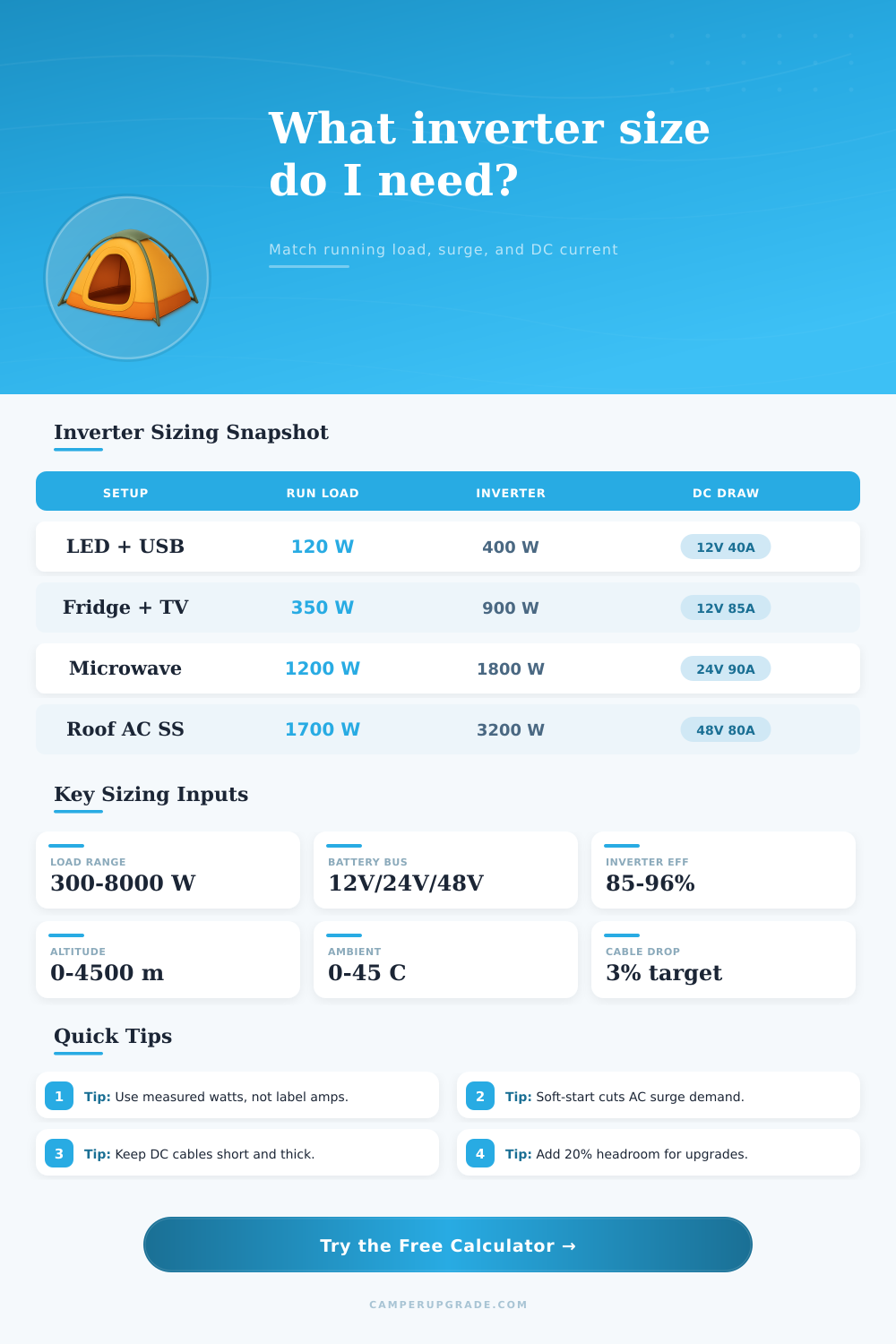
In considering the sizing of the inverter, the surge capacity of the inverter is often more important than the inverters continuous capacity. Many people may calculate how much power the appliances uses simultaneously. Not all of the appliances will be used at the same time in an RV or van, so it is not necessary to size the inverter to handle all of the appliance in the RV or van.
However, it is always a good idea to allow for the possibility of adding more appliances to the RV or van. Additionally, the inverter will lose power output if the temperature in the area rise above 25 degrees Celsius. Additionally, the inverter will also lose efficiency if the RV or van is at high altitude above sea level due to the thinner air.
Another factor that may affect the performance of the RV or van inverter is the cable that are connected to the inverter. If the cables are too long or thin, there may be a voltage drop in the system that cause the inverter to malfunction. If there is a voltage drop of more than 3 percent, the inverter will likely malfunction.
Using short and thick cables will help to avoid any voltage drop in the system. Thick cables will provide more efficient power to the inverter. Additionally, another factor in selecting an inverter is the type of power wave that the inverter will produce.
Inverters can produce either a pure sine wave or a modified sine wave. Using a pure sine wave inverter will be better for powering sensitive electronic like laptops. Using a modified sine wave inverter will allow the appliances to run, but may cause the motors within those appliances to run hotter and less efficient than using a pure sine wave inverter.
The inverters electrical system will also have to be designed to handle high amperage within the system. High amperage require high fuses and batteries. For instance, a 2000 watt inverter will draw 185 amps from a 12 volt battery if it is 90 percent efficient.
Since amperage is so high for an inverter of this size, you must use a fuse that can handle 125 percent of the amperage of the inverter. Additionally, you should use a Class T fuse since it has fast-blow protection. Another factor that will impact the inverter and the amperage is the type of battery.
For instance, using a lithium battery like a LiFePO4 battery will allow the battery to be drained to 90 percent of its capacity; however, a lead-acid battery will have a shallower limit for how much the battery can be drained. In order to ensure that the inverter function as it should, there are some step that should be taken to ensure proper installation and maintenance of the inverter. First, you should mount the inverter in a location where there is good airflow around the inverter to avoid overheating of the inverter.
Additionally, the inverter should be properly grounded to avoid the risk of electrical shock. Another step that should be taken is to test the inverter while it is under a load prior to the trip that is to be taken with the RV or van. Testing under the load will reveal any issue with the installation of the inverter that the calculations did not reveal.
Finally, another recommendation is to overbuild the system by 20 percent to provide some headroom for any power demand beyond those of the appliances that will be used and to allow the inverter to run more quiet.