RV Gray Tank Fill Time Calculator
Estimate when an RV gray tank will reach a warning level and when it will be full using tank size, current fill, showers, dishwashing, sink flow, use window, conservation, and reserve.
📌Gray Tank Fill Time Presets
⚙Tank, Fixture, and Use Inputs
Gray tank fill time estimate
📊Gray Tank Spec Grid
📘Gray Tank Fill Reference Tables
Fixture Flow Planning
| Fixture | Low Flow | Typical Flow | Fill-Time Impact |
|---|---|---|---|
| RV shower head | 1.0 gpm | 1.5-1.8 gpm | Highest short burst use |
| Bathroom faucet | 0.4 gpm | 0.7-1.0 gpm | Many small events add up |
| Kitchen faucet | 0.6 gpm | 0.9-1.5 gpm | Rinsing can dominate |
| Dish basin | 1 gal/session | 2-4 gal/session | Depends on rinse habits |
| Outdoor rinse | 0 gal gray | varies | Count only if routed to tank |
Tank Size Fill Examples
| Tank Size | 10 Gal/Day | 18 Gal/Day | 28 Gal/Day |
|---|---|---|---|
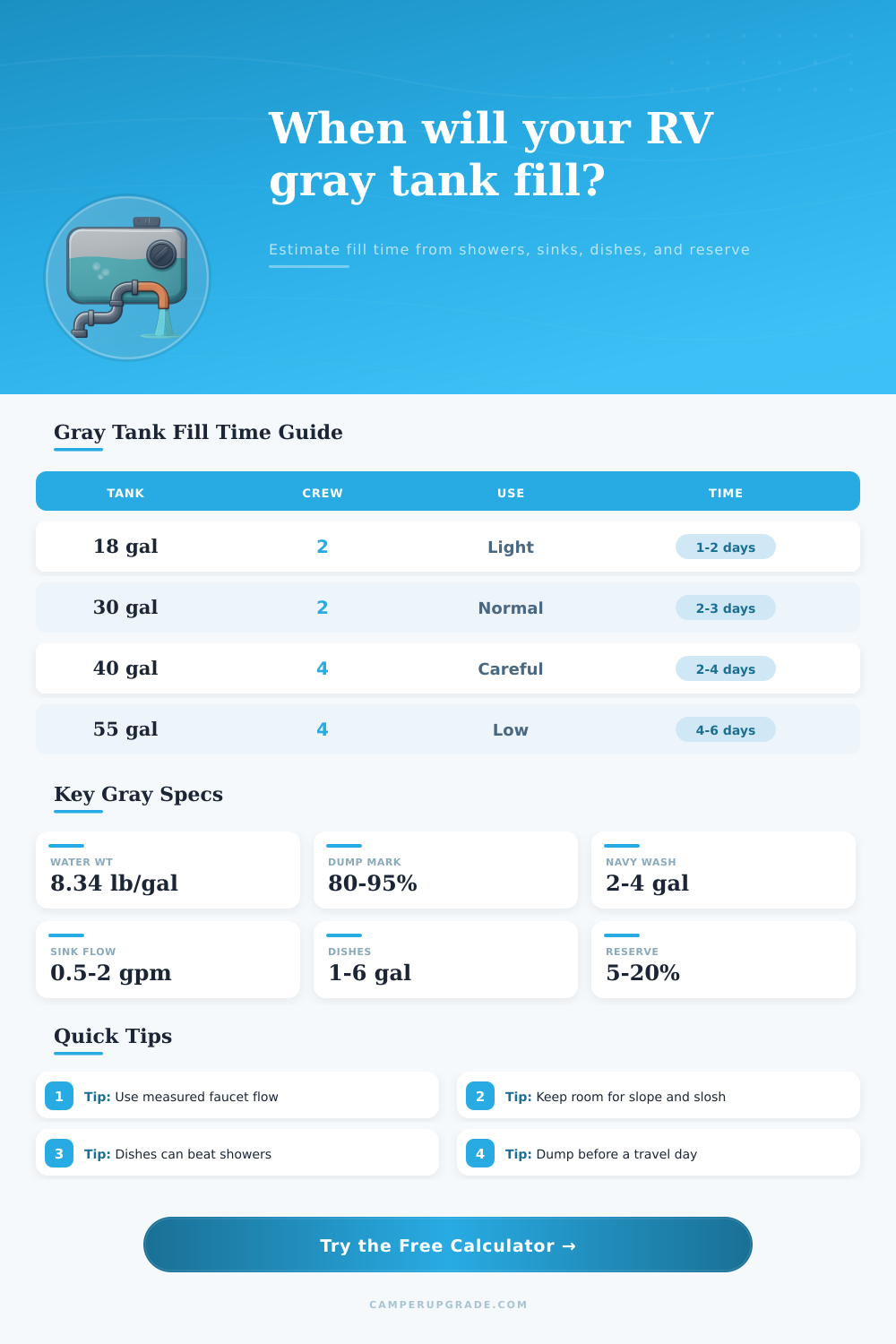
| 18 gal | 1.6 days | 0.9 days | 0.6 days |
| 25 gal | 2.3 days | 1.3 days | 0.8 days |
| 32 gal | 2.9 days | 1.6 days | 1.0 days |
| 40 gal | 3.6 days | 2.0 days | 1.3 days |
| 55 gal | 5.0 days | 2.8 days | 1.8 days |
Conservation Multiplier Guide
| Multiplier | Use Style | What Changes | Best Fit |
|---|---|---|---|
| 115% | Casual water | Longer faucet runs | Full hookups nearby |
| 100% | Normal RV use | Short showers | Typical campground trip |
| 85% | Careful shutoff | Water off while soaping | Weekend dry camp |
| 70% | Strict boondock | Basins and quick rinses | Remote sites |
| 55% | Ultra low-flow | Minimal inside drains | Tank-stretching days |
Planning Buffer Reference
| Buffer | Why Use It | Gallons On 40 Gal | Good For |
|---|---|---|---|
| 0% | Exact measuring only | 0 gal | Known tank and level |
| 5% | Light sensor error | 2 gal | Level campsite |
| 10% | Normal margin | 4 gal | Most RV planning |
| 15% | Slope or foam | 6 gal | Uneven campsites |
| 20% | Travel slosh | 8 gal | Dump before driving |
💡Gray Tank Fill Tips
Gray water is the water that comes out of showers, sinks, and sink in the kitchen where people wash they dishes. This type of water goes into what is known as a gray water tank. Once the gray water tank are filled with gray water, the tank wont be able to fill any more water until the water in the tank is dumped.
Therefore, the management of the gray water determines the length of time that a person can stay at the campsite before having to find a dump station for the gray water tank. The amount of gray water that the sinks, showers, and sinks in the kitchen produce depends on the size of the gray water tank and the speed at which the water is entering the tank. The speed at which the water enter the gray water tank is referred to as the flow rate.
Find Out When Your Gray Water Tank Will Be Full
The length of time that a person runs the water from each of the fixtures in the camping vehicle determines the flow rate. For instance, a shower head that releases one and a half gallon of water per minute will fill the gray water tank much faster if the person use the shower for a longer period of time. Additionally, the running of water from the sink and the sink in the kitchen will also contribute to the amount of gray water that is released into the tank.
Furthermore, because the person may be washing dish in the kitchen sink, the sink in the kitchen can contribute a significant amount of gray water to the gray water tank. By using the calculator to enter the flow rates of the fixtures in the camping vehicle and the number of times that the water is used in the vehicle can help to eliminate the guess work in determining how long before the tank will be full with gray water. The current amount of gray water that is contained within the tank will also help to determine how long the tank will remain in use before the person must find a location to dump the water.
For instance, if the gray water tank starts at thirty percent full with gray water rather than ten percent, then the length of time that the tank will be able to remain in use is reduced. Many individuals dont check the gray water tank until the first day of there trip is over. However, by checking the tank on a regular basis and by choosing a percentage of the tank that is to be filled with gray water prior to reaching its maximum indicated capacity will allow for a buffer period in which water that is sloshing within the tank while the camping vehicle is in motion.
Furthermore, using the tool will allow an individual to test different percentage amount and see if their habits regarding the use of water and gray water matches the number of days that they plan to use the dump station for their gray water tank. Within the calculator for the gray water tank are conservation setting. Each setting allows for a percentage to be entered that indicates the habits of the individual regarding their use of water.
For instance, if the percentage is set to eighty-five, it indicates that the individual will turn off the water while using the soap to clean themselves and that their showers will be shorter. Additionally, if the percentage is set to seventy, it indicates that the individual will wash their dishes in a basin in the kitchen rather than using the running water in the sink to perform this task. Each of these settings will reduce the amount of gray water that is released daily from the gray water tank.
Thus, the reduction of the daily output of gray water from the tank will allow for the tank to last for more days before it reaches the warning level for that tank. It is possible for an individual to make a mistake in accounting for all of the sources of gray water. For instance, a navy shower is a type of shower in which the person turns off the water between each use of the shower head and the amount of gray water that is produced from such showers is less than from a standard shower head.
Additionally, the kitchen faucets can produce gray water if an individual is rinsing their vegetables or using the faucet to fill a pot on the stove. Additionally, the amount of gray water from other sources, such as a pet’s water bowl or wet gear can be entered into the “other gallons” field of the calculator. By accounting for all of the sources of gray water will prevent the gray water tank from filling to its capacity at a faster rate than the individual anticipates.
Within the calculator are reference tables that provide information regarding the length of time that a certain sized gray water tank will last depending upon the length of time that the water is used within the camping vehicle. For instance, the reference table shows that a thirty-two gallon gray water tank will last the individual for three days if the use of water within the camping vehicle is light, but that the same size tank may only last the individual for less than two days if the individual is a family that utilize the water tank for their daily showers. These reference tables will allow an individual to decide if the size of the gray water tank is appropriate for the individual based off their water use.
Additionally, the calculator will assist in the individual with the timing of their travel by providing the number of hours that the individual has until their next designated dump station for the gray water tank. If the number of hours until the next dump station is less than the amount of days that the tank will last, the calculator will provide an indication of the need for the individual to either reduce the amount of gray water that is produced by the camping vehicle or to adjust the individual’s travel schedule to ensure that they will reach the dump station in time with the fill of their gray water tank. In order to utilize the calculator to effectively manage the gray water tank, an individual should measure the flow of water from each of the faucets in the vehicle and the number of showers that are used each day.
By entering these values into the calculator will allow the calculator to provide a timeline for the individual regarding when the tank will be filled with gray water. By having a clear idea of when the next dump station will occur for the camping vehicle will allow the individual to ensure that their trip is on schedule.