RV Furnace BTU Sizing Calculator
Estimate required RV furnace output, practical furnace size class, propane use, and heat-up time from rig dimensions, insulation, temperature difference, windows, slide-outs, leaks, altitude, and efficiency.
RV furnace sizing estimate
| Nameplate input | Typical delivered output at 80% | Best fit | Planning note |
|---|---|---|---|
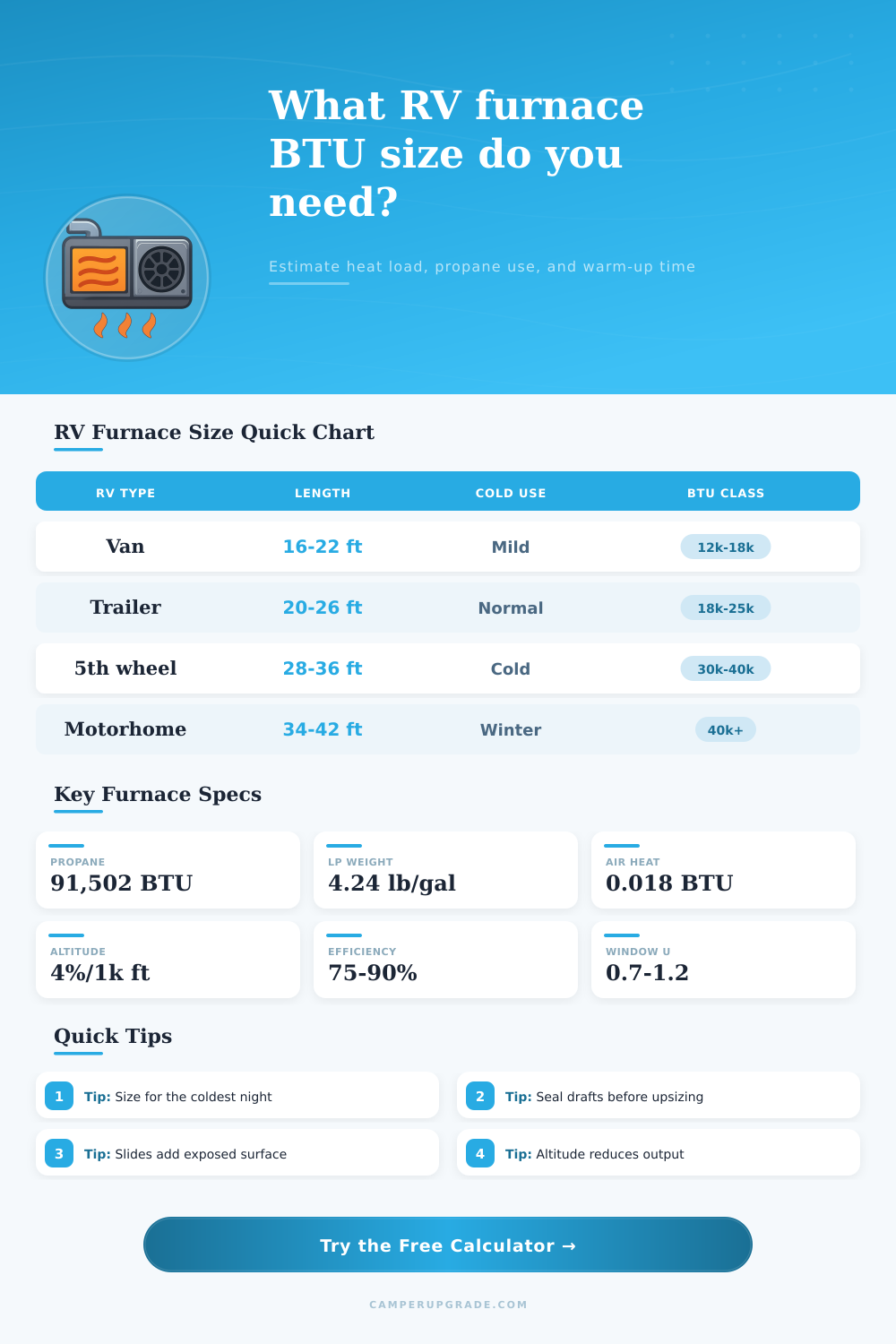
| 12,000 BTU/hr | 9,600 BTU/hr | Vans, truck campers, small insulated trailers | Works for compact rigs in mild to moderate cold |
| 16,000 BTU/hr | 12,800 BTU/hr | Teardrops and small travel trailers | Often enough when volume and glass are modest |
| 20,000 BTU/hr | 16,000 BTU/hr | 18 to 24 ft trailers | Common mid-small trailer class |
| 25,000 BTU/hr | 20,000 BTU/hr | 22 to 28 ft trailers | Good reserve for colder nights or one slide |
| 30,000 BTU/hr | 24,000 BTU/hr | Long trailers and smaller fifth wheels | Common class when slides and ducts add load |
| 35,000 BTU/hr | 28,000 BTU/hr | Large trailers, Class C, fifth wheels | Useful in mountain cold or draftier floorplans |
| 40,000 BTU/hr | 32,000 BTU/hr | Large fifth wheels and motorhomes | Plan carefully for duct balance and propane use |
| 45,000+ BTU/hr | 36,000+ BTU/hr | Large coaches or severe winter use | Often split between zones or paired furnaces |
| Setting | Calculator factor | What it represents | When to use it |
|---|---|---|---|
| Premium insulated coach | U 0.09 | Better wall, roof, floor, and thermal breaks | High-end four-season rigs with covered windows |
| Four-season RV | U 0.13 | Improved insulation and enclosed underbelly | Cold-weather trailers and fifth wheels |
| Standard RV | U 0.18 | Typical laminated or framed RV shell | Most travel trailers and motorhomes |
| Light or older RV | U 0.35 | Thin panels, more thermal bridging, less floor insulation | Older rigs, light trailers, vans, and conversions |
| Tight air leaks | 0.45 ACH | Lower draft heat loss | Good seals, covered vents, adjusted latches |
| Very drafty leaks | 1.60 ACH | High infiltration through doors, slides, ramps, vents | Toy haulers, older seals, wind exposure |
| Furnace input | Gallons per burner hour | Pounds per burner hour | Approx 20 lb cylinder burner hours |
|---|---|---|---|
| 12,000 BTU/hr | 0.13 gal/hr | 0.56 lb/hr | 35.9 hours |
| 16,000 BTU/hr | 0.17 gal/hr | 0.74 lb/hr | 26.9 hours |
| 20,000 BTU/hr | 0.22 gal/hr | 0.93 lb/hr | 21.6 hours |
| 25,000 BTU/hr | 0.27 gal/hr | 1.16 lb/hr | 17.2 hours |
| 30,000 BTU/hr | 0.33 gal/hr | 1.39 lb/hr | 14.4 hours |
| 35,000 BTU/hr | 0.38 gal/hr | 1.62 lb/hr | 12.3 hours |
| 40,000 BTU/hr | 0.44 gal/hr | 1.85 lb/hr | 10.8 hours |
| 45,000 BTU/hr | 0.49 gal/hr | 2.08 lb/hr | 9.6 hours |
| Camping altitude | Planning output factor | Example delivered effect | Calculator use |
|---|---|---|---|
| 0 to 2,000 ft | 100% | No altitude derate applied | Sea level, low desert, low forest campgrounds |
| 3,000 ft | 96% | 40k furnace acts near 38.4k input before efficiency | Small but worth keeping in reserve |
| 5,000 ft | 88% | 40k furnace acts near 35.2k input before efficiency | Common mountain campground adjustment |
| 7,000 ft | 80% | 40k furnace acts near 32.0k input before efficiency | May require the next furnace class |
| 9,000 ft | 72% | 40k furnace acts near 28.8k input before efficiency | Use conservative cold-weather reserve |
| RV setup | Cold-night scenario | Common size class | Why it lands there |
|---|---|---|---|
| Class B van, 19 ft | 40°F outside to 68°F inside | 12k to 16k BTU/hr | Small volume but lighter shell and cab glass |
| Small travel trailer, 19 ft | 25°F outside to 68°F inside | 16k to 20k BTU/hr | Moderate shell area with limited slides |
| Family trailer, 26 ft | 20°F outside to 68°F inside | 25k to 30k BTU/hr | More volume, windows, and duct losses |
| 30 ft trailer with slide | 15°F outside to 68°F inside | 30k to 35k BTU/hr | Slide walls and seals raise heat loss |
| 34 ft fifth wheel | 10°F outside to 70°F inside | 35k to 40k BTU/hr | Large envelope and high ceiling volume |
| 40 ft motorhome | 5°F outside to 70°F inside | 40k+ BTU/hr | Large area, cab glass, zones, and altitude reserve |
When choosing the furnace for an RV, understanding how much heat escapes from the RV and how quickly the furnace must replace that heat is essential. Many people look at the size of the furnace used by others to choose the furnace for there RV. However, choosing a furnace based off guesswork can cause various problems for the owner of the RV.
If the furnace is too small for the size of the RV, the furnace will continuously run on cold night to attempt to provide enough heat for the interior of the RV. This will eventually lead to emptying of the propane tank at a much faster rate then expected. The furnace must provide enough BTU to compensate for the heat loss from the RV to maintain a comfortable temperature.
Choose the Right Furnace Size for Your RV
There are several way that heat can escape the RV. Heat escapes from the RV through the walls, the roof, and the floor. Additionally, heat can also escape through the windows of the RV.
These all play a significant role in determining how much heat is lost from the RV. The same can be said for the slide-outs of the RV. Both of these will allow for the loss of heat from the RV.
Air leaks within the RV can also create a significant amount of heat loss. Both air leaks and the insulation levels of the RV impact the amount of heat that is lost from the RV. These factors must all be considered when choosing the size of the furnace for the RV.
The RV furnace size calculator require several specific inputs to determine the size of furnace that is required for the RV. The length, width, and height of the RV must be entered into the calculator. Additionally, the insulation level and the low temperature that the RV will experience must also be entered.
Other factors that the calculator considers include the area covered by the RV’s windows, the number of slide-outs that the RV features, and the level of air leakage within the RV. Altitude is also included in the calculation because propane furnaces loses heat output as the altitude increases. Finally, the efficiency of the furnace can be entered into the calculator.
This will allow the calculator to account for how much BTU the furnace will output into the RV as opposed to the total BTU that the furnace will output. This will provide an RV owner with a figure for the heat output that is required by the RV and what class of furnace will provide that heat output. The RV furnace size calculator considers two different variables for heat: warm-up energy and steady-state load.
Warm-up energy refers to the amount of energy that is required to heat the RV from a cold temperature to a warm starting point for the RV. The steady-state load is the amount of BTU per hour that is required to maintain the temperature within the interior of the RV. Two RVs of the same length may require different furnace classes.
For instance, one RV may be stored in a heated garage while the other may be left unheated. This impacts the warm-up time that it will take for the RV to heat up to the comfortable temperature for the RV owners. One of the many misconceptions of furnace size is that choosing a furnace that is larger than what is calculated for the RV is always the best choice.
While true, this isnt the case. A larger furnace will shorten the time that it will take for the RV to warm up to the desired temperature. However, the larger the furnace, the more that it will cycle on and off within the RV to maintain the temperature.
This will cause the furnace to cycle on and off more frequently and will create more noise within the RV. The other misconception is that RV owners undersizes their furnace. Many people choose a furnace size that only considers the length of the RV.
An undersized furnace will continuously run on cold nights to try and provide heat for the RV. Additionally, the furnace may fail to maintain the interior temperature of the RV if either the external temperature increases or the altitude of the RV increases. Propane consumption is directly related to the size of the furnace that is chosen as well as the operation of the furnace.
A general rule of thumb is that every gallon of propane contain a similar amount of energy. Thus, if the RV owner can determine the rate at which the furnace will input heat into the RV and how often the furnace will be in operation, they can determine the amount of gallons of propane that will be consumed by the RV each day. This information is provided by the furnace size calculator in the form of the firing rate of the furnace in gallons per hour as well as the projected total daily consumption of propane by the RV.
This information is essential when planning trips for the RV. The impact of altitude on the propane furnace is another essential factor to consider when selecting a furnace for the RV. The higher the altitude, the less heat that the furnace will output.
A propane furnace that heats an RV well at sea level will output less heat at five thousand feet. The same RV may struggle to maintain the same interior temperature at seven or eight thousand feet. To avoid surprises with the furnace, it is recommended that the RV owner enters the actual altitude of the location at which the RV will be camping into the calculator to account for this effect on the furnace output.
Another factor to consider is the level of insulation of the RV and the level of air leakage within the RV. An RV with a four-season underbelly and well-insulated walls will lose less heat through the floor than an RV with an open underbelly. Additionally, an RV with a large ramp door will lose more heat through air exchange than an RV without a ramp door.
The furnace size calculator allows RV owners to independently select the level of insulation and air leakage of the RV to determine the total heat loss of the RV. Finally, although the calculator can provide an accurate measurement of the amount of heat that the RV will lose, there are many factors in the real world that can impact the RV furnace. The impact of the wind will increase the loss of heat from the RV.
Poorly balanced ductwork will reduce the amount of heat that the furnace delivers into the RV. Additionally, the placement of the furnace relative to the thermostat will also have an impact upon the furnace. If the thermostat is in a warm area of the RV, the furnace may cycle more frequently to maintain the temperature.
To account for these factors, many RV owners will increase the calculation of the heat loss by a percentage to ensure that the furnace is large enough to compensate for the actual loss of heat from the RV. Thus, the goal is to ensure that the furnace matches the heat loss of the RV to ensure that the interior of the RV remains at a comfortable temperature without consuming excessive amount of propane for heating.