RV Fridge Cooldown Calculator
Estimate how long an RV refrigerator needs to reach food-safe temperature based on box size, starting temperature, ambient heat, door openings, fridge type, and loading habits.
Cooldown estimate
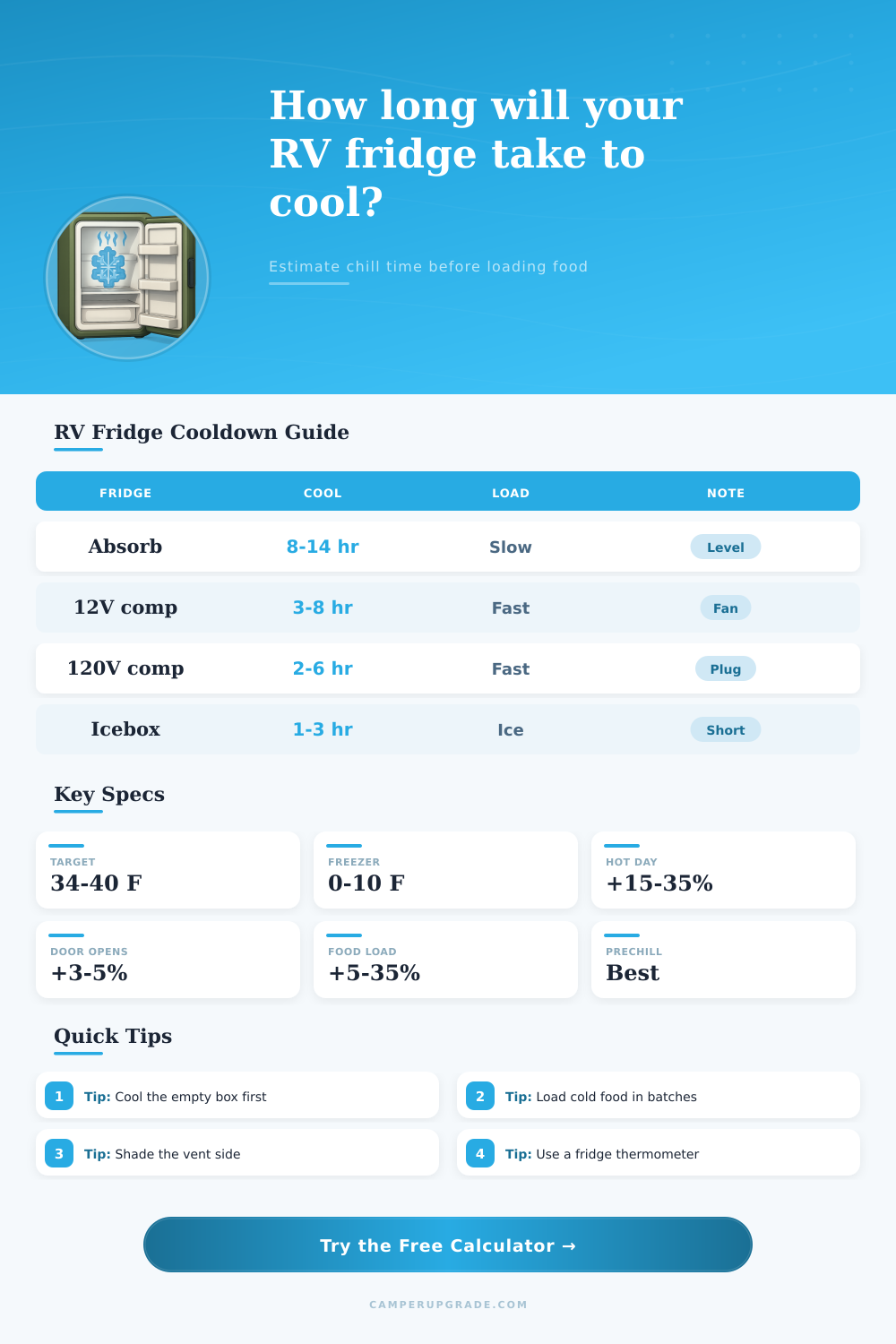
| Fridge type | Typical empty-box time | Best use case | Main slowdown |
|---|---|---|---|
| Propane absorption | 8 to 14 hours | Night-before prechill while level | Hot vent stack, off-level parking, warm food |
| 120V absorption | 7 to 13 hours | Shore power before departure | Limited airflow behind the refrigerator |
| 12V compressor | 3 to 8 hours | Vans, truck campers, solar rigs | Low battery voltage, poor condenser airflow |
| 120V compressor | 2 to 6 hours | Campers plugged in at home or campground | Large warm food load added too early |
| Thermoelectric cooler | 6 to 16 hours | Small beverage or lunch cooler duty | High ambient heat; limited drop below ambient |
| Ambient or cabinet temp | Absorption impact | Compressor impact | Practical reading |
|---|---|---|---|
| 60 to 70 F | About 5% faster | About 3% faster | Good prechill weather before a trip |
| 75 to 85 F | Baseline to 18% slower | Baseline to 10% slower | Normal summer departure conditions |
| 90 to 100 F | 25% to 45% slower | 12% to 28% slower | Vent shade and fans matter more |
| Over 100 F | 45% or more slower | 25% or more slower | Load only cold food after stable readings |
| Condition in first 4 hours | Added time | Why it matters | Better practice |
|---|---|---|---|
| 0 to 2 quick openings | 0% to 8% | Cold air loss is limited | Check thermometer through the door if possible |
| 3 to 6 openings | 10% to 25% | Warm moist air replaces chilled air | Stage food beside the fridge first |
| 25% pre-chilled food load | 3% to 10% | Cold food adds useful thermal mass | Load in one organized batch |
| 50% room-temperature load | 20% to 45% | Food mass must cool along with the box | Use a cooler until the fridge reaches target |
| Target | Use for | Cooldown effect | Loading note |
|---|---|---|---|
| 40 F / 4 C | Upper food-safe fridge limit | Fastest practical food loading point | Keep monitoring after loading |
| 38 F / 3 C | Common RV fridge target | Balanced time and safety margin | Good default for mixed groceries |
| 35 F / 2 C | Hot weather buffer | Adds noticeable time | Avoid freezing sensitive produce near fins |
| 32 F / 0 C | Near-freezing cabinet | Often unrealistic for absorption fridges in heat | Use only when your fridge can hold it |
A cooldown calculator is a tool that will allow you to estimate how long it will take for your refrigerator to reach a safe temperature. Many peoples use a cooldown calculator because many people want to know when their refrigerator will reach a cold enough temperature to hold there food. The time it takes for a refrigerator to reach a stable temperature depend on several factors.
The factors that impact the cooldown time for a refrigerator include the type of refrigerator, the outside temperature, the amount of food in the refrigerator, and how often the refrigerator door are opened. Refrigerators requires several different inputs to calculate how long it will take for the refrigerator to cool down. The volume of the refrigerator is one of the more important inputs.
How Long Will My Fridge Take to Cool Down
The larger the volume of the refrigerator, the more longer it will take for the refrigerator to cool down. The starting temperature is another of the most important inputs. Starting temperature allow the refrigerator to calculate how much refrigeration is required to cool the refrigerator.
The ambient temperature is another of the most important inputs. For absorption refrigerators, high ambient temperature can make it difficult for the refrigerator to cool the food because it would have to work harder to move heat out of the refrigerator when the outside temperature is high. The number of times the refrigerator door was opened is another of the most important inputs.
Every time the refrigerator door is opened, warm air enter the refrigerator. The food load is another of the most important inputs. By adding food to the refrigerator, the refrigerator has to work harder to maintain the desired temperature within the refrigerator.
Finally, the ventilation and leveling of the refrigerator is another of the most important inputs. If the refrigerator is not properly level or well-ventilated, the refrigerator may not be able to reach the target temperature as efficient as it should. The technology used for the refrigerator can also have a significant impact on the cooldown time.
If you have an absorption refrigerator, the refrigerator will be sensitive to both the ambient temperature and the level of the refrigerator. If you have a compressor refrigerator, it will be able to reach the desired temperature faster than an absorption refrigerator. Thermoelectric coolers and iceboxes has limited refrigeration abilities compared to other technologies.
Therefore, thermoelectric coolers and iceboxes will take longer to reach the desired temperature. The estimates given by a cooldown calculator are simply a guide for how long it will take for the refrigerator to cool down. The estimate is not a replacement for a refrigerator thermometer.
If the cooldown calculator shows that your refrigerator will take many hour to reach the desired temperature, you will have to start your refrigerator in the timeframe that will allow for your refrigerator to reach the desired temperature. In contrast, if the cooldown calculator shows a short cooldown time, you will have to load your refrigerator with food sooner. However, you must always measure the refrigerator temperature with a thermometer to ensure that it is reaching the desired temperature.
The numbers that you enter into the cooldown calculator may not reflect what your refrigerator can expect in the real world. If it is currently a very hot day outside, your refrigerator will take longer to cool down. The same is true for making stops along the way.
Every time the refrigerator door is opened, warm air will enter the refrigerator and make it take longer to cool down. Another factor that may affect your refrigerator is the amount of food that is loaded into the refrigerator. If you load too much food into the refrigerator, it will have to work harder to maintain the desired refrigerator temperature.
However, if you load foods that are cold into the refrigerator first, the refrigerator will maintain a more stable internal temperature. Furthermore, it will protect the food that is already inside of the refrigerator. Refrigeration technology depend on several factors, such as proper ventilation of the refrigerator and proper leveling of the refrigerator.
Absorption refrigerators need clear openings for air to circulate behind the refrigerator. Furthermore, if the refrigerator is not level, the liquid solution inside the refrigerator will not be able to properly circulate. Compressor refrigerators also require proper ventilation, but they are more forgiving of improper leveling of the refrigerator.
In either case, you must use a thermometer to ensure that the refrigerator is reaching the proper temperature in the middle of the refrigerator. Many people make several mistakes when refrigerating food. One of the most common is turning on the refrigerator too late in the day.
Another mistake is loading warm food into a refrigerator that is not yet at the correct temperature. This will make it so that the temperature within the refrigerator remain high. People also make mistakes with absorption refrigerators.
For instance, if the refrigerator is on a slope, it may not be able to reach the proper temperature at all. When you use a cooldown calculator, you can see the different mistakes that you could potentially make. Another factor that you must decide on is the target temperature that the refrigerator should reach.
40 degrees is the most common target temperature for food safety, but a refrigerator that reaches 40 degrees will not be able to maintain that temperature if the door is opened too frequently. A target temperature of 35 degrees would work better for a refrigerator that is accessed more frequently, but it would take longer for the refrigerator to reach that temperature. The cooldown calculator will allow you to choose the target temperature that is the best for your trip.
Refrigerators can help you to decide when to go shopping for the food that you want to refrigerate and how to pack the refrigerator. If the cooldown calculator indicates that it will take ten hours for the refrigerator to cool down, you can start the refrigerator the night before. However, if the refrigerator will take only two hour to cool down, you can shop later in the day.
The goal is always to reach the target temperature before placing any perishable food into the refrigerator. Always use a refrigerator thermometer to ensure the proper temperature in the refrigerator.