Cargo Carrying Capacity Calculator
Estimate RV CCC, loaded weight, water weight, passenger load, cargo load, and remaining margin before you roll.
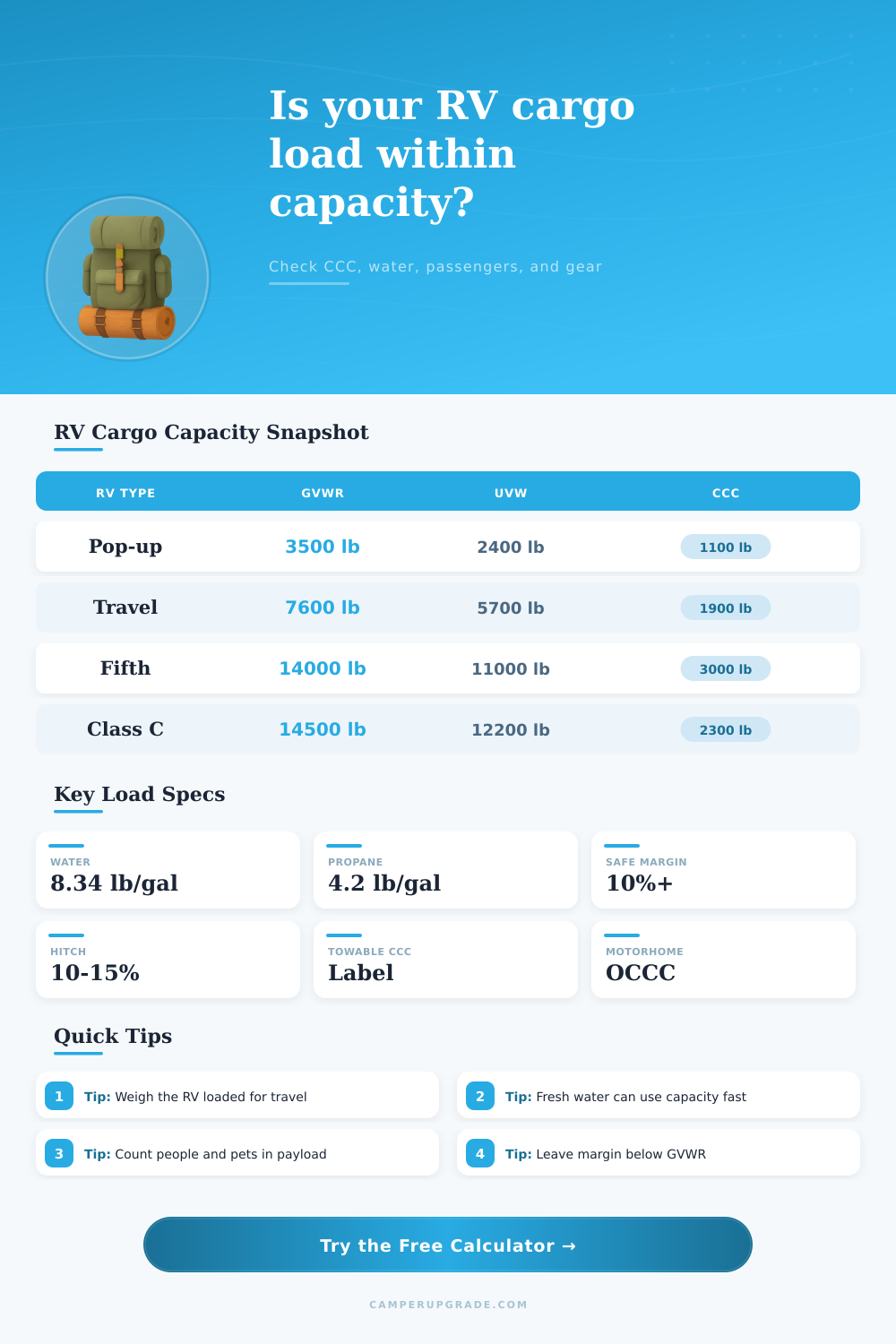
| RV Type | Typical GVWR | Typical UVW | Typical CCC |
|---|---|---|---|
| Pop-up camper | 2,400 to 3,800 lb | 1,600 to 2,700 lb | 700 to 1,200 lb |
| Small travel trailer | 4,500 to 6,500 lb | 3,300 to 5,100 lb | 900 to 1,600 lb |
| Family bunkhouse trailer | 7,000 to 9,500 lb | 5,400 to 7,300 lb | 1,400 to 2,500 lb |
| Fifth wheel | 12,000 to 16,800 lb | 9,800 to 13,900 lb | 2,000 to 3,800 lb |
| Class C motorhome | 12,500 to 14,500 lb | 10,800 to 12,800 lb | 1,200 to 2,500 lb |
| Class A gas motorhome | 18,000 to 24,000 lb | 15,200 to 20,500 lb | 2,200 to 4,200 lb |
| Tank or Supply | Amount | Added Weight | CCC Impact |
|---|---|---|---|
| Fresh water | 20 gal | 167 lb | Light weekend carry |
| Fresh water | 40 gal | 334 lb | Noticeable trailer load |
| Fresh water | 60 gal | 500 lb | Major capacity use |
| Gray/black water | 30 gal | 250 lb | Common dump-day load |
| Propane fuel only | 20 lb | 20 lb | Fuel weight only |
| Twin loaded cylinders | Approx. 60 to 75 lb | 60 to 75 lb | Fuel plus cylinders |
| Cargo Group | Light Pack | Moderate Pack | Heavy Pack |
|---|---|---|---|
| Food and kitchen | 60 to 120 lb | 120 to 220 lb | 220 to 350 lb |
| Clothes and bedding | 80 to 150 lb | 150 to 260 lb | 260 to 420 lb |
| Outdoor furniture | 50 to 110 lb | 110 to 220 lb | 220 to 380 lb |
| Tools and spares | 40 to 100 lb | 100 to 220 lb | 220 to 450 lb |
| Generator and fuel | 0 to 90 lb | 90 to 180 lb | 180 to 320 lb |
| Bikes or recreation | 40 to 120 lb | 120 to 280 lb | 280 to 600 lb |
| Remaining CCC | GVWR Used | Status | What It Means |
|---|---|---|---|
| Above target margin | Under 90% | Comfortable | Good room for normal scale variation |
| Below target margin | 90% to 100% | Watch closely | Weigh the loaded RV before travel |
| Near zero | 98% to 100% | Tight | Small additions can exceed GVWR |
| Negative capacity | Over 100% | Over GVWR | Remove load before towing or driving |
| Unknown label data | Any value | Verify first | Use actual door sticker or weight label |
Every RV has a cargo-carrying capacity. The cargo carrying capacity is the difference between the weight of the manufactured RV when empty and the weight of the RV when it is fully loaded. People must understand the cargo carrying capacity of an RV.
As the number of individuals, the amount of gear, and the amount of water and propane that is stored in the RV increase, the cargo carrying capacity of the RV decreases. Many people do not account for this and under estimate the decrease of cargo carrying capacity that these items can contribute to the RV. Items like water and propane can contribute significant to the weight of the RV.
Check Your RV Weight Limit
For instance, a forty-gallon fresh water tank will add over three hundred pounds of weight to the RV before any person are in the RV. Additionally, you must also account for the weight of propane tanks, groceries, clothes, and bedding. A calculator is provided that helps individuals to add the weights of each of these items.
The calculator will allow people to determine whether there RV’s total loaded weight is within or outside of the RV’s weight limit. Each of the inputs for the calculator are items that will be loaded into the RV. Fresh water is one of the inputs because fresh water has weight.
Additionally, because gray water and black water also have weight, those are also inputs for the RV. The weight of propane tanks must also be accounted for and is therefore an input. For RVs such as motorhomes and truck campers, the number of passengers will impact the total loaded weight of the RV.
Thus, the number of passengers is an input for those model of RVs but not trailers as the individuals in the trailer will be riding in the towing vehicle. Additionally, because pets have weight, the number of pets is an input for the RV. The food and gear fields accounts for the weight of items such as canned goods, bikes, and generators.
The hitch line allows individuals to account for the weight of items like batteries, sway bars, and spare tire carriers. The results of the calculator will provide information regarding how much weight the RV can take. The remaining capacity will provide the total weight that the RV can take before reaching the gross vehicle weight rating.
The gross vehicle weight is the maximum weight that the RV can reach. A reserve target can also be set that allows individuals to stay within the gross vehicle weight of the RV with a safety margin. Many travelers will aim to have there loaded RV weight be ten percent of the gross vehicle weight limit as the gross vehicle weight can range on the scale tickets for the RV.
The reference tables provides information about the cargo carrying capacity of small travel trailers and fifth wheels. Each model of trailer has a different cargo carrying capacity and the difference in the two can be significant. For instance, water and propane tanks adds weight to the RV and the examples in the reference tables show how much weight can be added by each of these items.
Additionally, the other examples in the reference tables indicate the weight that can be contributed by items such as clothing, kitchen items, and outdoor furniture. Many people will under estimate the actual loaded weight of there RV and the weight that will be contributed by the items that are loaded into the RV. For instance, people may not realize that the actual empty weight of an RV can be higher than the weight listed for the RV by the manufacturer.
To know the actual loaded weight of an RV, you will have to weigh the RV on a certified scale. The calculator will only provide an estimate as to the weight of an RV but the scale will provide the actual weight to ensure that the RV is within the legal weight limits for the RV. Additionally, the payload weight of an RV and the towing capacity of the towing vehicle is a separate limit to the gross vehicle weight of the RV.
It is possible for the towing vehicle to have a high towing capacity but still reach the payload limit of the towing vehicle due to the weight of the individual, passengers, and gear in the trailer. Similarly, it is also possible for the RV to remain within the gross vehicle weight limit but overload one or more axle of the RV. Thus, understanding the weight of the RV and the limits of the axle and hitch is also important in addition to the gross vehicle weight limit of the RV.
Individuals can choose to either load their RV with water tanks or to leave the water tanks empty. Water tanks will allow individuals to have more independence while they are camping but will also reduce the cargo capacity of the RV. Thus, some people will only fill in the water tanks that they will need for the time that they will be traveling but other people may choose to add the weight of the full water tanks in order to have the ability to boondock without having to refuel the water.
Both choices are acceptable as long as the loaded weight of the RV remains within the cargo carrying capacity of the RV. Similar to the water tanks, people can choose to have minimal clothing within the RV or to include gear such as bikes, grills, and tools. Both of these choices are acceptable as long as the total weight of the cargo that is within the RV is within the limits of the cargo carrying capacity.
Individuals should also periodically use the calculator to determine the loaded weight of the RV. The weight of the batteries, spare tires, and the number of individuals within the RV can change over time. Thus, by recalculating the loaded weight of the RV each camping season, individuals will avoid the situation in which the loaded weight of the RV slowly increases over time.
By periodically using the calculator, individuals will always know the loaded weight of the RV. Thus, they can ensure that the loaded weight of the RV will never be a surprise. Additionally, by knowing the loaded weight of each of the items that will be within the RV, individuals can make informed decisions about the items that they will choose to load onto the RV.