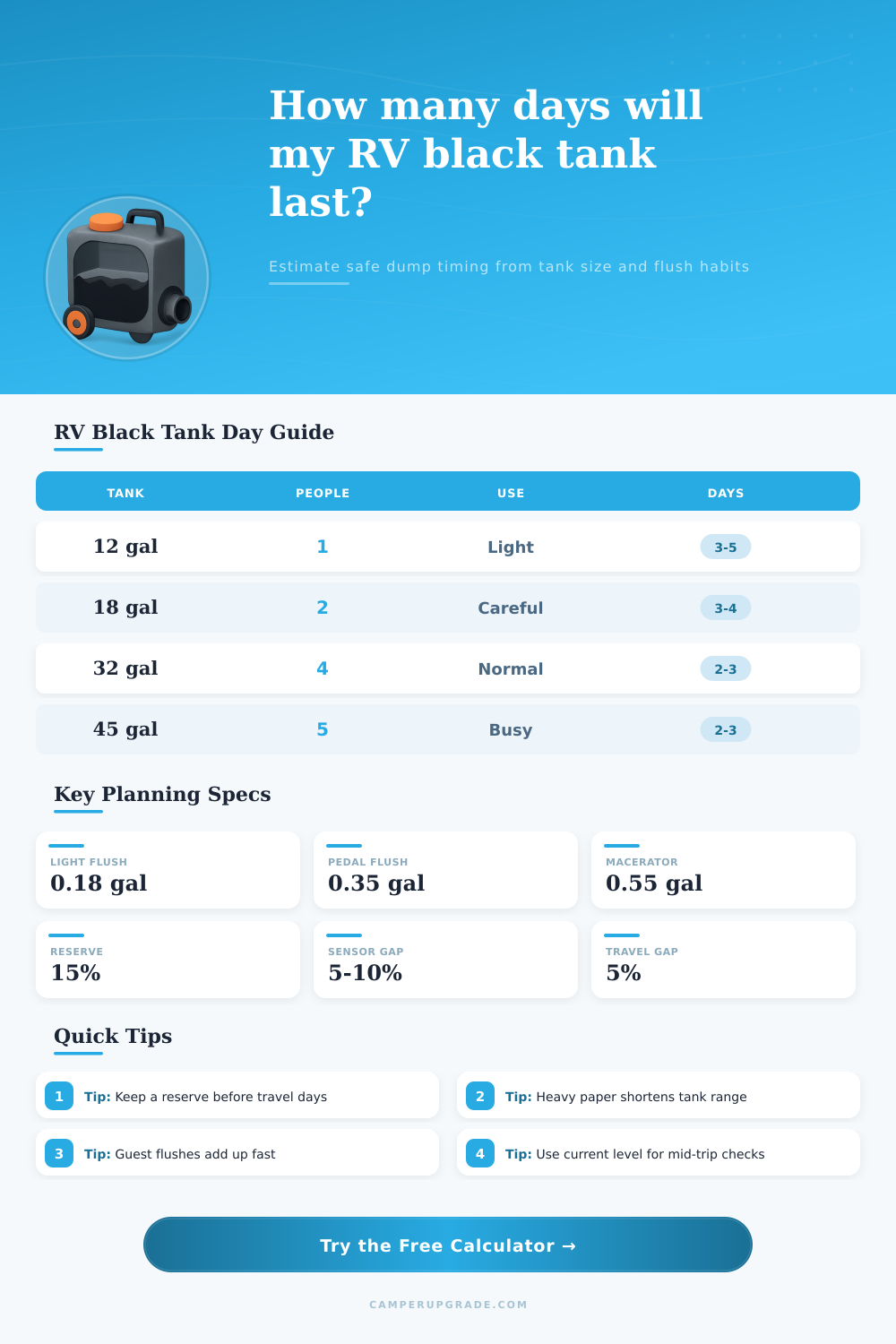
RV Black Tank Capacity Days Calculator
Estimate how many safe camping days remain before your black tank reaches its planned dump point.
Low-water flushes are modeled at 65% of a normal flush.
| RV Type | Typical Black Tank | Best Planning Use | Watch Point |
|---|---|---|---|
| Camper van or wet bath Class B | 8 to 15 gal | Solo weekends and careful couple trips | Small tanks react quickly to guest use |
| Compact travel trailer | 18 to 28 gal | Two-person long weekends | Sensor readings can jump in one day |
| Bunkhouse travel trailer | 30 to 40 gal | Family campground or dry-camp stays | Paper load can matter as much as flush count |
| Fifth wheel or toy hauler | 40 to 55 gal | Group trips, rallies, and longer stays | Multiple bathrooms may not share one tank |
| Class A motorhome | 40 to 65 gal | Longer stays with bigger reserve margins | Large tanks still need travel slosh room |
| Toilet Pattern | Typical Water Per Flush | Daily Impact For 2 People | Calculator Match |
|---|---|---|---|
| Foot pedal, quick liquid flush | 0.15 to 0.25 gal | About 1.5 to 2.5 gal/day at 10 flushes | Use low-water share of 60% or more |
| Foot pedal, normal mixed use | 0.30 to 0.45 gal | About 3.0 to 4.5 gal/day at 10 flushes | Use 0.35 gal and standard paper |
| Macerator or electric toilet | 0.50 to 0.80 gal | About 5.0 to 8.0 gal/day at 10 flushes | Raise water per flush before calculating |
| Family comfort flushing | 0.45 to 0.65 gal | About 4.5 to 6.5 gal/day at 10 flushes | Use comfort or high-use style |
| Margin | When It Fits | Volume Held On 32 gal Tank | Why It Matters |
|---|---|---|---|
| 5% | Short stationary stay near dump access | 1.6 gal | Small cushion for end-of-day readings |
| 10% | Normal campground planning | 3.2 gal | Useful when people use the RV at night |
| 15% | Boondocking or unknown dump access | 4.8 gal | Protects the final day from surprise load |
| 20% | Rough travel or unreliable sensors | 6.4 gal | Gives headroom before towing or driving |
| Scenario | Inputs Used | Daily Load Range | Planning Note |
|---|---|---|---|
| Solo Class B weekend | 12 gal, 1 person, 4 flushes | 1.1 to 1.6 gal/day | Usually limited by small tank capacity |
| Couple small trailer | 18 gal, 2 people, 5 flushes each | 3.0 to 4.2 gal/day | Careful flush habits often add a day |
| Family bunkhouse | 38 gal, 4 people, 5 flushes each | 7.0 to 10.0 gal/day | Paper load and guest use change timing fast |
| Toy hauler rally | 45 gal, 5 people, guests included | 10.0 to 15.0 gal/day | Guest flushes should be entered separately |
When planning a trip without knowing how long the black tanks will last on a trip, the planning of the trip can become difficult due to the need to time the refills of the black tank. Though black tank calculators is available to calculate how long the black tank will last on a trip, it is important to understand the impact that various factors will have upon the black tank. Variables to consider with the black tank include the capacity of the tank itself, the number of gallons that will be used with each flush of the black tank, the number of individual that will be on the RV, and the number of guests that will be on the RV.
Each of these variables will impact the rate at which the black tank will refill and the calculator will allow for the adjustment of these variables to help determine both how long the black tank will last, and where along the trip it may be necessary to find a dump station. Within the black tank is not just water, but other solid materials as well. As such, the volume contributed to the black tank by solids and paper will not empty in the same way that the liquid in the black tank can empty.
How to Plan Your RV Black Tank Use
Thus, variables related to the solid materials that contribute to the black tank, like the number of gallons contributed by the use of toilet paper, are include in the black tank calculator. If the individuals that are traveling on the RV are using mostly liquid flushes, then there will be more room within the black tank prior to the black tank filling with solid material created by the individuals. In contrast, if there are heavy patterns in the use of toilet paper by the individuals that are on the RV, the black tank will fill with solids at a faster rate.
These variables allow the RV owner to adjust their habit to ensure that they are not too soon required to empty the black tank. In addition to the factors related to the volume that will fill the black tank, it is also important to consider the current level of the black tank. If the black tank already contains a percentage of its total capacity, there will be less room within the tank prior to the black tank beginning to refill with black tank waste.
Thus, the black tank calculator will account for the percentage of the tank that is already filled, as well as account for the need to reserve some of that black tank for travel or in the case of the sensors reading incorrectly. If the black tank begins to fill while the RV is stationary, the liquid that is within the tank may move within the RV and shift in relation to the sensors that read the percentage of the black tank that is filled. Thus, an initial offset within the calculation for the black tank can account for the roughness of the roads that the RV will travel.
Additionally, the number of guests that may be on the RV will contribute to the amount of water that is used and, subsequently, that refills the black tank. One additional guest for a two-night stay, for example, may contribute several gallon to the black tank that were not originally planned. In addition, an additional small amount of water that can be used by the individuals to clean their mouth and their teeth can also contribute to the black tank.
These factors can be accounted for within the black tank calculations to allow the black tank to be emptied at an appropriate time and place. The flush volume per use is a variable that requires your attention. A quick pedal flush to dispose of liquid waste uses less water than a full mixed flush, and some RVs have toilets that use even less water than others.
Using the low water share button on the calculator allows you to account for this and see the savings that this makes over the course of your multi-day stay. However, the use of paper is still a consideration for this calculation as the amount of paper used will not shrink with the reduction in water use. The sensor readings for black tanks can sometimes be inaccurate.
Due to the way that black tanks can develop residue along the probe tips or how the waste within the tank is distributed, the digital readouts can be high or low when compared with the actual tanks fill level. Using the sensor margin button allows for an adjustment to the sensor reads should you know that your sensors are showing lower readings (such as when traveling with young children) or higher readings (such as when you have a higher standard of cleanliness in your RV). The reference tables on the calculator show the black tank size for each class of RV and the different types of flush patterns for the different types of toilets that may be found on an RV.
The size of the black tank will determine how often the black tank is dumped, although individual habits will play a role in how full the black tank can become. For instance, a couple that has flush habits that use less water and use less paper will fill an eighteen gallon black tank less often than a family with higher flush standards and with more frequent guests. The plans that you make for your travel will impact your black tank and the way in which you must manage that black tank.
If you plan to move your RV prior to dumping the black tank, the slosh margin will be more important to you than if your plans are to leave your RV in one spot for multiple days. If you plan to travel on rough roads or downhill grades, the slosh margin will be more important than on a more flat travel destination. The goal of this calculator is to provide you with a time frame within which you should dump your black tank.
Within this timeframe you can adjust your water and paper use habits, limit the use of your RV by guests, or plan your travel to the next black tank dump site. While there may not be an exact deadline for dumping your black tank, these calculations will provide you with a more accurate picture of when it may be necessary to do so. This will allow you to plan your travel around your black tank needs.