RV Battery Days of Autonomy Calculator
Estimate how many off-grid days your RV battery bank can support after usable depth of discharge, battery age, temperature, inverter losses, DC loads, AC loads, solar harvest, driving charge, generator charge, and reserve margin.
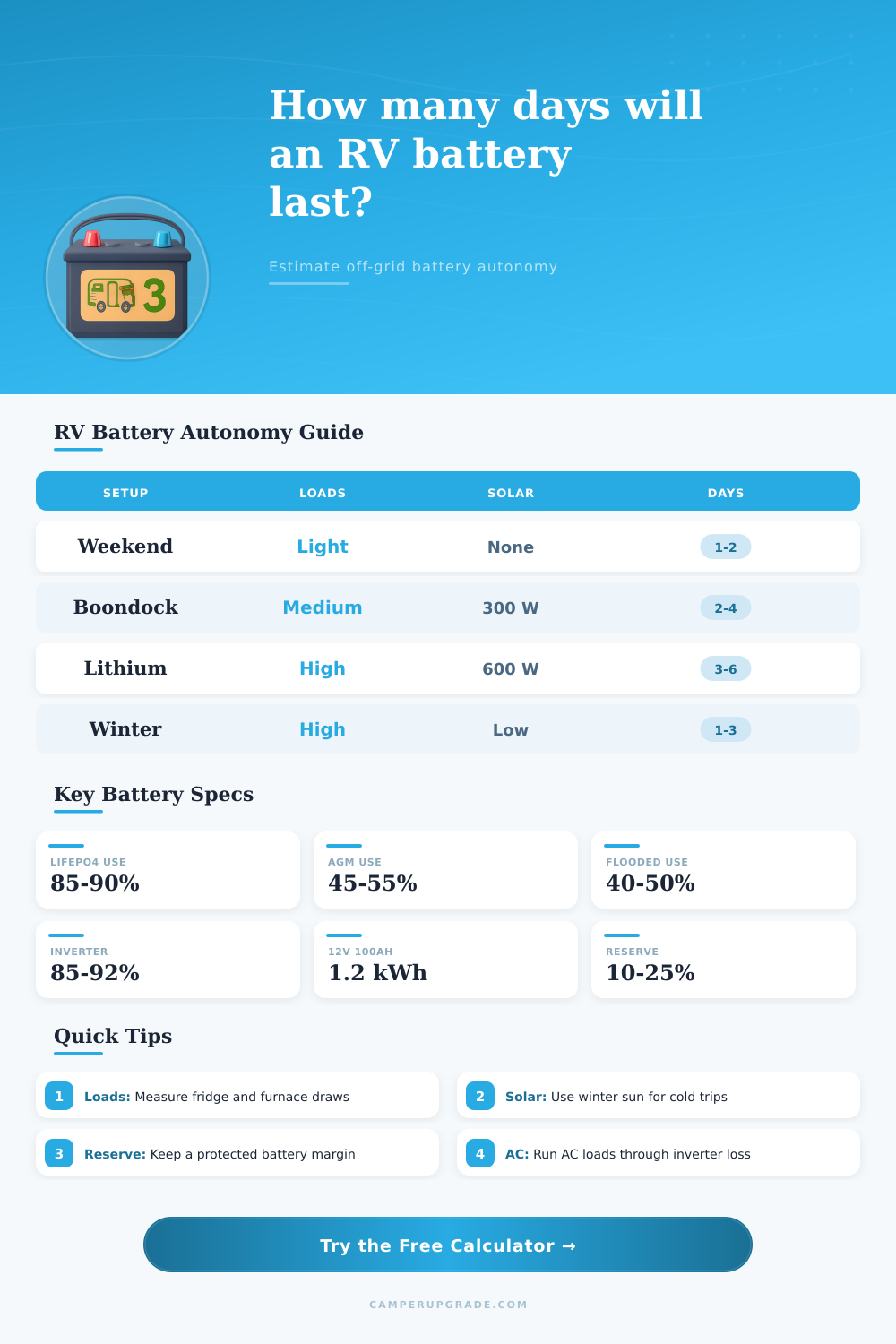
🏕RV Battery Autonomy Presets
⚙Battery Bank, Loads, Charging, and Reserve Inputs
📊Battery Planning Spec Grid
📋RV Battery Reference Tables
| Battery type | Usable band | Cold effect | Planning note |
|---|---|---|---|
| LiFePO4 lithium | 80 to 90% | Moderate discharge derate | Great usable capacity, but charging below freezing needs protection. |
| AGM lead acid | 45 to 55% | Noticeable cold loss | Good sealed option, but deep cycling shortens life. |
| Flooded lead acid | 40 to 50% | High cold and voltage sag | Use conservative depth and check state of charge carefully. |
| Gel lead acid | 50 to 60% | Moderate cold loss | Charge settings must match the battery specification. |
| Daily load | Typical draw | Hours | Daily energy |
|---|---|---|---|
| LED lights and USB | 15 to 35 W | 4 to 6 | 60 to 210 Wh |
| Compressor fridge | 35 to 60 W average | 8 to 16 | 280 to 960 Wh |
| Furnace blower | 3 to 10 A | 1 to 8 | 36 to 960 Wh at 12 V |
| CPAP or laptop | 40 to 120 W AC | 2 to 8 | 90 to 1,070 Wh after inverter loss |
| Charging source | Formula | Efficiency cue | Best use |
|---|---|---|---|
| Roof solar | Watts x sun hours x harvest | 50 to 80% | Daily offset during stationary camping. |
| Portable tilted solar | Watts x sun hours x harvest | 70 to 88% | Better angle and shade avoidance. |
| DC-DC alternator | Volts x amps x drive hours | 85 to 95% | Reliable help on travel days. |
| Generator charger | Volts x amps x run hours | 80 to 95% | Fast recovery when solar is weak. |
| Bank example | Raw capacity | Planned usable | Autonomy cue |
|---|---|---|---|
| One 12 V 100 Ah LiFePO4 | 1,200 Wh | About 1,080 Wh | Light overnight or careful weekend. |
| Two 12 V 100 Ah AGM | 2,400 Wh | About 1,200 Wh | Good for modest loads without big AC use. |
| Two 12 V 200 Ah LiFePO4 | 4,800 Wh | About 4,320 Wh | Multi-day fridge, fan, CPAP, and laptop use. |
| Four 12 V 100 Ah LiFePO4 | 4,800 Wh | About 4,320 Wh | Large trailer or fifth wheel house bank. |
💡Battery Autonomy Tips
Battery autonomy show how many days a battery bank can supply power to the RV’s electrical loads without receiving a charge from an outside source. Battery autonomy is a critical measurement to determine if the lights in the RV will function and if the RVs furnace will function during the trip. In order to calculate the battery autonomy for an RV trip, you must calculate the total capacity of the battery bank and the total electrical load consumption.
The first step in calculating battery autonomy is to determine the usable capacity of the battery bank. You can determine the total capacity of an battery bank by multiplying the voltage of the battery bank by the amp-hour capacity of the battery bank. However, not all battery bank have the same total capacity.
How Long Your RV Battery Will Last
The chemistry of the batteries within the battery bank determine how much energy can be drawn from the battery bank. Additionally, the age of the battery bank impact the usable capacity of the battery bank. Battery banks wear down over times.
Finally, the temperature of the battery bank impacts the usable capacity of the battery bank. Battery banks has reduced capacity to deliver energy in cold temperatures. The second step in calculating battery autonomy is to determine the electrical load that will drain the battery bank of its energy.
Electrical loads can come from the RV’s direct DC devices or its AC devices. The direct DC device that are typically powered by the battery bank include lights and water pumps. The AC devices require an inverter to be use to power the devices.
The inverter will use additional energy from the battery bank to perform the necessary conversions of DC to AC power. Additionally, some electrical loads will use energy from the battery bank for extended periods of time, like the furnace blowers. Other device, like propane detectors, will create parasitic draws on the battery bank.
The third step in calculating battery autonomy is to calculate the charging source of the battery bank. The charging sources can include solar panels, alternators, or generators. The size of the solar panel array installed on the RV and the amount of sunlight that hits those panels affects the energy provide by solar panels.
An alternator or DC-DC charger will provide energy while the RV is driven. Finally, a generator will provide energy more quick than solar panels will in cloudy weather. In addition to the factors described above, temperature also plays a critical role in battery autonomy.
Battery autonomy calculations is based on the capacity of lead-acid battery banks to be reduced in cold temperatures, as well as the likelihood that the lithium battery banks will not be able to accept a charge in cold temperatures. Therefore, it is necessary to plan for battery autonomy according to the lowest temperatures that will be experienced during the trip, and for the shortest period of sunlight during the trip. Planning according to the lowest temperatures will ensure that the RV is not surprised by rapidly diminish battery autonomy during the trip.
The reader can reference a set of tables to check the calculations of the energy that will be used by the RV’s electrical loads, as well as the energy that will be provide by the charging sources. These tables will assist the reader in checking the calculations, but not as fixed values. For instance, the time that each person use a laptop will vary between RV travelers.
When calculating battery autonomy, there are some mistake to avoid. One mistake is to not account for the fact that an inverter left on standby will use more energy than the actual loads that are running on the RV. Another mistake is not to properly calculate the reserve capacity of the battery bank.
For instance, a small change in the use of the RV’s furnace or in the use of the inverter will have a more greater impact on battery autonomy than adding more solar panels to the RV. Finally, battery autonomy calculators are used to provide people with an understanding of the different factor that impact battery autonomy. For instance, a person can choose an RV with a small battery bank if they plan to go on a short trip, or they can choose a larger battery bank for their RV if they plan to travel long distance.
All the calculator must do is perform the calculations for the users once they have entered the number of electrical loads that the RV will have and the assumptions about the charging of the battery bank.