Wind Speed Calculator
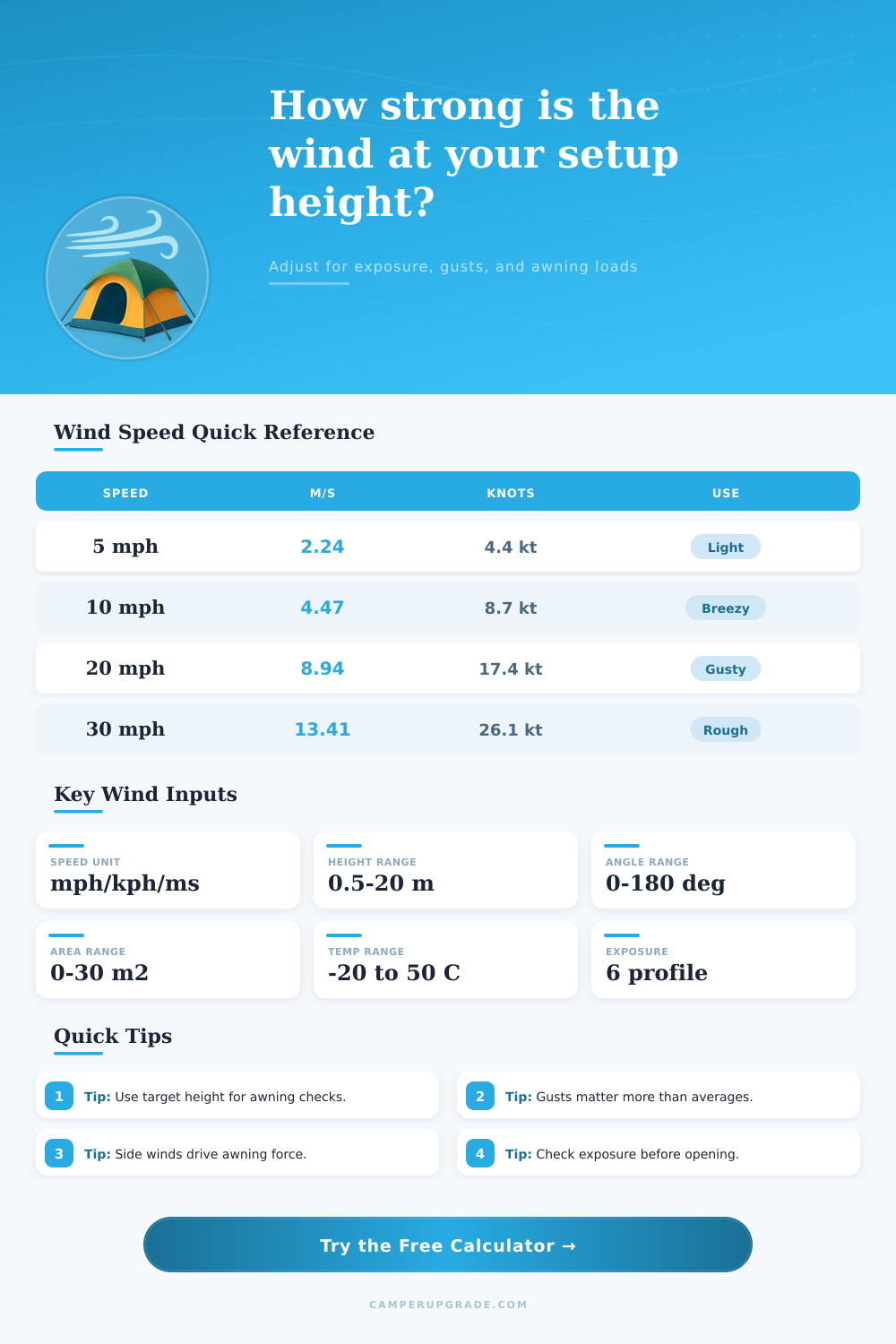
Adjust wind for height, exposure, gusts, and awning load checks at a campsite or RV stop.
📍Campsite Presets
⚙Wind Inputs
📊Wind Model Spec Grid
📘Wind Speed Reference Tables
| Unit | To m/s | To mph | To knots |
|---|---|---|---|
| 1 mph | 0.447 | 1.000 | 0.869 |
| 1 kph | 0.278 | 0.621 | 0.540 |
| 1 m/s | 1.000 | 2.237 | 1.944 |
| 1 kt | 0.514 | 1.151 | 1.000 |
| Exposure | Exponent | Typical Scene | Use Case |
|---|---|---|---|
| Open Water | 0.10 | Few barriers | Harbor edge |
| Open Field | 0.14 | Flat terrain | Most camps |
| Suburban | 0.22 | Low buildings | Mixed shelter |
| Woodland | 0.28 | Dense cover | Deep shelter |
| Speed Band | m/s | Behavior | Camper Note |
|---|---|---|---|
| Light breeze | 1.6-3.3 | Small sway | Easy setup |
| Fresh breeze | 5.5-7.9 | Awning tug | Watch clips |
| Strong breeze | 8.0-10.7 | Load rises | Stow loose gear |
| Near gale | 10.8-13.8 | Hard gusts | Close awning |
| Awning Area | 12 mph | 20 mph | 30 mph |
|---|---|---|---|
| 6 m2 | 81 N | 225 N | 506 N |
| 8 m2 | 108 N | 300 N | 675 N |
| 10 m2 | 136 N | 375 N | 844 N |
| 12 m2 | 163 N | 450 N | 1012 N |
When placing an awning at a campsite, there are many factor to consider. Two of the factors to consider are the wind speed and an wind direction. Many peoples use weather applications to determine the wind speed at there location, but these applications typically take the measurements at 10 meter.
The awning is placed at a lower height; therefore, the wind speed will be differents at the awning location. It is essential to adjust for this when determining the actual wind speed that will impact the awning. Another factor to consider are the terrain at the camping site.
Check the wind and site before setting up an awning
The terrain can impact the wind speed at the site. For instance, in an open field, the wind speed increase with the height. However, in a wooded area, trees create friction for the wind, which impact the wind speed.
Therefore, wind speed will be lower in a wooded area then in an open field. This factor should of been considered when determining the wind speed at the campsite. Another important factor to consider is the gust in the wind.
A gust is a temporary increase in the wind speed that can be twice the recorded wind speed. The additional force that the gust create can overload the clips and the poles of the awning. Therefore, you must consider the gusts of the wind when determining the safety of an awning.
The angle of the wind is also important. For instance, a headwind will impact the awning different than a crosswind. A crosswind will apply more force to the awning; it act like a sail.
The force of the wind also relate to the density of the air and the temperature of the air. Cold air is denser than warm air. Therefore, the force of the wind will be stronger on the awning when the air is colder, as dense air will impact the awning more than less dense warm air.
The temperature of the area should be consider. The total force on the awning is equal to the density of the air times the speed of the wind squared times the area of the awning times a coefficient of pressure. Intuition would dictate that a large awning would experience more force from the wind then a small awning.
If the crosswind speed is high enough, the awning should be retract to prevent damage to the awning. For instance, if the crosswind speed is 12 mph or more, the awning should be retract. If the wind speed is under 3.3 meters per second, it is considered a light breeze.
If the wind speed is past 10.8 meters per second, it is considered to be a near gale. Monitoring the wind speed will allow a campsite visitor to determine when to retract the awning. Many individuals will make mistakes when placing an awning at a campsite.
For instance, they will calculate the average wind speed and fail to account for the gusts that could overload the awning. They may also fail to consider the area of the awning. Another mistake is assuming that the wind speed at 10 meters is the same as the awning.
To avoid these mistake, calculate the force of the wind at the awning site using the terrain, the height of the awning, and the angle of the wind. One way to choose the camping site is by choosing the lee side of a ridge. The ridge will block the wind from the campsite, which reduce the wind speed at the site.
Campers should be aware that the highways and lakes in the area may impact the wind at the site. Highways can create strong gusts of wind due to the trucks that travels the highway. Additionally, lakes can allow the wind to funnel through the area during the evening.
By choosing a camping site that is sheltered from the wind, campers can reduce the force of the wind on the awning. By following these guidelines for determining the safety of an awning at a campsite, campers can ensure that the awning is safe from damaging winds.