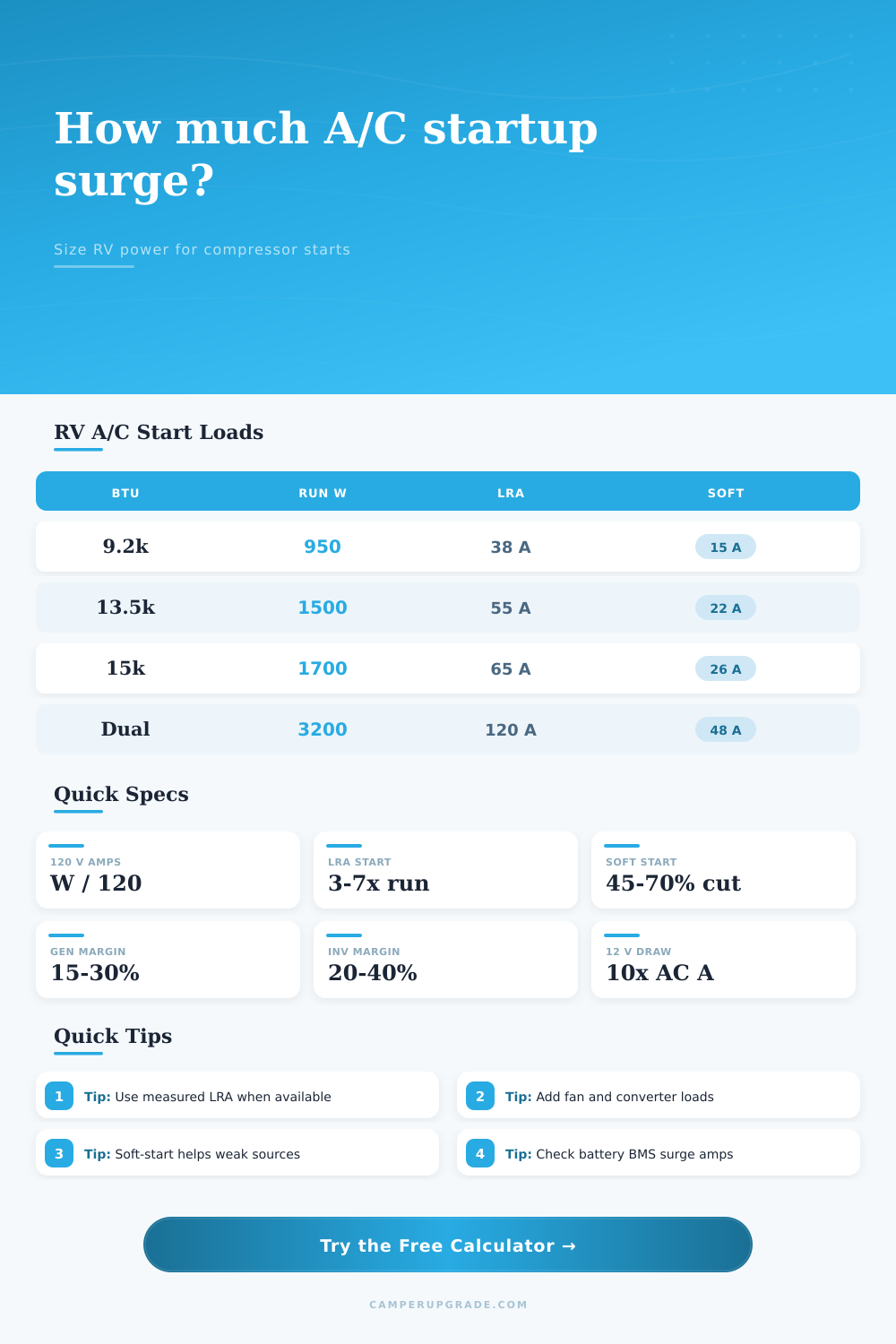
RV Air Conditioner Startup Surge Calculator
Estimate compressor starting watts, soft-start reduction, generator or inverter headroom, and battery-side DC current for one RV air conditioner start event.
Startup sizing breakdown
| A/C size | Typical running watts | Typical running amps at 120V | Common LRA range |
|---|---|---|---|
| 8,000 BTU compact or window unit | 700 to 950 W | 5.8 to 7.9 A before power-factor effects | 28 to 42 A |
| 9,200 to 11,000 BTU low-profile rooftop | 900 to 1,250 W | 7.5 to 10.4 A before power-factor effects | 35 to 50 A |
| 13,500 BTU standard rooftop | 1,300 to 1,650 W | 10.8 to 13.8 A before power-factor effects | 48 to 62 A |
| 15,000 BTU ducted rooftop or heat pump | 1,550 to 1,900 W | 12.9 to 15.8 A before power-factor effects | 58 to 75 A |
| Two rooftop units started one at a time | 2,700 to 3,500 W combined running | 22.5 to 29.2 A before power-factor effects | Use the highest single LRA plus the other unit running |
| Startup method | Reduction to use | Example 60A LRA result | Use when |
|---|---|---|---|
| No soft-start module | 0% | 60 A start estimate | Factory capacitor only, no measured reduction available. |
| Hard-start capacitor kit | 5% to 15% | 51 to 57 A estimate | May shorten start duration but usually does not make inverter use easy. |
| Basic soft-start after learning | 45% to 55% | 27 to 33 A estimate | Common setting for one rooftop unit on a small generator. |
| Well-tuned soft-start with verified clamp reading | 60% to 70% | 18 to 24 A estimate | Use only when measured starts are repeatable under warm conditions. |
| AC load at inverter output | 12.8V DC draw at 90% | 24V DC draw at 90% | 48V DC draw at 90% |
|---|---|---|---|
| 1,500 W running load | 130 A DC | 69 A DC | 35 A DC |
| 2,200 W running load | 191 A DC | 102 A DC | 51 A DC |
| 4,000 W starting surge | 347 A DC | 185 A DC | 93 A DC |
| 6,000 W starting surge | 521 A DC | 278 A DC | 139 A DC |
| 8,000 W starting surge | 694 A DC | 370 A DC | 185 A DC |
| Source | Nominal power | What usually limits startup | Practical calculator note |
|---|---|---|---|
| 15A household outlet | 1,800 W at 120 V | Breaker trip, cord voltage drop, converter load | Usually needs soft-start and reduced RV loads. |
| 30A RV pedestal | 3,600 W at 120 V | Shared coach loads and low campground voltage | One A/C is normal; two loads require active management. |
| 50A RV pedestal leg | 6,000 W per 120 V leg | Panel leg balance and simultaneous starts | Stagger compressor starts when possible. |
| 2,000 to 2,200 W inverter generator | 1,600 to 1,800 W running, 2,000 to 2,200 W surge | Short surge rating and compressor inrush | Often requires soft-start, eco mode off, and few other loads. |
| 3,000 to 3,500 W RV generator | 2,600 to 3,200 W running, about 3,000 to 3,500 W surge | Altitude derate and converter draw | Common target for one soft-start rooftop A/C. |
running amps = running watts / voltage / power factor.adjusted start amps = LRA or measured start amps x (1 - soft-start reduction).startup surge watts = adjusted start amps x AC voltage + fan watts + other active RV watts.battery-side amps = AC watts / battery voltage / inverter efficiency.
An RV’s air conditioner is one of its biggest power drains, and many times the first time you try to cool down your parked trailer your generator trip or your inverter shuts down. The lights will flicker, the fridge will shut off, and then your generator will trip because it can’t handle that big hit of power on startup.
Everyone knows the air conditioner’s running wattage, but not many know its surge wattage. That is the short second hit of power required to get compressor going and if your equipment can’t handle that you are going to either have problems or find new equipment. Running current is normal amount of electricity your device draws while it is operating normaly. Most roof-top units pull anywhere from three to seven times their normal amperage during startup.
Why RV Air Conditioners Use So Much Power
For example, a typical thirteen-point-five thousand BTU unit might operate at fifteen-hundred-watts but could require as much as six-thousand (or more) watts during startup. The inverter protects itself by shutting down or the breaker trip if power source can’t accommodate that spike. Bottom line: Sizing equipment strictly by steady-state load won’t work.
That’s why the calculator above do this very math for you. Inrush current is reduced by 50% or better with a soft-start module that lets compressor spin up gradually. That cuts the demand down to where an air conditioner can be run on a generator as small as three thousand watts without blowing its circuit. The tool takes that into account and if you fiddle with the soft-start percent setting, you’ll see that needed surge wattage goes way down. Not magic, but physics, you’re paying for convenience of a quicker startup in terms of less current draw.
Also remember that your battery provides power to an inverter, which then generates house electricity with a slight loss of efficiency. This means there is also a DC side of the equation if you are running off a bank of batteries. A big surge of electricity on the AC side mean a huge surge in amperage on the DC side. This isn’t good for battery chemistry, fuses, or cables.
For example, a 4 kilowatt surge on the AC side equates to a 300-amp surge on the battery side (refer to the table on the page). Many people misunderstand this and order an inverter according to its watt rating but not the amperage limit on the DC side of their battery management system.
A third variable is one you can easily forget: Heat and altitude reduce the amount of power a generator output. A three-thousand watt generator running at sea level may provide two thousand five hundred watts at eight thousand feet. This means if you’re heading into the mountains, you want that additional buffer. This device accounts for those variables so you don’t think it’s going to give you X and then fail to do so. You’d rather discover ahead of time that you have a very small margin, rather than after thermostat kicks on.
The average day is easy. A hot July afternoon is not. Your system gets tested when it’s a hot July afternoon with the AC cycling on, the converter charging your house batteries, and the fan running. Combined loads reveal what your system is made of. When you see both your continuous load and your startup surge, you’ve got a complete picture. You stop guessing if you can handle the heat in your current setup.
Maintain healthy margins and keep the math simple and you’ll keep the air flowing. You should of used this tool sooner.