RV 50 Amp Leg Balance Calculator
Compare L1 and L2 loads on a 120/240V RV pedestal, estimate usable reserve, neutral current, total watts, and momentary start-surge pressure.
| RV load | Running amps | Panel leg | Duty note |
|---|---|---|---|
| Front A/C compressor | |||
| Rear or bedroom A/C | |||
| Third A/C or heat pump | |||
| Microwave / convection oven | |||
| Electric water heater element | |||
| Converter / battery charger | |||
| Residential refrigerator | |||
| Fireplace or space heater | |||
| Washer / dryer circuit | |||
| Kitchen small-appliance outlets | |||
| Custom circuit or inverter pass-through |
50 amp leg balance results
| Service point | Value used by calculator | Formula | Planning meaning |
|---|---|---|---|
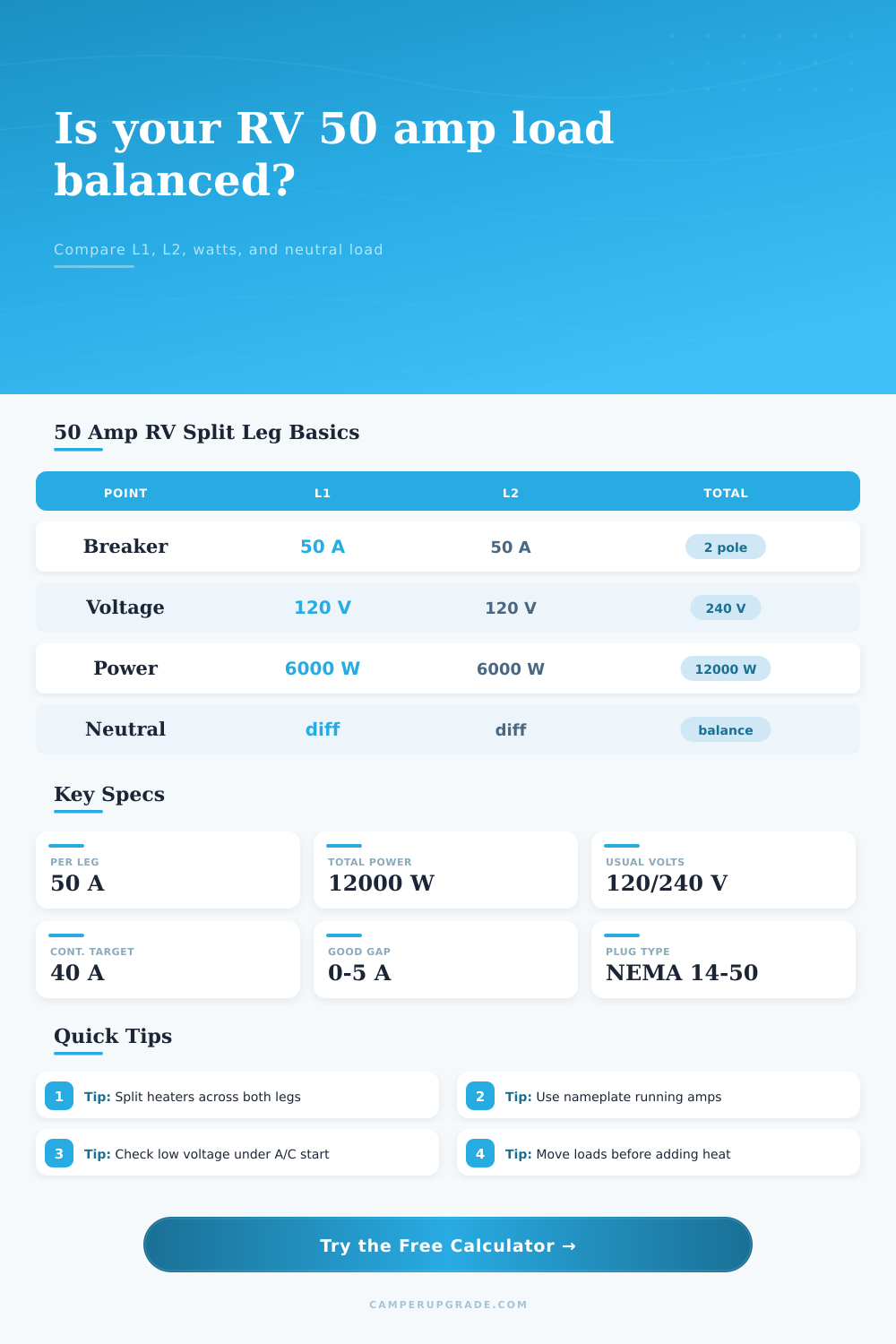
| Each hot leg | 50 amps at about 120V | Leg watts = amps x volts | L1 and L2 are checked separately against the breaker limit. |
| Total theoretical output | About 12,000 watts | 50A x 120V x 2 legs | Total watts can look acceptable while one leg is still overloaded. |
| Neutral current estimate | Difference between legs | | L1 amps - L2 amps | | On split-phase 120V loads, balanced legs reduce neutral current. |
| Both-leg load entry | Adds amps to L1 and L2 | L1 + amps, L2 + amps | Use for rare 240V or split loads that pull equally from both legs. |
| Usable planning limit | Breaker amps minus reserve | Service amps x (1 - reserve) | Reserve is a planning cushion, not a breaker replacement. |
| Load | Typical running amps | Common breaker | Balance note |
|---|---|---|---|
| 13.5k BTU roof A/C | 12 to 14A | 20A | Usually the largest steady summer load. |
| 15k BTU roof A/C | 13 to 16A | 20A | Start surge can briefly add much more than running amps. |
| Electric water heater | 11 to 13A | 15A | Easy load to move by switching to propane if needed. |
| Microwave oven | 10 to 15A | 15A or 20A | Short use, but it stacks badly with A/C on the same leg. |
| Converter charger | 3 to 12A | 15A | Can be high after arrival when batteries are low. |
| Electric fireplace | 12 to 13A | 15A | Often the cold-weather load that tips one leg over target. |
| Residential refrigerator | 2 to 5A | 15A | Small running load, but keep start surge in mind. |
| Washer or dryer cycle | 8 to 16A | 15A or 20A | Check the appliance plate because RV laundry loads vary widely. |
| Result condition | Leg gap | High leg percent | Suggested calculation action |
|---|---|---|---|
| Well balanced | 0 to 5A | Under 80% | Keep major heating and cooking loads where they are. |
| Usable but uneven | 5 to 10A | Under 90% | Move one 5A to 10A load from the higher leg to the lower leg. |
| Tight reserve | Any gap | 90% to 100% | Reduce optional electric heat, water heating, or kitchen loads. |
| Likely overload | Any gap | Over 100% | The high leg exceeds the selected usable planning limit. |
| Start-surge risk | Varies | Peak over 100% | Stagger A/C compressor starts or shed loads before startup. |
| Connection | Usable conductors | Typical maximum | Calculator note |
|---|---|---|---|
| 50A RV shore pedestal | L1, L2, neutral, ground | 50A per leg | Use the normal split-leg balance calculation. |
| 50A RV generator output | Usually split 120/240V or dual 120V legs | Often below 50A per leg | Enter the generator's rated amps per leg. |
| Energy management limit | Same shore wiring, lower allowed load | User selected | Lower the breaker rating or raise the reserve percent. |
| 50A to 30A dogbone | Single 120V hot leg supply | 30A total | Do not treat it as two independent 50A legs. |
The lights flash back on as you plug in that fifty-amp cord. You feel right at home in your RV…until dinnertime. You want to use the microwave, but the breaker trips.
It is a great power struggle between air conditioning and microwave. It’s an all-too-familiar battle waged each summer at campgrounds everywhere. And while it might not be because there isn’t enough power, per se, its a question of how that power are distributed.
How to Balance Your RV Power
It is twelve thousand watts. Sounds like a lot, right? Well, here’s the kicker: it comes in on two different hot legs. Each leg have fifty amps and one hundred twenty volts of electricity running through it.
When both reach max at the same time, the breaker flips off to avoid a fire; no matter how much slack exist on the other end. Most RVers treat electricity like water. They assume total wattage is what matters. Well, that’s where they’re mistaken.
Electricity isn’t just one thing; it has two legs, separate circuit. A difference in watts between those legs flow back into your electric system through the neutral line. Leg One draws 40 amps, leg two draws 10? Thirty amps will flow up the neutral line. Both pull 40 amps? Zero amps will flows up the neutral.
Your electrical panel can handle a certain amount of amperage safely. When you keep those loads balanced you’ll see lower amps on your neutral line. Lower amps mean the breaker won’t trip and ruin everyone’s dinner party.
But how can you see that split before you get there? This page has a calculator. Put in your major appliance. What are they? Microwave oven. It is an electric water heater. They are roof mounted air conditioner. Assign them to leg one or leg two.
The tool totals their amps on both sides, then it figures out the imbalance. And it includes a planning reserve, which is an empty buffer. It takes care of voltage drop due to a long shore cord. It takes care of breaker heat buildup.
Most folks go all the way to the fifty-amp limit. That’s risky! Keep a ten percent reserve. That puts you safely in the green zone.
The biggest load first. Generally air conditioners is the biggest of all. While they are running they will generaly pull between fourteen and sixteen amps apiece. That means if you plug both into the same leg, you’ve just taken up half of your capacity on that leg. You want to stagger them. Plug the front one into leg one. Plug the back one into leg two.
Next, look at flexible loads. Electric water heater can be moved easily. Turn them off. When you don’t need hot water, move the water heater to the leg where there’s less load on it. Same thing with electric fireplaces or space heaters in the winter.
Note: The initial surge when a compressor first engage pulls such a huge amount of current for several seconds. The calculator allows you to account for that surge. That way you know whether or not the reserve should of be able to handle it. If the peak usage is more than your available capacity, even though your running load may look acceptable, you’ll trip the breaker. That’s why having the “summer two A/C” preset is so helpful. It shows just how easily two A/C units plus a kitchen load can turn the tables.
For starters, those are common amperages for your average RV appliance and they’re laid out in the reference tables on the page. But if you have access to a clamp meter, check it yourself. A residential fridge draws less than a built-in one. An air conditioner draws like a high wattage microwave does.
You want to maintain a difference no greater than five amps between the two legs. Less then that is great balance. If it is ten amps or more, it is time to do some plug shuffling. Imagine that panel as a seesaw. Your goal is for the seesaw to be level. If there’s too much on one side, you add weight to the other side. When the weight are evenly distributed, it levels off. And no, you don’t have to get it exact. Do just enough so that the lights won’t shut down.
When you plan your load now, instead of playing the guessing game, you’re able to strategize. No more battling with the breaker. More about controlling the energy flow. Next time you’ll know exactly what devices caused the load imbalance. Know how to correct it before the lights shut off.
A little tweak but one that can make all the difference between having a comfortabley stay or no electricity at all.