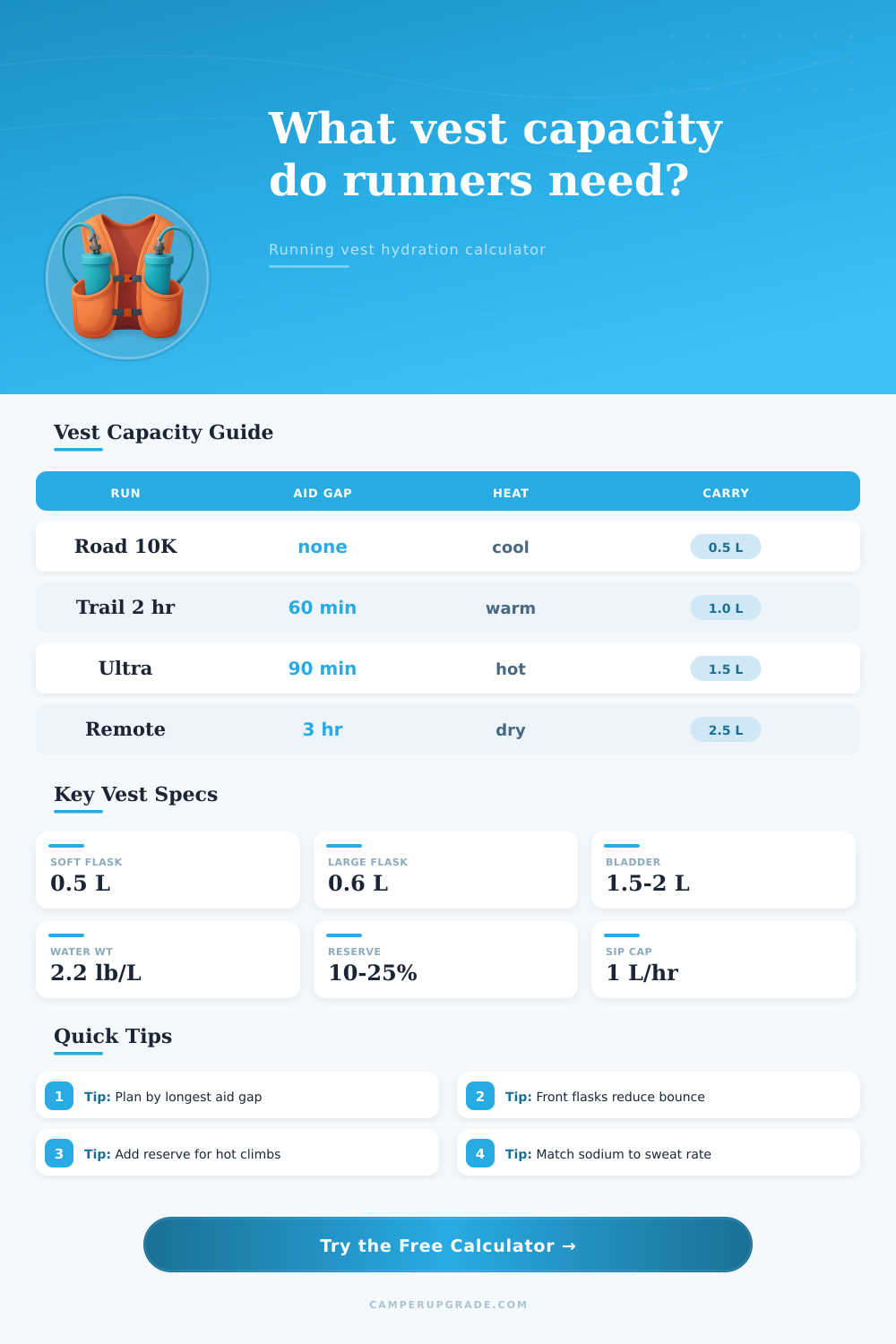
Running Vest Hydration Capacity Calculator
Estimate flask, bottle, and bladder capacity for road runs, trail races, ultras, unsupported loops, and hot-weather training from pace, aid gaps, terrain, weather, sweat profile, and vest fit.
🏃Running Vest Presets
📝Run And Vest Inputs
Include warmup, cooldown, and any off-route water detours.
Use elapsed time between start and finish, not moving-only time.
This drives starting vest capacity more than total distance.
Climb density raises effort and bottle demand per mile.
Use the warmest expected portion of the route.
Humidity increases heat strain even when pace stays steady.
Sets the base liters per hour before conditions are applied.
Terrain affects sweat rate and realistic refill timing.
Higher intensity raises hourly fluid demand.
Sun, wind, and reflected heat change vest capacity needs.
Count bottles you can reach without removing the vest.
Common soft flasks are 0.5 L or 0.6 L each.
Enter 0 if you run flask-only.
Use for a stowed bottle, filter bottle, or collapsible backup.
The load you can carry without serious bounce or rib pressure.
Reserve covers missed aid, heat spikes, or slower pacing.
Lower fill levels need more nominal capacity for the same water.
Most runners cannot absorb unlimited water at race intensity.
Use your drink mix or capsule plan per liter carried.
This planning tool estimates fluid volume, not medical hydration advice. Adjust to thirst, urine color, race rules, heat alerts, and your own tested sweat rate.
Your Running Vest Hydration Plan
📊Capacity Snapshot
📘Running Vest Reference Tables
| Vest setup | Typical capacity | Best use | Watch point |
|---|---|---|---|
| Handheld bottle | 0.3-0.6 L | Road runs, short trail loops, races with frequent aid | Hand fatigue and uneven carry |
| Two front soft flasks | 1.0-1.2 L | Half marathon trails, 2 hour runs, fast races | Chest fit and straw height |
| Flasks plus small bladder | 1.8-2.5 L | Mountain runs, warm 25K to 50K, long aid gaps | Rear slosh if bladder is half full |
| Large bladder plus flasks | 2.5-3.5 L | Remote ultras, desert training, unsupported pushes | Weight, bounce, and shoulder pressure |
| Condition band | Common rate | Capacity cue | Practical adjustment |
|---|---|---|---|
| Cool easy run | 0.3-0.5 L/hr | One flask may be enough | Do not skip reserve on remote routes |
| Warm trail effort | 0.5-0.8 L/hr | Two flasks or small bladder | Refill before long exposed climbs |
| Hot race effort | 0.8-1.1 L/hr | Vest plus confirmed aid timing | Pair fluid with sodium plan |
| Desert or radiant heat | 1.0-1.4 L/hr | Large carry and larger reserve | Shorten gaps or cache water |
| Container | Nominal volume | Usable planning volume | Notes |
|---|---|---|---|
| Small soft flask | 0.35 L | 0.30-0.35 L | Good for gels, sports drink, or short racing |
| Standard soft flask | 0.50 L | 0.45-0.50 L | Most common front vest bottle size |
| Large soft flask | 0.60 L | 0.50-0.60 L | Useful when aid gaps are just beyond two bottles |
| Rear reservoir | 1.5-2.0 L | 1.3-2.0 L | Best when long gap volume exceeds front carry |
| Route example | Elapsed time | Aid gap | Suggested carry |
|---|---|---|---|
| Urban half marathon training | 1.5-2.2 hr | 0.5-1 hr | 0.5-1.0 L plus refill access |
| Trail 25K with climbs | 2.5-4 hr | 1-1.5 hr | 1.0-1.5 L in front flasks |
| Warm 50K race | 5-9 hr | 1.5-2.5 hr | 1.5-2.5 L with bladder option |
| Remote mountain traverse | 6-12 hr | 2.5-4 hr | 2.0-3.5 L and route-specific reserve |
💡Vest Planning Tips
For me, the best amount of water in my running vest is just enough for the longest distance between aid stations, but not so much that I slow down or have it bounce around. That’s different for each run, depending on conditions. You may need very little water on a cool loop on the road, while a hot day traversing mountains will drain bottles fastly. Try to gauge how your body feels before the next source point.
When you plug in your distance, time, and longest stopgap, that’s all the math the calculator does for you. It sounds obvious, but this is what most runners don’t know: length of their gap matters far more then the distance or time of the race. A short, often-stationed race could still be too much if the gap hits the hot spot.
How to Choose the Right Amount of Water for Running
Then there’s the base sweat rate: Enter in weather factors like heat, humidity, and whether it’s sunny out, which will help you fine tune to a close guess. No two routes scales the same way for heat and effort. A technical uphill with the sun blasting down will make you lose more fluids than on a level, shady path for the exact same distance.
You also has to consider sweat profile and intensity: some people loses more water and salt than others while running at the same pace. A bladder mounted at the rear vs. A flask in the front affects both the feel of the weight as well as drinking ease. It tells you how much water you’ll have available at any time before you stop. And it tells you how many refills you’re likely to need; and whether that total weight is over your comfortly threshold.
That eliminates the error of lugging more than needed “on principle,” because now you know. It’s an easy thing to do (like when I was young) but it’s uncomfortabley.
That page has reference tables that set up what is normal for various types of conditions and route length. The tables aren’t rules, but when you don’t know how to compare your previous races to a new one they provide a starting point from which you can add a cushion for missed aid or slower pacing. That way you won’t have to guess at how much that adds to your total weight.
Runners vastly underestimate how rapidly their situation change as they go. The climbing gets steeper. Sun out? The calculator makes those shifts visible before you are on the trail with an empty bottle. Also: the gut-absorption limit stays in sight; relevant if the numbers tell you you need more water than you can comfortable drink in an hour. This is the point at which you’d typically reduce effort or decrease the gap instead of just increasing size of your carrying capacity.
You should of considered this earlier. Run the numbers on your longest unsupported section first. Then see if all the numbers fit comfortably within your vest. This will eliminate most of the guessing, and it will keep your day’s weight honest when you finally get out there to run.