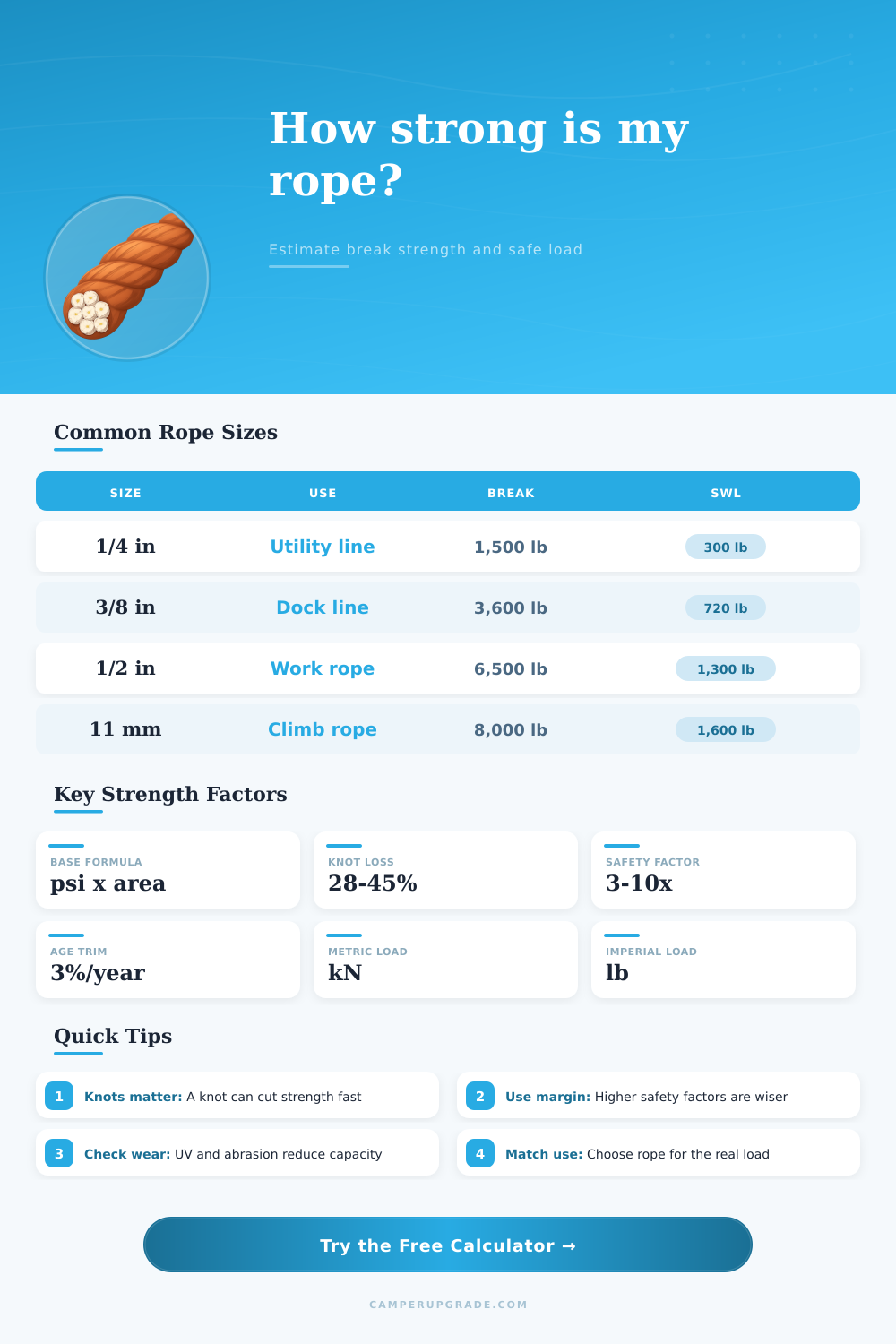
Rope Tensile Strength Calculator
Estimate breaking load, safe working load, knot loss, and rope weight with metric and imperial support.
| Rope Size | Typical Use | Break Load | Working Load |
|---|---|---|---|
| 1/4 in | Utility line | 1,500 lb | 300 lb |
| 3/8 in | Dock line | 3,600 lb | 720 lb |
| 1/2 in | Work rope | 6,500 lb | 1,300 lb |
| 11 mm | Climb rope | 8,000 lb | 1,600 lb |
| Factor | Range | Effect | Note |
|---|---|---|---|
| Condition | 1.0-0.55 | Wear loss | Age matters |
| Knots | 0.72-0.55 | Big loss | Shortest path |
| Bend ratio | 12:1+ | Higher is better | Use larger sheaves |
| Safety factor | 3-10x | More margin | Depends on task |
| Use Case | Material | Factor | Comment |
|---|---|---|---|
| Climbing | Kernmantle | 0.94 | Dynamic stretch |
| Docking | Polyester | 0.96 | Low stretch |
| Winching | HMPE | 0.98 | Light and strong |
| Rigging | Nylon | 0.88 | Shock absorbs well |
Use the real rope type: Construction changes strength as much as diameter.
Do not ignore knots: A neat knot can still remove a large share of strength.
Rope strength is a complex subject because there is a difference between the strength that the rope manufacturer state the rope has and the actual strength of the rope when it is in use in the real world. The manufacturer states the breaking strength of the rope, which is the maximum amount of load that the rope can hold when being straightly pulled in a laboratory. However, when the rope is in use, it may fail under much less then the breaking strength.
Factors that may degrade the strength of a rope while in use include the use of knots, bend in the rope, sunlight, salt, and the age of the rope. Material is the first decision to be made in the selection of a rope. Some of the most common materials for ropes include nylon, polyester, HMPE, and natural manila.
How to Choose and Use Rope Safely
Nylon will stretch under a heavy load, which makes it appropriate for situation where a shock load is expected. Polyester will have less stretch than nylon. HMPE is a lightweight material that is very strong, but it can wear down certain sheaves.
Natural manila is a natural product, but it will absorb water and lose it’s gripping ability when it is in damp conditions. You must choose the material of the rope according to the task it will perform. The wrong rope for the task will not perform well.
The construction of the rope is the next consideration. For example, kernmantle ropes have a core and a sheath, which protect the core. Double-braid ropes are constructed to bite into a winch so the rope will not slip.
Three-strand twist ropes are less expensive but lose their strength when they are around a sharp bend. Additionally, the weave of a rope will allow more strength in a braided rope than in a twisted rope. Another reason for rope strength loss is the use of knots.
Any time that a rope is knotted, its fibers is pinched, which weakens the rope. For example, a figure-eight knot weakens a rope to 70% of its original strength, and a bowline knot weakens it to 66%. In these cases, professional often use an eye splice instead of a knot to maintain the strength of the rope.
However, another consideration is the bend radius of the rope. If a rope is bent around an object with a diameter smaller than 12 times the rope’s diameter, the rope’s fibers will be crushed, which will weaken the rope. Another factor that weakens a rope is the age and environmental exposure to sunlight and salt air.
Sunlight contains UV rays that unravel the polymer in the rope. Similarly, salt air and wet nylon will degrade a synthetic rope. Over time, a rope may only have 85% of its original strength.
If the rope is weathered or worn, it may only have 67% of its original strength. In both of these situation, the rope should be inspected for fuzz or flat spots in the rope, which are indicators of worn rope. To manage the inherent uncertainty of the strength of the rope, a safety factor is used.
The safety factor is a ratio used to show how much the actual load of the rope will be compared to the percentage of the breaking strength that is considered a safe load. For even the most steady of lifts, a safety factor of three times the breaking strength of the rope is used. For dynamic situation, a safety factor of ten times the breaking strength is used.
You can calculate the utilization of the rope by dividing the peak load by the breaking strength. If the utilization of the rope is under 20%, then there is a large margin of safety for the rope. However, if the utilization of the rope is near 80%, then the rope is near the limit of its strength.
Another consideration in the selection of the rope is its length and in what environment it will be used. The longer the rope, the more the rope will weigh. If the rope is to be used in a rescue, a heavier rope will be more difficult to manage.
The environment in which the rope will be used will also change the math based off the strength of the rope. A new rope that has not been exposed to sunlight or salt will be stronger than a rope that has been exposed to these elements over time. Therefore, when making a decision about the rope that will be used, each of these factor must be considered.
For instance, if a rope is to be used to rig a tree limb, a nylon double-braid rope with spliced eye and large pulleys will be chosen. If, however, a different material is chosen, such as polypropylene, then the rope will have to be of a larger diameter since polypropylene is less strong than nylon. Many people make mistakes when they use ropes.
For example, they may choose a large diameter rope but the wrong material. They may use knots instead of eye splice to connect two ropes. In addition, they may not use the correct bend ratios on the pulleys, and they may not account for dynamic forces when calculating the peak load.
To avoid these mistakes, you can use reference tables to determine the strength of the materials and the strength losses due to knots. Additionally, there are tools to calculate the breaking strength of the rope, the safe load of that rope, and the utilization of the rope. However, these calculations are only estimates of the actual strength of the rope.
Therefore, individuals must visually inspect and test the rope before using it if there is any suspicion that it may be damaged. You should of checked the ropes condition first. It is alot more safe to be careful.
There is many ways to fail if you dont check teh equipment. Use moddern methods to keep things safe. It is better to be safe than sorry.