Rope Rappel Doubled Length Calculator
Estimate max rappel drop, safe usable length, tail margin, and retrieval risk from rope length, strand setup, anchor height, knots, stretch, pull side, reserve, terrain wandering, and shrinkage.
🧭Rappel Presets
⚙️Rope and Anchor Inputs
📊Rope Spec Grid
📋Rappel Length Reference Tables
| Rope Length | Doubled Before Losses | Doubled With 10 ft Reserve | Single Strand Before Losses |
|---|---|---|---|
| 30 m / 98 ft | 49 ft / 15 m | 39 ft / 12 m | 98 ft / 30 m |
| 40 m / 131 ft | 66 ft / 20 m | 56 ft / 17 m | 131 ft / 40 m |
| 50 m / 164 ft | 82 ft / 25 m | 72 ft / 22 m | 164 ft / 50 m |
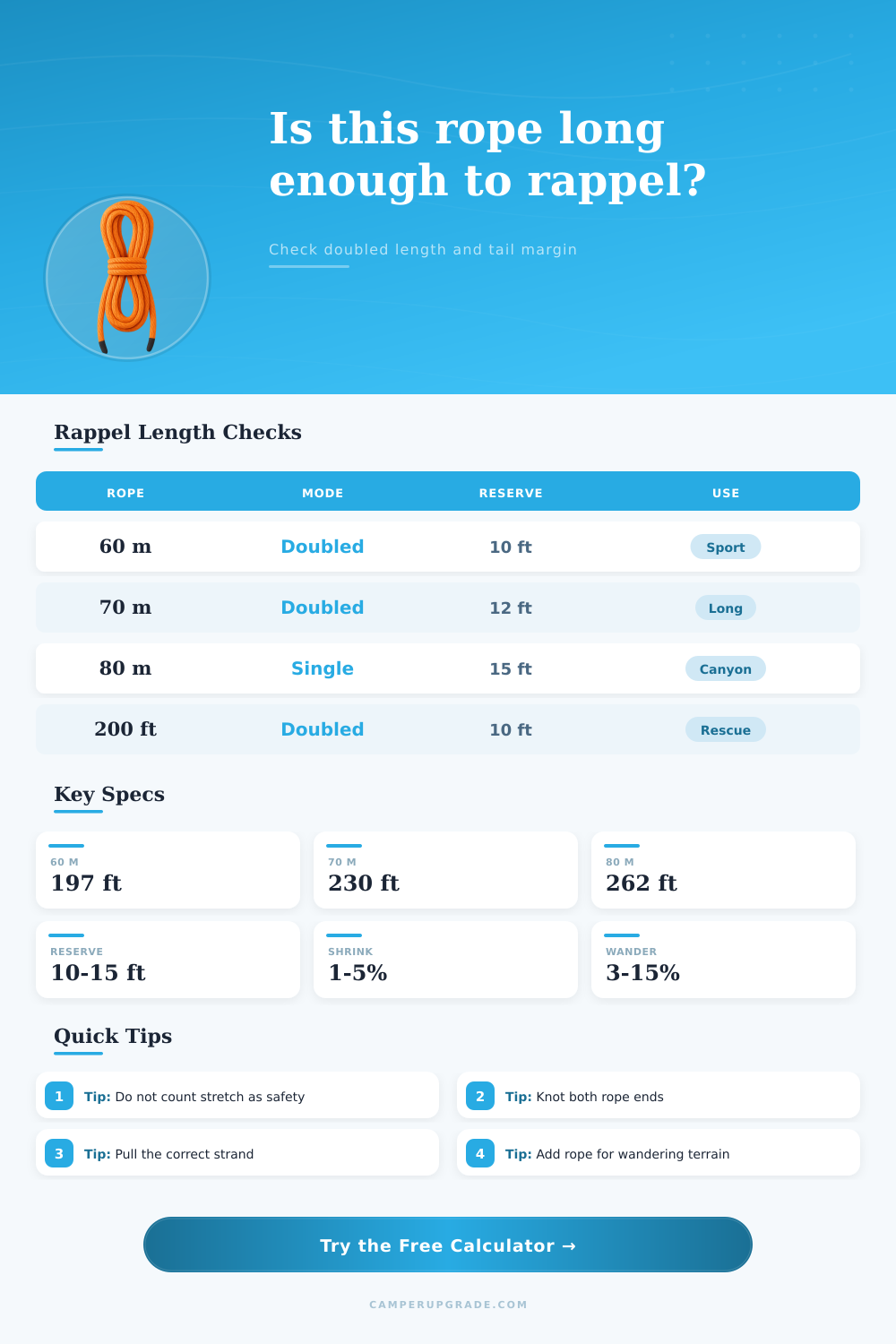
| 60 m / 197 ft | 98 ft / 30 m | 88 ft / 27 m | 197 ft / 60 m |
| 70 m / 230 ft | 115 ft / 35 m | 105 ft / 32 m | 230 ft / 70 m |
| 80 m / 262 ft | 131 ft / 40 m | 121 ft / 37 m | 262 ft / 80 m |
| Setup | Length Rule | Retrieval Check | Primary Risk |
|---|---|---|---|
| Doubled rope, centered | Usable drop is roughly half the rope minus losses. | Pull either correct side after ends are safe and clear. | Uneven ends or rope too short. |
| Doubled two-rope join | Each strand length depends on equalization and knot tails. | Pull the strand that moves the joining knot away from the anchor hardware. | Knot catching at rings, cracks, or edges. |
| Single strand block | Usable drop can approach full rope length minus losses. | Pull the unweighted retrieval side specified by the block system. | Wrong-side pull or jammed block. |
| Single with pull cord | Main line length sets rappel reach; pull cord must reach the stance. | Confirm pull cord routing and knot cannot pass through hardware. | Complexity and thin-cord handling. |
| Reserve | Use | When to Add More | Calculator Effect |
|---|---|---|---|
| 5 ft / 1.5 m | Controlled practice with visible rope ends. | Rarely enough outdoors. | Higher max drop, less safety buffer. |
| 10 ft / 3 m | Common conservative crag planning reserve. | Use more for night, poor visibility, or uneven ends. | Balanced default in presets. |
| 15 ft / 4.5 m | Canyons, ledges, or awkward next anchors. | Use when stance is uncertain. | Lower max drop, better tail margin. |
| 20 ft / 6 m | High uncertainty or training buffers. | Use when rope length is not freshly measured. | Strongly reduces allowed drop. |
| Knot or Rope-End Setup | Allowance Used | Why It Reduces Length | Field Check |
|---|---|---|---|
| No stopper knots entered | 0 ft / 0 m | No calculator length loss, but no closed-system allowance. | Only appropriate if a qualified setup calls for it. |
| Stopper knots in both ends | 3 ft / 0.9 m | Accounts for knots and small tails at the ends. | Dress and tighten knots; confirm both ends reach. |
| Bulky stopper knots | 5 ft / 1.5 m | Allows extra tail, bulky knots, or uneven ends. | Use when visibility or rope handling is poor. |
| Two-rope join knot | 7 ft / 2.1 m | Allows knot tails and a conservative unevenness buffer. | Make sure the pull side moves the knot correctly. |
| Single strand block knot | 8 ft / 2.4 m | Reserves rope around the blocking system and tails. | Confirm the block cannot pass through the anchor. |
| Terrain Wandering | Extra Rope Used | Common Example | Planning Advice |
|---|---|---|---|
| Straight free-hanging | 0% | Clean vertical rappel with visible landing. | Still verify ends and anchor height. |
| Slightly angled wall | 3% | Typical face rappel with mild sideways drift. | Good default when the line is mostly straight. |
| Ledges or uneven wall | 7% | Rope runs over shelves or blocky features. | Add reserve and protect rope from edges. |
| Wandering slab or gully | 12% | Diagonal descent with stance shifts. | Expect tail margin to shrink quickly. |
| Brush, corners, severe drag | 18% | Canyon, tree, corner, or snag-prone descent. | Retrieval risk can matter as much as length. |
| Risk Band | Score | Typical Causes | Response |
|---|---|---|---|
| Low | 0 to 24 | Clear pull, straight line, healthy tail margin. | Still perform partner and end checks. |
| Moderate | 25 to 49 | Some drag, small margin, or uncertainty at the anchor. | Increase reserve, check pull side, test movement. |
| High | 50 to 74 | Wrong-side concern, ledges, sharp lip, or tight length. | Re-rig, choose another anchor, or add rope. |
| Severe | 75+ | Negative margin, severe pull path, or single-strand complexity. | Stop and rebuild the plan with qualified help. |
💡Rappel Length Tips
When using a rope to perform a rappel, the length of the rope that will be available for the rappelling descent must be considered. The length of the rope as listed on the label of the rope is one consideration in determining the length of the rope that will be available for the rappel, but the length of the rope listed on the label is not the length of the rope that will be available for the rappel. Various type of losses in the rope can reduce the length of the rope that can be utilized during a rappel, and each of those types of losses indicates the length of the rope that you must deduct from the length of the rope as listed on the label of the rope to determine the actual length of the rope that will be available for the rappel.
The types of losses that can occur in the rope include the length of the rope that is lost due to knots in the rope, the length of the rope that is lost due to shrinkage of the rope, and the length of the rope that is lost due to the terrain upon which the rappelling will occur. If these losses is not accounted for when determining the length of the rope that will be available for the rappel, it is possible that the rappeller will not have a safe tail at the end of the rappel. A safe tail is the length of the rope that remains on the rappeller feet after the rappelling descent is performed.
How to Calculate Rappel Rope Length
The length of the rope that will be available for the rappel can decrease due to various factor. For instance, the rope can decrease in length after the rope is washed, as the rope often shrinks when washed. Additionally, the length of the rope can decrease due to the knots in the rope.
For instance, the length of the rope can decrease with the formation of knots at either end of the rope, or at the knots that join two separate piece of rope together. Thus, the length of the rope that is available for rappelling will always be less than the length of the label of the rope. Additionally, the length of the rope that is available for rappelling can also decrease due to the terrain upon which the rappelling is to occur.
For instance, if the rappeller must rappel over ledges or into gullies, the length of the rope that is available for rappelling will be less than the length of the label of the rope due to the longer path that the rappeller and rope must travel. Thus, the terrain also has the potential to consume some of the length of the rope, reducing the length of the rappellers safe tail. The rappel rope length calculator can be used to input various variables related to the rappel to calculate the length of the rope that will actualy be available for the rappel.
You can enter the label length of the rope into the rappel rope length calculator. Additionally, it is also possible to enter whether the rappel will use a single strand of rope or a doubled rope. The height of the drop that is to be performed can be entered into the rappel rope length calculator.
The knot allowance for the rappel can also be entered into the rappel rope length calculator. The reserve of the rope that is to be used for rappelling can also be entered into the rappel rope length calculator. The reserve of the rope is the length of the rappeller’s safe tail.
Finally, the percentage of the terrain factor can also be entered into the rappel rope length calculator. The rappel rope length calculator helps to track the retrieval risk of the rappel. The retrieval risk of a rappel is the chance that the rappeller will experience difficulty in retrieving the rope from the rappeller after the rappel has been performed.
If the rappeller plans to perform a rappel using a doubled rope setup, the length of the rope that will be available for the rappel will be less than if the rappel was to use a single strand of rope. For instance, with a doubled rope setup, a 60 meter rope will only be able to allow rappellers to descend 30 meters of that rope. However, with the same 60 meter rope, the length of that rope that can actually be descended will be less than 30 meters if the length of the rope that is consumed by the knots and the safe tail is subtracted from that 30 meters.
A rappel that utilizes a single strand of rope will allow the rappeller to travel a greater distance then a rappel with a doubled rope setup, but using a single strand of rope changes the rules of the rappel in regard to how the rope is to be retrieved after the rappel is performed. There are a variety of mistake that many people make when performing a rappel. For instance, many people do not consider that the length of the rope will decrease due to the stretch of the rope with the load of the rappeller.
Additionally, many people do not consider that the length of the rope that they set aside for rappelling (the rope reserve) may not be enough if the rappeller’s stance when rappelling is awkward. Thus, many people do not consider that the safe tail that they provide for rappelling may be too short when the length of the rope is decreased by a variety of factors. By utilizing the rappel rope length calculator, each of the variables related to the rappel can be made visible within the equation of the rappel.
For instance, the calculation of the rappel rope length calculator can see the length of the rope that will be consumed by the knots at the rappellers end of the rope. Additionally, the length of the rope that will be consumed by the terrain can also be seen within the rappel rope length calculator. Additionally, rappel rope length calculator also allows for the retrieval risk to be seen in relation to the margin of safety of the rappel.
Thus, the rappel rope length calculator does not, however, replace the importance of inspecting the site for rappelling. Furthermore, the rappel rope length calculator also does not replace the importance of receiving qualified training in rappelling from an experienced individual. Instead, the rappel rope length calculator is an essential tool in determining the impact of each of the variables related to rappelling.
For instance, if rappel rope length calculator displays that the rappeller will have a negative margin for the rappel tail, or if the risk of retrieval of the rappeller from the rappel site increases with the decreasing margin of safety, the rappeller should of shorten the rappel drop or add more rope to the rappel site. Thus, the rappel rope length calculator allows the rappeller to make a decision regarding rappelling that is based off the numbers generated by the rappel rope length calculator, instead of making the rappeller’s decision a mere guess.