Rope Length Calculator
Estimate safe cut length from anchor geometry, setup profile, knots, loops, stretch behavior, and reserve margin before you pack or rig.
🪢Preset Scenarios
⚙Rope Planning Inputs
Imperial mode: distances in feet and allowances in inches. Use presets, then adjust for your knot and reserve style.
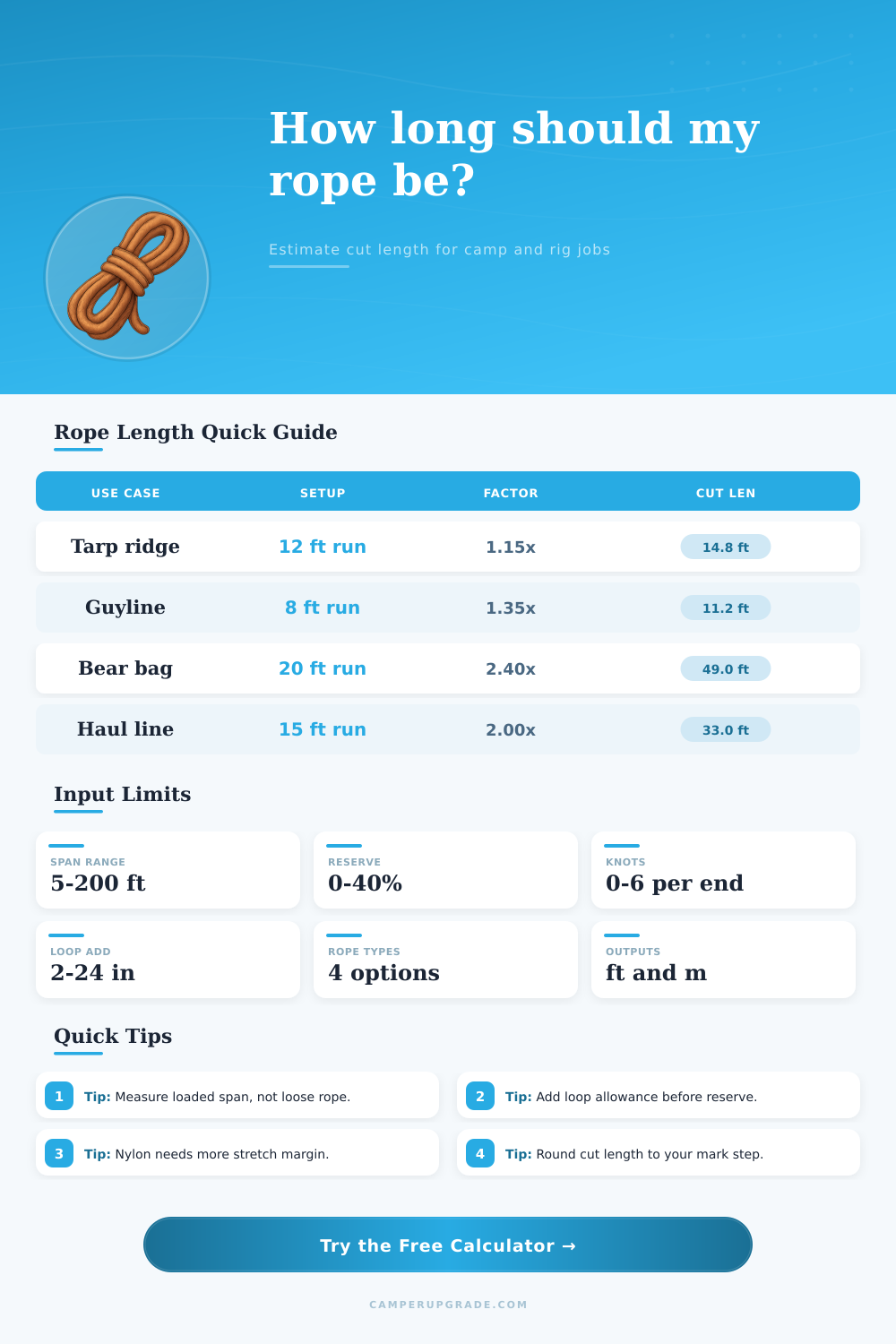
| Setup Profile | Factor | Typical Use | Planning Note |
|---|---|---|---|
| Straight tie line | 1.00x | Direct lash | Shortest path with little slack |
| Tarp ridgeline | 1.15x | Shelter ridge | Accounts for pitch and quick adjust |
| Guyline to stake | 1.35x | Wind anchor | Extra for tension hitches and re-tie |
| Bear bag throw line | 2.40x | Food hang | Up-over-down path plus pull tail |
| Simple haul line | 2.00x | Lift or drag | Round trip to load and handler |
| Hammock ridgeline | 1.30x | Suspension tune | Allows wraps and sag adjustment |
| Trucker hitch lash | 1.55x | Cargo tie-down | Includes pulley loop and tail wraps |
| Roof rack lashing | 1.60x | Canoe or kayak | Cross wraps around bars and rails |
| Rescue drag setup | 2.25x | Field recovery | Keeps margin for redirects |
| Span | Straight | Ridgeline | Guyline | Bear Bag |
|---|---|---|---|---|
| 8 ft | 8.0 ft | 9.2 ft | 10.8 ft | 19.2 ft |
| 12 ft | 12.0 ft | 13.8 ft | 16.2 ft | 28.8 ft |
| 16 ft | 16.0 ft | 18.4 ft | 21.6 ft | 38.4 ft |
| 20 ft | 20.0 ft | 23.0 ft | 27.0 ft | 48.0 ft |
| 30 ft | 30.0 ft | 34.5 ft | 40.5 ft | 72.0 ft |
| Knot Type | Allowance Each | Loop Use | Field Use |
|---|---|---|---|
| Bowline | 4 to 6 in | Fixed eye | Guyline or tarp corner |
| Figure-8 loop | 6 to 8 in | Strong eye | Haul and safety lines |
| Trucker hitch | 8 to 12 in | Mechanical pull | Cargo lash systems |
| Taut-line hitch | 5 to 7 in | Adjust slider | Stake tension control |
| Double overhand | 3 to 5 in | Stopper | Tail security on loops |
When planning the length of rope that is needed for the camping setups, there is several different factors that must be considered. If these factor are not accounted for in the planning of camping setup, the rope may be too short to complete the necesary camping tasks. Factors to consider include the distance between the two points, the length taken by the knots, the stretch in the rope, and any additional length that may be required for safety.
The first factor to consider is the geometric distance between the two points of attachment for the rope. The geometric distance is the straight-line distance between the two points of attachment, but only if the two points are at the same height. If the two points of attachment are of different heights, then you must also account for the vertical distance between the two points in the calculation of the total length of the rope that will be required.
How to Plan Rope Length for Camping
For instance, if one point of attachment is a high tree branch and the other is a low camping stake, then the rope will have to travel the vertical distance between those two points. Additionally, different camping tasks require different profiles of the rope. For instance, a ridgeline will require room for the tarp to sag and for the ropes to be adjusted, while a food hang will require the rope to travel up to the tree and back to the ground.
You can account for the profile of the camping task by multiplying the initial distance calculation by a certain percentage to account for the additional length of rope that will be required for these specific camping tasks. For instance, a ridgeline may require 15% more additional length for the sag in the tarp, while a food hang may require 140% additional length for the rope to counteract the effects of gravity. The second major factor to consider when planning the length of the rope is the length that the knots in the rope will take up.
Different knots will consume different amount of the rope to create those knots. For instance, a taut-line hitch may require four inches of rope to form the knot, while a figure-eight loop may require eight inches of rope to form the knot. You must account for the length of rope that will be consumed by the knots in the total length of the rope that is to be purchased and prepared for camping.
For instance, if camping tasks require a knot to be created at each of the two points of attachment for the rope, the length of rope that is consumed by those two knots will have to be accounted for in the total length of the rope that is needed for that camping task. Additionally, different types of knots will consume more rope than others. For instance, a bulky trucker’s hitch will consume more rope than a simple overhand knot.
Therefore, you must measure the length of you knots realisticly based off the knots you intend to tie. The material of the rope will also impact the total length of the rope. For instance, nylon rope can stretch by as much as 10 percent when you pull on the rope to even tight pitches.
Other materials, such as polyester or Dyneema, will stretch to a much lesser degree; however, they can also stretch by two to three percent. The stretch in the length of the rope will require you to determine the tension that you will place on the rope when you form your required pitches. If you plan to form tight pitches between your anchors, you will minimize the length of the rope that hangs between the two points; however, you will need to take precise measurements to ensure that the rope does not fall short of covering the distance between your two anchor points.
You must also provide a safety reserve for your rope. The safety reserve will be insurance against errors in your measurements. Adding a safety reserve of 10 to 20 percent to your total calculated length will ensure that any errors in your calculations will not impact your setup of the ropes between the two anchor points.
In environments with high winds or for conditions that you dont yet know when setting up camp, you should provide a 20 percent safety margin. Using this safety reserve will allow for minor calculation errors to not impact the success of your setup. To calculate how long the rope should be, you will need to determine the geometric run between the two anchor points.
Then, you will know how much length the knots will require. After this calculation, you will calculate the length needed for the stretch of the rope. Finally, you can add in the safety reserve to the total length of the rope.
You will round the total length of the rope to the nearest half-foot increment for ease of measurement of the rope. By using this calculation method, you can ensure that the length of the rope will be long enough to complete your camping tasks.