Roof Tent Ladder Angle Calculator
Set up a rooftop tent ladder from tent floor height, target angle, ladder length, foot setback, surface sink, and loaded rating so the climb feels stable at camp.
🏷Topic Labels
⛺Roof Tent Setup Presets
Ladder Angle And Fit Snapshot
⚙Calculator Inputs
🔧Ladder Material And Spec Comparison
📊Reference Tables
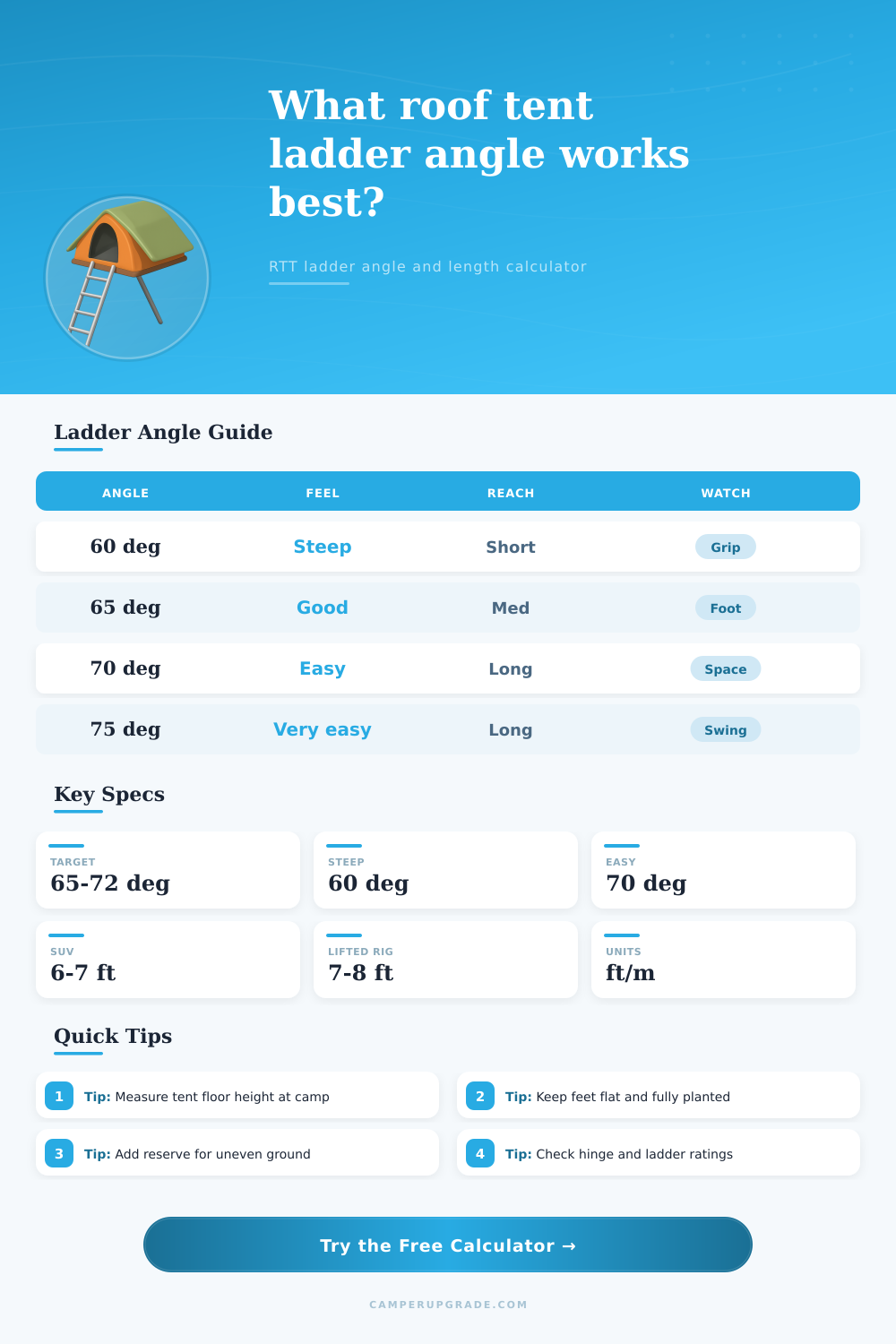
| Ladder angle | Climb feel | Typical use | Setup note |
|---|---|---|---|
| 58 to 62 degrees | Steep | Short campsite footprint | Use care with wet shoes or high entry points. |
| 63 to 67 degrees | Balanced | Most SUV and pickup RTTs | Good compromise between reach and comfort. |
| 68 to 72 degrees | Easy climb | Family use, frequent trips | Needs more space beside the vehicle. |
| 73 to 76 degrees | Very laid back | Low trailer or annex clearance | Check ladder flex and hinge side loading. |
| Vehicle or mount | Common floor height | Target length at 68 degrees | Approx foot run |
|---|---|---|---|
| Low utility trailer RTT | 48 in / 122 cm | 4.3 ft / 1.32 m | 1.6 ft / 0.49 m |
| Pickup bed rack RTT | 60 in / 152 cm | 5.4 ft / 1.64 m | 2.0 ft / 0.61 m |
| Compact SUV roof rack | 72 in / 183 cm | 6.5 ft / 1.97 m | 2.4 ft / 0.73 m |
| Lifted 4x4 roof rack | 84 in / 213 cm | 7.6 ft / 2.30 m | 2.8 ft / 0.85 m |
| Tall van side mount | 90 in / 229 cm | 8.1 ft / 2.46 m | 3.0 ft / 0.91 m |
| Effective height | 65 degree length | 68 degree length | 72 degree length |
|---|---|---|---|
| 54 in / 137 cm | 5.0 ft / 1.51 m | 4.9 ft / 1.48 m | 4.7 ft / 1.44 m |
| 66 in / 168 cm | 6.1 ft / 1.85 m | 5.9 ft / 1.80 m | 5.8 ft / 1.76 m |
| 78 in / 198 cm | 7.2 ft / 2.18 m | 7.0 ft / 2.14 m | 6.8 ft / 2.08 m |
| 90 in / 229 cm | 8.3 ft / 2.52 m | 8.1 ft / 2.47 m | 7.9 ft / 2.40 m |
| Surface | Footing behavior | Suggested reserve | Practical check |
|---|---|---|---|
| Firm dirt or pavement | Low sink and predictable grip | 2 to 3 in / 5 to 8 cm | Confirm both feet contact evenly. |
| Gravel campsite | Small roll under rubber feet | 3 to 4 in / 8 to 10 cm | Kick a shallow pocket or use pads. |
| Grass or pine duff | Compresses after first climb | 4 to 5 in / 10 to 13 cm | Step on the foot area before final angle. |
| Sand or soft soil | Feet can creep outward | 5 to 7 in / 13 to 18 cm | Use wide pads and re-check after loading. |
| Snow or mud | High sink and slip risk | 6 to 8 in / 15 to 20 cm | Clear down to firm base when possible. |
💡Setup Tips
After a long day on the road, your eyes are already weighed down as you grab first rung of your roof tent ladder. Before you’ve even placed a foot, something just doesn’t feel right about the ladder. Is it too steep? Are you forced to take each step like a shaky scramble, or does it lean outward so much that your feet sinks into soft ground and feel unstable? Fatigue increases all angles; this moment, more so then any other aspect of setting up camp, is where little things becomes huge dangers.
Plug in your own height and surface conditions and the calculator will handle math for you. You’ll save yourself the guessing game at half-sleepy geometry.
How to Pick the Right Roof Ladder Angle
People get obsessed about ladder height, paying no attention to angle it makes. Length is just half the equation; it’s easy to assume that as long as bottom of the ladder touches down, all will be well. But angle also impacts where your center of gravity lie when climbing, and how far foot pads are pushed out from under the vehicle.
Sixty-five to seventy-two degrees is a sweet spot in terms of balancing structural integrity with climbing conveniance. Angles steeper than that feel more stable against toppling over, while asking more of upper body. Angles shallower than that save shoulder muscles some exertion, though they call for considerably more clear space behind the vehicle. It is a tradeoff between real estate and muscle power.
Reality comes in at the input for ground sink, where surface conditions matter (pavement resists pressure while sand yields, gravel shifts, and snow compresses under load). So the tool adjusts actual rise for likely depth of feet sinking into it. If you fail to account for softness at surface, what was a perfectly correct starting angle will soon be off as ladder gets sunk in. You’re climbing up a seventy-degree slope and then coming down a slippery, sixty-five-degree slope. It makes you feel like you could of fly off the bottom.
Footing reserve lets you know how much leftover ladder you need to allow for settling without bottoming out. It is a little something nobody thinks about but it keeps the wobble away so you don’t lose confidence.
Another factor to throw off calculations quicker than most think is vehicle pitch. Parking on a slope effectively raises or lowers tent floor in relation of ground level at the bottom of the ladder. Even a slight camber can raise one side by several inches, altering geometry enough to shift angle outside your comfort zone. Thankfully, the calculator accounts for that slope so neither end of the ladder is too long on the high side or too short on the low side. But in case you have no choice but to park the rig on a slope, knowing how angle changes height lets you adjust to match without panicking.
Also consider: Look at load ratings again. It’s worth remembering why manufacturer listed a working load limit. Adding the weight of your body adds to the weight of whatever else you’re carrying; rungs and hinges sees greater stress. Hauling a dog (and maybe a sleeping bag) up those stairs? Consider combined weights accordingly. Going beyond comfort margins is not always fatal, but it increases the chance of user error and mechanical slip. That shows up in stability status of results: Your set-up will be safe within those parameters, subject to surface friction and angle.
After you establish the angle that suits your terrain style and your vehicle, it’s handy to mark the spot you want to hook onto on your preferred extension point with tape. You spend less time fumbling around trying to figure out where each rung go and more time getting settled in and going to sleep. This makes setting up the same way in low light feel naturaly instead of like a puzzle. It’s amazing what geometry can do for ladders; they goes from something you have to deal with to a reliabel component of your routine.