Roof Cargo Drag MPG Loss Calculator
Estimate roof box, soft bag, basket, gear, or crossbar-only MPG loss using baseline MPG, frontal area, speed, miles, wind, drag penalty, and fuel price.
📌Cargo presets
⚙Trip and drag inputs
Use the custom drag penalty if you have test data. Otherwise, the calculator blends cargo type, frontal area, speed, wind, and crossbar mode into an estimated MPG loss.
Calculation breakdown
📊Live comparison grid
💨Quick drag factor grid
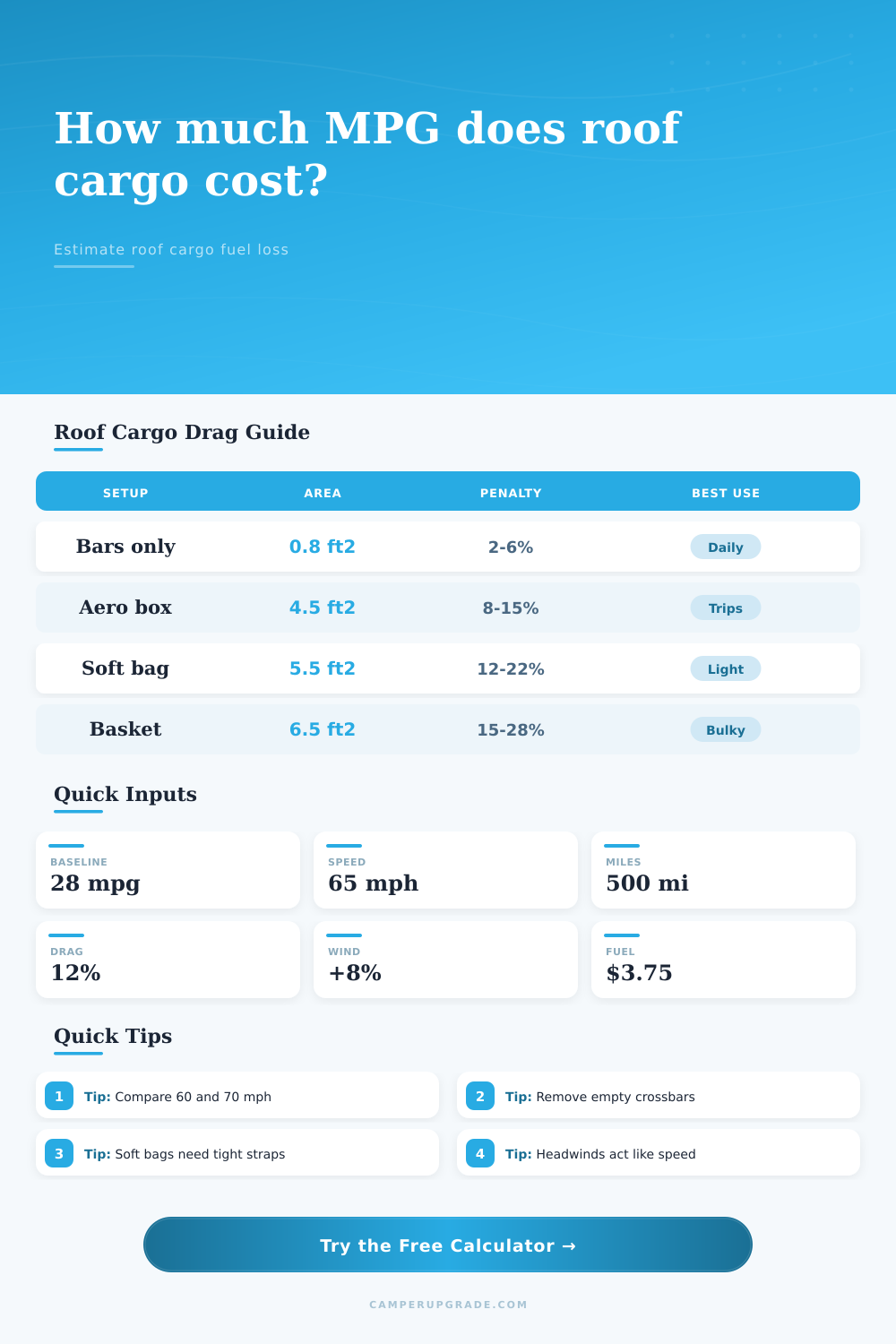
📋Roof cargo type table
| Roof setup | Typical added frontal area | Typical MPG penalty | Planning note |
|---|---|---|---|
| Aero crossbars only | 0.5 to 1.0 sq ft | 1% to 4% | Lowest empty-rack penalty |
| Round or square bars only | 0.7 to 1.4 sq ft | 3% to 7% | Noticeable if left on year-round |
| Low aero roof box | 3.5 to 5.0 sq ft | 8% to 15% | Best choice for highway travel |
| Mid-size family box | 4.5 to 6.0 sq ft | 10% to 18% | Common camping road-trip setup |
| Tall cargo box | 5.5 to 7.5 sq ft | 14% to 24% | Extra height increases drag quickly |
| Soft roof bag | 4.5 to 7.0 sq ft | 12% to 22% | Shape and strap tension matter |
| Basket with duffels | 5.5 to 8.0 sq ft | 15% to 28% | Exposed gear causes turbulent flow |
🛣Speed effect table
| Cruise speed | Drag multiplier | When to use | Roof cargo note |
|---|---|---|---|
| 55 mph | 0.72x | Back roads or economy runs | Often cuts roof-box loss sharply |
| 60 mph | 0.85x | Fuel-saving highway pace | Useful for soft bags and baskets |
| 65 mph | 1.00x | Default highway estimate | Good baseline for trip planning |
| 70 mph | 1.16x | Fast interstate cruising | Drag rise is easy to feel at the pump |
| 75 mph | 1.33x | Only where legal and safe | Racks, bags, and boxes get noisy |
🌬Wind factor table
| Condition | Factor | What it means | Best use |
|---|---|---|---|
| Tailwind or sheltered | -5% | Less air load than normal | Tree-lined roads or tailwind legs |
| Calm route | 0% | Baseline weather | Use for normal trip planning |
| Light headwind | +6% | Small drag increase | Open roads with steady breeze |
| Steady headwind | +12% | Harder highway pull | Conservative roof-cargo estimate |
| Strong headwind | +20% | Major aerodynamic penalty | Use for exposed routes and storms |
⛽Extra fuel reference table
| Baseline MPG | 10% loss MPG | Extra gallons per 500 mi | 20% loss MPG |
|---|---|---|---|
| 20 mpg | 18.0 mpg | 2.8 gal | 16.0 mpg |
| 25 mpg | 22.5 mpg | 2.2 gal | 20.0 mpg |
| 30 mpg | 27.0 mpg | 1.9 gal | 24.0 mpg |
| 35 mpg | 31.5 mpg | 1.6 gal | 28.0 mpg |
| 40 mpg | 36.0 mpg | 1.4 gal | 32.0 mpg |
💡Roof cargo drag tips
Hitting the road for a long weekend, you grab luggage and pack camping gear into car and head up highway. You realize that your gas tank are going down much quicker than normal. No, it isn’t the added weight of all those bags and outdoor gear. That box on top of the car is the real problem.
Most people thinks about how much their cargo weighs or takes up space, but the real problem is aerodynamics, which is where you lose most money. Once you enter your speed and roof configuration into the calculator above, it do the math for you (spares you from having to guess complicated wind resistance factors and drag coefficients).
Why Your Gas Tank Goes Down Faster With a Roof Box
You can double your speed, but that doesn’t double the drag. It quadruples it because drag increase with the square of your speed. The physics here are unforgiving.
You’ll feel that more keenly then ever in the car at the pump: those few extra miles-per-hour between cruising at sixty and seventy-five miles an hour feel like a whole lot harder to maintain if you’ve got a roof box on there. At a modest pace, even a low aerodynamic box will cost you maybe eight percent in terms of fuel economy, that’s not nothing, but if you’re pushing that number higher then the penalty get steeper and soon reaches double-digit territory.
The reference table on page spells it all out, and makes clear just how steep that multiplier becomes. I know this sounds odd: The choice of which carrier make a difference. An aero box is built to cut through the air and it minimize the turbulence slamming into your car’s side. A soft bag or basket create turbulent air pockets behind it and pulls the car more aggressively forward. You can literaly feel engine fighting back.
So it’s not simply having room for your kayaks or your ski boots; it’s minimizing frontal area exposed to the wind. Cross bars even on an empty roof has a small but measurable drag penalty that adds up on thousands of mile of commuting.
These calculations also take into account something I didn’t expect; wind direction. In practice, a consistent headwind behave as though there’s an invisible wall slowing you down. This effectively increase your speed relative to the air mass; the tool lets you input wind factors so it can take this into consideration (very important if you’re doing a long cross-country trip).
You may be planning on no wind at all, only to encounter a long stretch of open highway with a strong headwind against you. That extra bump in effective speed will drain your tank quicker than expected.
This topic tends to get way too hung up on weight. Yes, if you add one-hundred pounds to your roof, it will reduce MPG. But it is not as much than all that aerodynamic drag. The calculator has a weight field so you can see for yourself. It verifies that your primary issue is not carrying a lot of gear.
Your shape matter more then its weight. A sleek box containing a hundred pounds might actualy be more efficient than a lightweight basket full of bulging items. This is information that smart travelers apply and use to save money through minor tweaks.
By slowing down just five to 10 mph along an extended stretch of highway, you’ll regain a significant portion of the fuel lost from carrying that load on top of your car. This help extend your range while also easing the load off your engine. You don’t need to take the box off completely to get the rewards.
Driving slightly slower makes this a doable drag instead of a huge problem, you should of known that. Roof cargo is a trade-off. At the end of the day, there’s a trade-off between efficiency and convenience: Convenience because you get some storage; inefficiency because you pay for it with wind noise and fuel costs.
Knowing your exact cost allows you to more accurately budget for trips. And knowing your exact cost helps you determine if it’s worth leaving the gear up (or taking it down) for the trip home if it’s only going to be a short road trip. The math is very clear based off speed vs. Air resistance.
Know what kind of drag you’ve created and you can drive smarter. Save money at the pump. Arrive with more range in the tank than you thought possible.
That extra margin makes all the difference when the next gas station is forty miles away.