River Trip Days Food Calculator
Estimate river trip food by days, paddlers, meal style, reserve food, calories, cooler volume, and dry storage space.
🛶River Food Presets
⚙Trip Food Inputs
📊Food Style Reference Grid
⚖River Food Material and Spec Comparison
Dehydrated Meals
125 cal/oz. Strong for kayak hatches, long carries, and trips with limited cooler space.
Fresh Cooler Food
55 cal/oz. Heavier and bulkier, but useful for early-trip dinners and hot-weather morale.
Canned or Pouched Food
70 cal/oz. Durable for rafting, but count both packed weight and carried-out empties.
Bulk Dry Staples
100 cal/oz. Rice, pasta, oats, tortillas, lentils, and potatoes work well in group barrels.
Snack-Heavy Menu
115 cal/oz. Efficient for continuous paddling where lunch stops are short or exposed.
Mixed River Menu
95 cal/oz. Balanced choice for most canoe, kayak, raft, and family river trips.
📘Calories by River Effort
| River Day Type | Typical Calories | Multiplier | Planning Note |
|---|---|---|---|
| Warm flatwater float with short mileage | 2200 to 2600 per person | 0.90x | Works when camp chores are light and snacks are easy to reach. |
| Normal paddling or rowing day | 2600 to 3200 per person | 1.00x | Good default for mixed canoe, kayak, and raft trips. |
| Cold starts, wind, or long mileage | 3200 to 3800 per person | 1.12x | Add hot drinks, dense snacks, and extra dinner portions. |
| Whitewater, portage, or heavy rowing | 3600 to 4300 per person | 1.25x | Lunch calories should be accessible without unloading all food. |
| Expedition pace or repeated hard days | 4000 to 5000 per person | 1.38x | Use high-fat foods carefully packed against heat and leakage. |
📦Food Density and Storage Reference
| Food Category | Calories per Ounce | Estimated Liters per Pound | Best River Use |
|---|---|---|---|
| Freeze-dried or dehydrated entrees | 110 to 140 | 4.5 to 5.5 | Long trips, small boats, and bear canister limits. |
| Mixed dry staples and meals | 85 to 110 | 4.0 to 5.0 | Most group river menus after repacking. |
| Fresh cooler food | 35 to 65 | 5.5 to 7.0 | First half of raft trips or short canoe camps. |
| Canned, jarred, and wet pouches | 50 to 85 | 3.0 to 4.0 | Durable meals where weight matters less than simplicity. |
| Nut butter, oil, nuts, and dense snacks | 140 to 180 | 2.0 to 3.2 | Boosting calories without adding much packed volume. |
🧊Cooler and Dry Storage Planning
| Storage Type | Usable Food Volume | Typical Food Days | River Planning Use |
|---|---|---|---|
| 30 liter dry bag | 24 to 27 liters | 2 to 3 dry person-days | Solo kayak or emergency reserve separated from main food. |
| 60 liter barrel | 50 to 56 liters | 5 to 7 dry person-days | Common canoe food barrel when food is repacked tightly. |
| 20 quart cooler | 11 to 14 liters for food | 1 to 2 fresh person-days | Short float or first-night fresh dinner after ice is loaded. |
| 45 quart cooler | 25 to 32 liters for food | 3 to 5 fresh person-days | Raft or canoe basecamp menu with frozen blocks. |
| 90 quart cooler | 50 to 65 liters for food | 7 to 10 fresh person-days | Group raft support where cooler weight is acceptable. |
🗺Common River Trip Food Estimates
| Trip Scenario | Person-Days | Food Weight Range | Storage Starting Point |
|---|---|---|---|
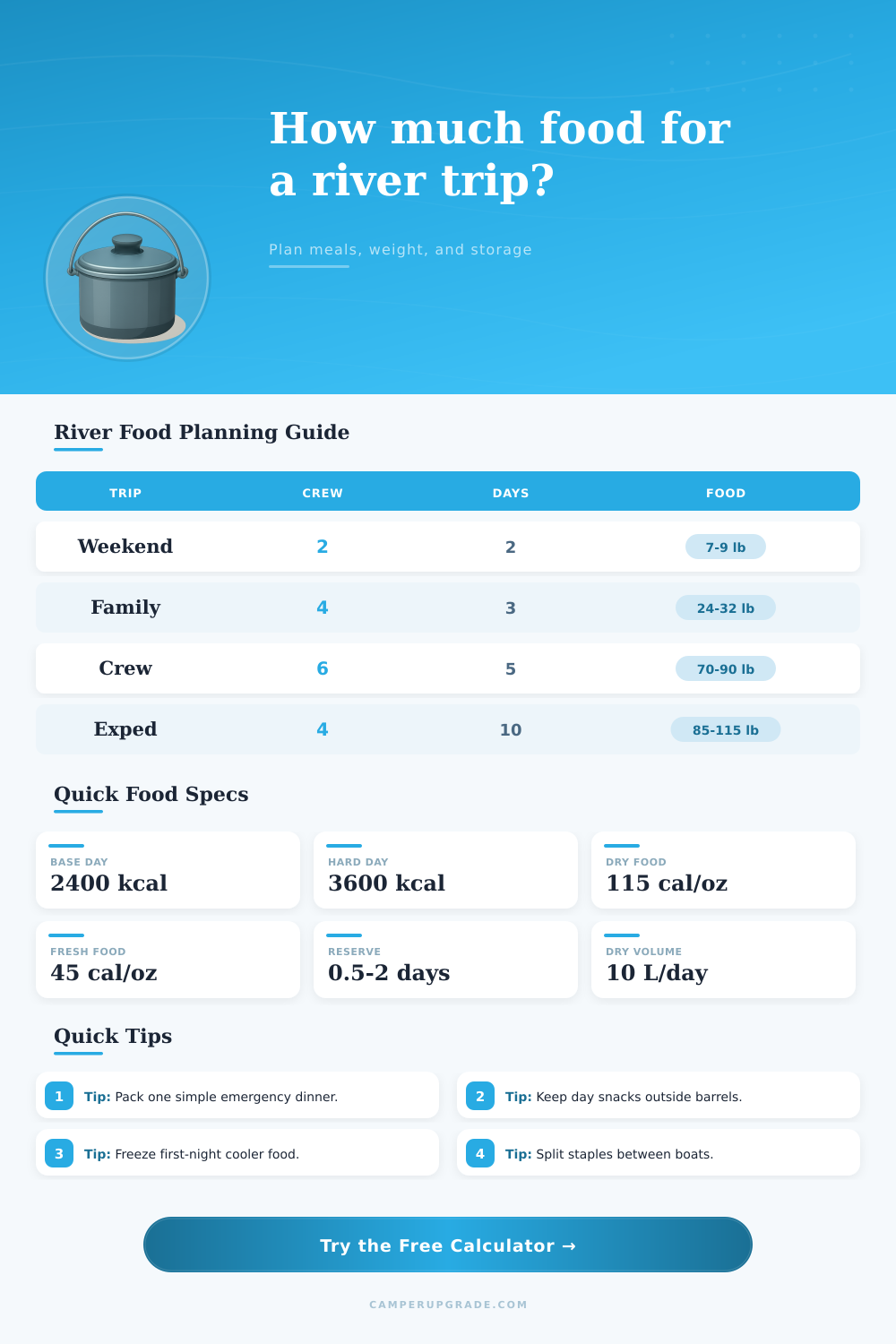
| 2 paddlers for a 2 day weekend float | 4 person-days | 7 to 10 lb mixed food | One small dry bag plus compact cooler. |
| 4 people for a 3 day family sandbar trip | 12 person-days | 24 to 34 lb mixed and fresh food | 45 quart cooler plus 40 to 60 liter dry storage. |
| 6 boaters for 5 whitewater days | 30 person-days | 70 to 95 lb high-output food | Two large dry boxes or barrels plus group cooler. |
| 4 paddlers for a 7 day canoe route | 28 person-days | 55 to 78 lb mostly dry food | Two 60 liter barrels or equivalent bear storage. |
| 1 kayaker for an 8 day self-support | 8 person-days | 13 to 18 lb ultralight dry food | Multiple small dry bags distributed in hatches. |
I call it the “what-the-hell-are-we-going-to-eat?” feeling. Panicky feeling” that comes over you as you look back at your hungry crew, stand on the river bank and stare into an empty cooler. You thought you packed well. But not quite well enough. Every paddler and guide who ever ignored math for the sake of optimism have felt this panic.
That’s where the tool comes in; it stops the panic before it begins and turns vague intention into hard numbers. Makes you face the physical fact of feeding people on moving water. Very different than having a barbecue.
How to Plan Food for River Trips
On a river trip, food comes at a double cost: both volume and weight. You’re hauling calories. But you’re also hauling the containers to hold those calories. And you have to plan for where all that will go in your boat.
On the one hand, dehydrated meals win on weight, but they usually lose on morale. On the other, fresh food wins on taste, but you lose big-time on ice management and cooler space. This is a tradeoff that we let you adjust to your preference with our menu styles. Then we calculate the volume required to store it, so you can know exactly how much space (how many barrel inches, how many dry bags) to book in advance.
Because once you’re committed to the water, there’s no such thing as extra space. Your daily calorie requirements changes wildly from day-to-day on the river. For instance, a lazy day of floating down warm water may only need two thousand four hundred calories each. Throw in some technical whitewater, long portages, or cold mornings and that climbs closer to three thousand six hundred or even more.
That’s where the activity multiplier within the inputs comes into play. Your body burns far more calories than you’d think trying to stay warm while slogging through cold spray and wind and exhaustion. When that happens, the river no longer becomes fun, it becomes hostile. To account for this, the tool scales the numbers upwards according to the level of difficulty you choose. This way you never get so exhausted that you can’t make dinner.
The final and possibly most ignored input to any plan is food. I know it’s painful to lug around more than necessary when every ounce becomes burdensome, but rivers are unpredictable beasts. A day of high water can close down a run. You miss your shuttle and end up stranded on the bank. A storm rolls in unexpectedly and you’re forced into a layover that was not planned. Half a day, sometimes two days of reserve food becomes an insurance policy against these delays. It will sit in your dry bag, gathering dust, doing nothing but taking up space… until the day it saves your sanity. This buffer is automatic and added by the calculator so that you don’t have to think about it later when you’re tired.
Most groups mess up storage planning: they don’t understand the difference between how much stuff can go in a container, and how much food you’ll be able to eat from it. That forty-five quart cooler seems huge, until you discover half its volume will be used for ice and air pockets and such. The page’s reference tables explains this and show how much food actualy fits inside common containers after accounting for wasted space. For example, a full, tight-packed, sixty-liter barrel holds only about five days’ worth of dry food for one person. Knowing the density of your food will spare you the embarassment of discovering you have no room for three more days of food, even though you still have three days’ worth.
Snacks: Snacking is the glue between meals, so snacks deserve some careful thought. Stashing concentrated snacks like nuts, jerky, dried fruit, etc. Keeping these in your day hatch or cockpit allows you to grab calories without having to stop or unload the primary food barrel. This little tweak will help maintain even energy levels on long paddle stretches. Also, it eliminates the mid-afternoon crash which usually results in poor decision making on the water. It is just another easy habit that brings huge rewards of comfort and safety.
Last, if you’re running a group, split your staples between the boats. No sense in losing your whole menu if one boat’s hatch gets lost or swamped. Spread out the heavy stuff such as coffee, pasta, and rice. One point of failure shouldn’t take down the whole trip. The calculator tells you what to get, but smart packing disperses the risk.
You pack for the trip you think you’ll have, but you prepare for the one that actualy does happen. That’s how you make sure everybody stays fed and happy until takeout.