River Crossing Safety Calculator
Estimate current force, depth ratio, exposure time, and crossing method from water depth, flow speed, width, pack load, group size, footing, and temperature.
Crossing estimate
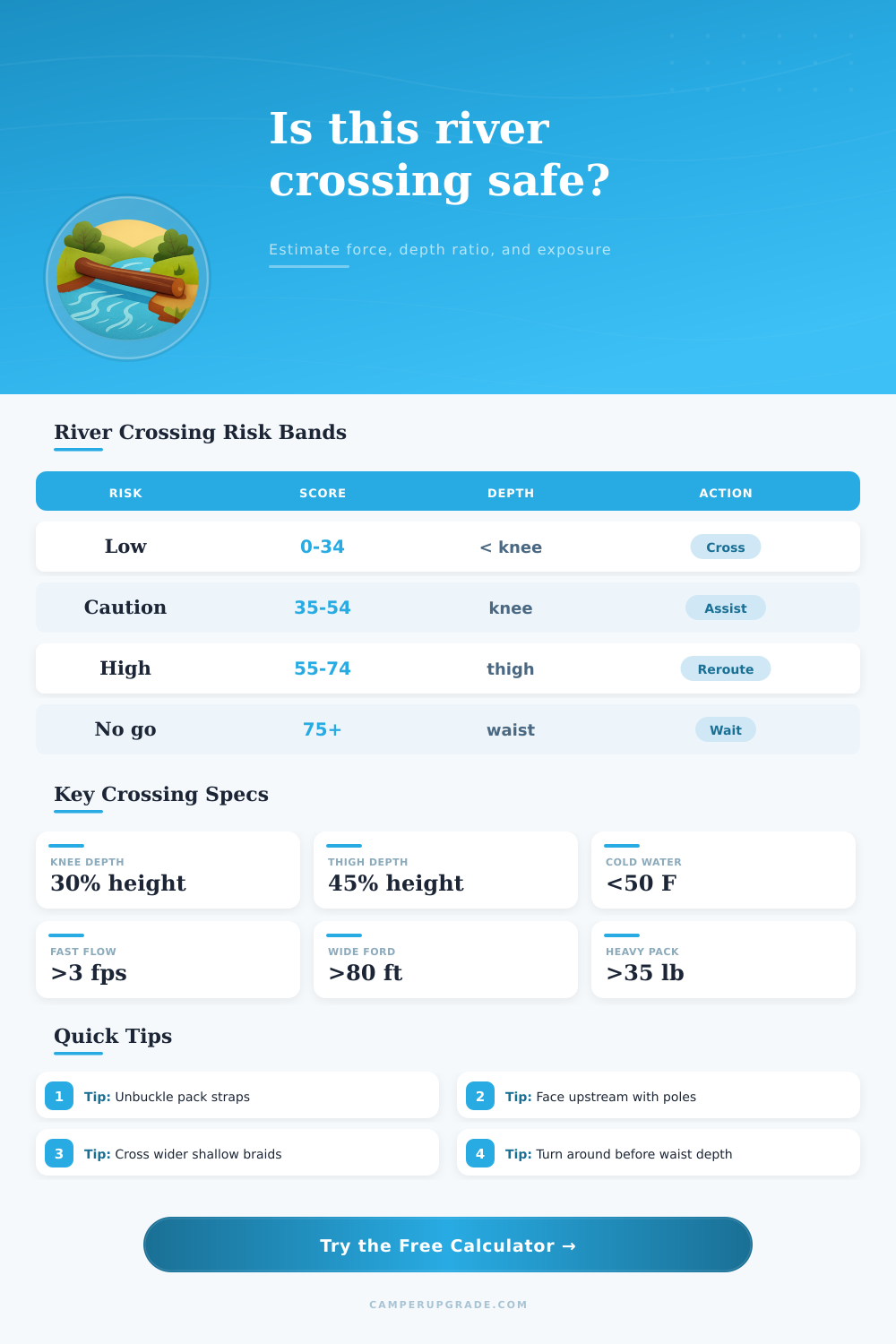
| Depth band | Height ratio | Typical concern | Default action |
|---|---|---|---|
| Ankle to shin | 10-20% | Foot placement | Cross with poles |
| Knee | 25-35% | Current begins pushing | Slow, angled steps |
| Mid-thigh | 40-50% | Balance drops fast | Use group support |
| Waist | 55%+ | Buoyancy and sweep risk | Do not cross |
| Flow speed | Visual cue | Force effect | Planning note |
|---|---|---|---|
| Under 1 ft/s | Slow drift | Low push | Footing usually controls |
| 1-2 ft/s | Steady walking pace | Moderate push | Poles help timing |
| 2-3 ft/s | Fast walking pace | Force rises quickly | Seek shallow braids |
| 3-4 ft/s | Foam moves fast | High lateral load | Use team or reroute |
| Over 4 ft/s | Hard to stand | Very high load | Wait, scout, or turn back |
| Water temp | Added risk | Crossing time | Response |
|---|---|---|---|
| 65 F+ / 18 C+ | Low cold stress | Under 60 sec | Normal caution |
| 55-64 F / 13-18 C | Cold distraction | Under 45 sec | Pre-plan exits |
| 45-54 F / 7-12 C | Dexterity loss | Under 30 sec | Use support |
| Under 45 F / 7 C | Cold shock risk | Keep very short | Strongly prefer reroute |
| Footing | Stability factor | Common issue | Best adjustment |
|---|---|---|---|
| Smooth gravel | 1.00 | Small rolling stones | Short steps |
| Mixed cobbles | 1.15 | Uneven step height | Probe every step |
| Slippery rocks | 1.35 | Low friction | Use poles or assist |
| Boulders and holes | 1.45 | Foot entrapment | Find another line |
| Soft sand or silt | 1.25 | Sinking or suction | Wider stance |
| Unknown bottom | 1.55 | Hidden holes | Scout shallow edges |
River crossings presents a hazard for hikers. River crossings tend to catch many hikers off guard. A person may think that the river that they are looking at from the bank is manageable to cross.
Yet the river may be much more dangerous than it appears to the individual. A person may refer to the map to determine the path that they will take. The map may show the individual a path that crosses over the river.
Use the River Crossing Risk Calculator
However, the current within that river may be strong enough to drag the hiker or there pack sideways from the river bank. Therefore, you should use the calculator provided for river crossings in order to reduce the risk that you may experience while crossing a river. The calculator for river crossings requires that you provide a few different types of input.
One of the required inputs is the depth of the river. The depth of the river is a value that is often difficult to judge for an individual that is observing the river from the bank. The depth input requires the individual to provide the depth of the deepest channel of the river, not the average depth of the river.
The depth of the river can contain deep area that are not visible to those on the bank. The second required input is the speed at which the river flows. The flow speed is one of the factors that contribute to the force that the river exerts against an individual when crossing a river; the faster the velocity of the river, the more stronger the force that is exerted against an individual.
The third required input is the width of the river. Any river of any degree of danger will typically have a wide width, which will expose an individual to the river for a longer amount of time. Exposure to the river for extended periods of time can lead to knockback of an individual, as well as the risk of becoming cold.
Finally, the fourth required input is the weight of the individual’s pack. The weight of a pack can contribute to the risk of crossing a river due to the risk of knocking an individual over when they stumble within the river; the heavier the pack, the more difficult it is for an individual to regain their balance. Another factor to consider is the temperature of the water within the river.
The temperature of the water can impact an individual’s ability to effectively function while crossing the river. Cold water can reduce an individual’s dexterity, as well as their speed in making effective decision. The calculator will apply a penalty to the risk score if the estimated temperature of the river is below 55 degrees.
Individuals lose fine motor control in water that is below 55 degrees. The footing quality of the river floor is another factor that affects the crossing of a river. The calculator permits an individual to input the footing quality of the river floor that is visible to the individual, and will adjust the risk score according to that footing quality.
The size of the individual and the method that they use to cross the river are related to one another. For instance, certain methods of crossing require a specific number of individuals to participate in the crossing. Methods like linked pairs require only two individuals, but methods like mutual support require three or more individuals to cross the river.
Thus, if the individual calculates that the number of hikers is too small to use the method that they desire, the calculator will introduce a penalty to that risk score. The calculator will not provide a green light for an individual that wishes to cross a river. Instead, the calculator will report a risk score for the individual to review, as well as provide the modeled safe depth ratio for the river, the estimated time that it will take to cross the river, and the recommended method that is indicated to be the safest for crossing that river.
The calculator calculates the risk score through the consideration of the depth of the river, the force of the river, the length of time that an individual will be exposed to the river, the weight of the individual’s pack, and the water temperature in the river. The risk score will be placed into one of four band of risk. The depth ratio is calculated by dividing the depth of the river by the height of the individual; the depth of a river to the knees will be different for individuals of five feet as compared to six feet in height.
The estimated time to cross the river is calculated through the width of the river divided by the individual’s pace. Finally, the recommended method for crossing the river may be different than that which is entered into the calculator; this is due to the risk score associated with the specific river crossing that the individual is to undertake. While the calculator includes various variables that may impact the decision of an individual to cross a river, there are other variables related to rivers that may exist outside of the calculator.
For instance, the snowmelt that occurred in the area prior to the individual beginning their hike may lead to the river rising during the afternoon. Jams of logs that may have fallen into the river can change the path of the river. Rain that occurred shortly before the individual began their hike can introduce cold water into the river.
Thus, these variables may impact an individual prior to entering the river. Therefore, the calculator is only one tool among many other that an individual should use in making their decision about crossing the river. The individual should run the calculator at camp the night prior to the hike, but must also recheck the depth of the river and the flow of the water prior to entering the river.
One of the mistakes that many individuals make when attempting to cross rivers is to not consider the depth of the water that they are stepping into. The depth of the water may appear relatively shallow from the bank of the river, but the water may be deep when an individual enters the river. Another of the mistakes that many individuals make is to keep their pack fully strapped to their body if the water level reaches an individual’s thigh.
An individual should use a quick release waist belt and loosen the straps on their backpack in case they fall into the river. The calculator for river crossings does not include a means of calculating the release of an individual’s pack, but the weight of the individual’s pack does factor into the risk score that the calculator provides. Another factor that impacts the risk of an individual’s downfall when crossing a river is the angle at which they cross.
Crossing downstream in a ferry fashion will apply less force against an individual’s legs than when they shuffle upstream across the river. The calculator allows for the adjustment of the risk score according to the angle at which an individual crosses a river. An individual’s footing within the river also interacts with the angle of the individual’s crossing of a river.
For instance, if the footing quality of a river is slippery, it may be better for an individual to cross the river downstream in order to minimize the effects of the river’s current upon the individual. The reference tables that are created for the calculator are based off thresholds for variables of the river that are common within many rivers. For instance, waist depth is a threshold for most individuals when crossing rivers; when an individual is in the water, their buoyancy can cause their feet to leave the riverbed, and the current may sweep their legs away.
Any river with a flow rate of three feet per second or higher will require that an individual use poles or walk alongside another individual when crossing that river. The temperature of water ranges below forty-five degrees is considered to be very cold; individuals should consider other routes in their hike than those that require them to cross water that measures below forty-five degrees in temperature. The goal for this calculator tool is not to eliminate every river that an individual crosses, but to make it easier for those individuals to understand which river crossings may be more dangerous to those individuals.
For instance, if the risk score for the individual’s proposed crossing of a river falls into the higher band of risk, those individuals will have to make a decision of whether to cross the river as planned, wait for the river to drop in flow and depth, or turn around and leave the river without traversing it. Conversely, if the risk score for the river that an individual would like to cross falls within the low range, the calculator will provide recommendation for each individual’s stability while crossing the river, as well as how long that crossing will take to occur. Thus, these numbers provided by the calculator may help an individual to avoid uncertainty in their middle of the river.
Additionally, the calculator will provide an individual with the numbers that determine their risk of falling into the river while the river is still in front of them.