Resupply Box Spacing Calculator
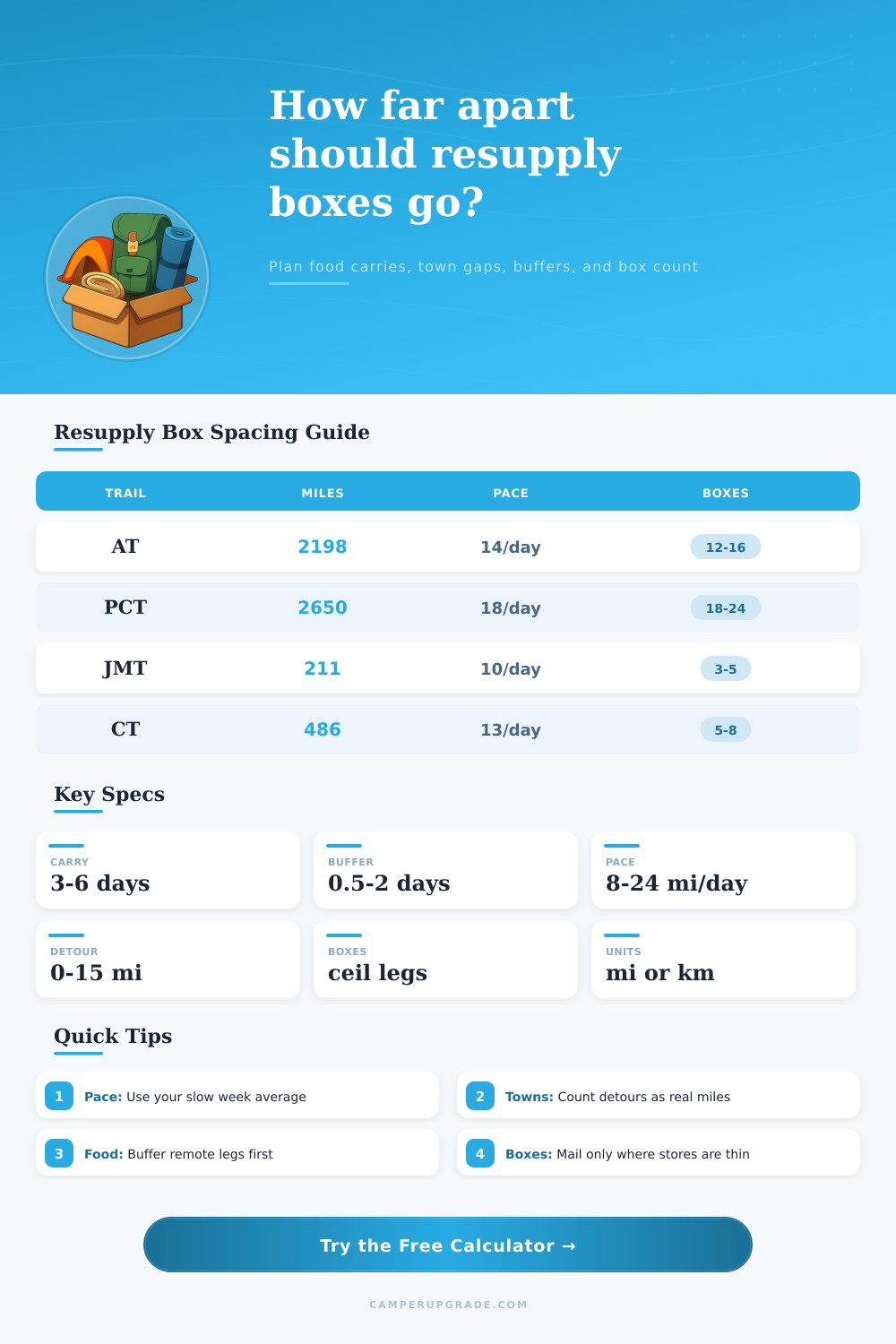
Plan thru-hike resupply spacing from trail miles, hiking pace, food carry limits, buffer days, town detours, and mailbox strategy so each segment has a practical food window.
📦Real Thru-Hike and Resupply Presets
⚙Trail, Pace, Food, Town, and Buffer Inputs
Formula basis: effective miles per food day = planned miles per day divided by terrain factor. Safe trail miles per carry = effective pace times maximum food days after subtracting buffer days. Box spacing is the lower of preferred spacing and safe carry distance, then adjusted for town detours, first carry, and mail strategy.
📐Resupply Planning Spec Grid
📊Resupply Spacing Reference Tables
| Trail | Approx Miles | Typical Pace | Planning Note |
|---|---|---|---|
| Appalachian Trail | About 2198 mi | 12-16 mi/day | Frequent towns, fewer mandatory boxes |
| Pacific Crest Trail | About 2650 mi | 16-22 mi/day | Remote sections make boxes useful |
| Continental Divide Trail | About 3100 mi | 16-24 mi/day | Longer gaps and route alternates |
| John Muir Trail | About 211 mi | 8-13 mi/day | Limited direct food access |
| Colorado Trail | About 486 mi | 12-18 mi/day | Mountain pace changes carry days |
| Food Carry | At 12 mi/day | At 16 mi/day | At 20 mi/day |
|---|---|---|---|
| 3 days plus 0.5 buffer | 30 mi safe | 40 mi safe | 50 mi safe |
| 4 days plus 0.75 buffer | 39 mi safe | 52 mi safe | 65 mi safe |
| 5 days plus 1 buffer | 48 mi safe | 64 mi safe | 80 mi safe |
| 6 days plus 1 buffer | 60 mi safe | 80 mi safe | 100 mi safe |
| 7 days plus 1.5 buffer | 66 mi safe | 88 mi safe | 110 mi safe |
| Mail Strategy | Box Share | Best Use | Tradeoff |
|---|---|---|---|
| Stores first | Remote share x 0.55 | Common town corridors | More flexible food choices |
| Balanced | Remote share x 0.85 | Most long trails | Boxes for weaker towns |
| Box heavy | Remote share x 1.20 | Strict diet or remote route | More office timing constraints |
| Minimal boxes | Remote share x 0.30 | Flexible hikers | Need reliable town food |
| Formula Step | Calculation | Output | Why It Matters |
|---|---|---|---|
| Route span | finish minus start | planning miles | Works for sections |
| Effective pace | pace divided by terrain | mi/day | Adjusts real progress |
| Safe carry | pace x food days minus buffer | trail miles | Prevents thin legs |
| Leg count | route divided by spacing | ceil value | Counts resupply gaps |
| Box count | stops x mail share | ceil value | Estimates mailed boxes |
💡Two Practical Resupply Tips
When planning a trail, you must decide how many miles you can walk between food resupplies. The distance between food resupplies is critically important to a hiker because the distance between food resupplies determine the weight of the hiker pack and the amount of food that they will have to carry. If a person choose the distance between food resupplies incorrectly, then they may find themselves in a situation where they either have run out of food due to a storm or whose pack is too heavy to carry the provided food.
Every trail has its specific town and empty stretches and the distance between food resupplies must be planned accordingly. People often start planning the trail based on the total mile within the trail and the average daily pace that they will travel at on the trail. These two can provide an estimate of the total number of days that it will take to complete the hike, but they does not account for various other factors.
How to Plan Food Resupplies on a Hike
For example, the terrain may slow the individual down because of the hill and snow. Additionally, there may be detours that may add to the total number of miles that an individual have to travel and the amount of food that they have to carry with them. It is also important to plan for buffer days in case of bad weather or other trail closures.
These various factor will reduce the number of miles that an individual can walk between food resupplies. The weight of the food that an individual can carry is just as important than the distance between food resupplies. For example, some individuals can carry six or seven days of meal, but others can only carry four days of meals due to the effect that the weight of the food has upon the joints of an individual and there overall mood.
In this case, an individual should of plan for an extra buffer of meals to be carried. This extra buffer of meal is important in case the individual must travel to a post office or if the weather is poorly and the individual cant go outside to perform any hiking activities. Another consideration is whether the individual will buy the food that they require in the various towns along the trail or if they will choose to mail a box of food to the location that they need.
Some trails has many towns while others may have long stretches of the trail that do not include any town. In these cases, mailing food to the individual is a protective strategy that will ensure that they have food during these more remotely parts of the trail. The individual must plan which stop will have mailed boxes of food and which stops will have food that is purchased in the town.
Using this strategy will allow the hiker to remain flexible with their schedule and ensure that they have enough food for the remote portion of the trail. Furthermore, an individual walking pace may change during the trail. For example, an individual may walk slow at the beginning of the trail and at a faster pace later in the trail when their fitness has increased.
If an individual uses a single pace between the beginning and the end of the trail, they may not account for these change in their planning. Therefore, an individual must plan to walk at a slower pace to the first food resupplies and adjust the remaining distance between food resupplies to account for their actual walking pace. An individual will also spend time in some of these towns during the trail.
This time is spent not on hiking but on other activity such as waiting for laundry or waiting for their package to be sorted. Time spent in a town will reduce the number of miles that they can hike during their next period of hiking. This time must be accounted for in the individuals plan for the trail.
The plan that an individual create for their spacing between food resupplies must be able to survive small changes to the individuals schedule. For example, there may be closed road that will require detours, rest days that may be taken to recover from the trail, or social meetings that must be made with others. Any plan for spacing between food resupplies will have to account for these change.
If a spacing plan is set up to account for every mile that an individual can hike based on the limit of the food that they can carry, any change to that schedule will pose a problem. An efficient spacing plan will account for any changes to the schedule that an individual may have on days that are unrelated to the calendar on which they plan to complete the trail.