Regulator Pressure Conversion Calculator
Convert RV regulator set points between inWC, psi, kPa, mbar, and oz/in², then compare appliance demand, hose drop, elevation derate, and usable pressure margin.
| Reference Unit | Equals inWC | Equals psi | Equals kPa | Equals mbar |
|---|---|---|---|---|
| 1 inWC | 1.000 | 0.03609 | 0.24909 | 2.4909 |
| 1 psi | 27.7076 | 1.000 | 6.8948 | 68.948 |
| 1 kPa | 4.0146 | 0.14504 | 1.000 | 10.000 |
| 1 mbar | 0.40146 | 0.01450 | 0.100 | 1.000 |
| 1 bar | 401.463 | 14.5038 | 100.000 | 1000.000 |
| 1 oz/in² | 1.7317 | 0.0625 | 0.4309 | 4.3092 |
Water-column conversions use the common gas-service factor of 1 psi = 27.7076 inWC; field readings may vary slightly with instrument calibration and temperature.
| Application | Typical Set Point | Converted Value | Use Case | Check Method |
|---|---|---|---|---|
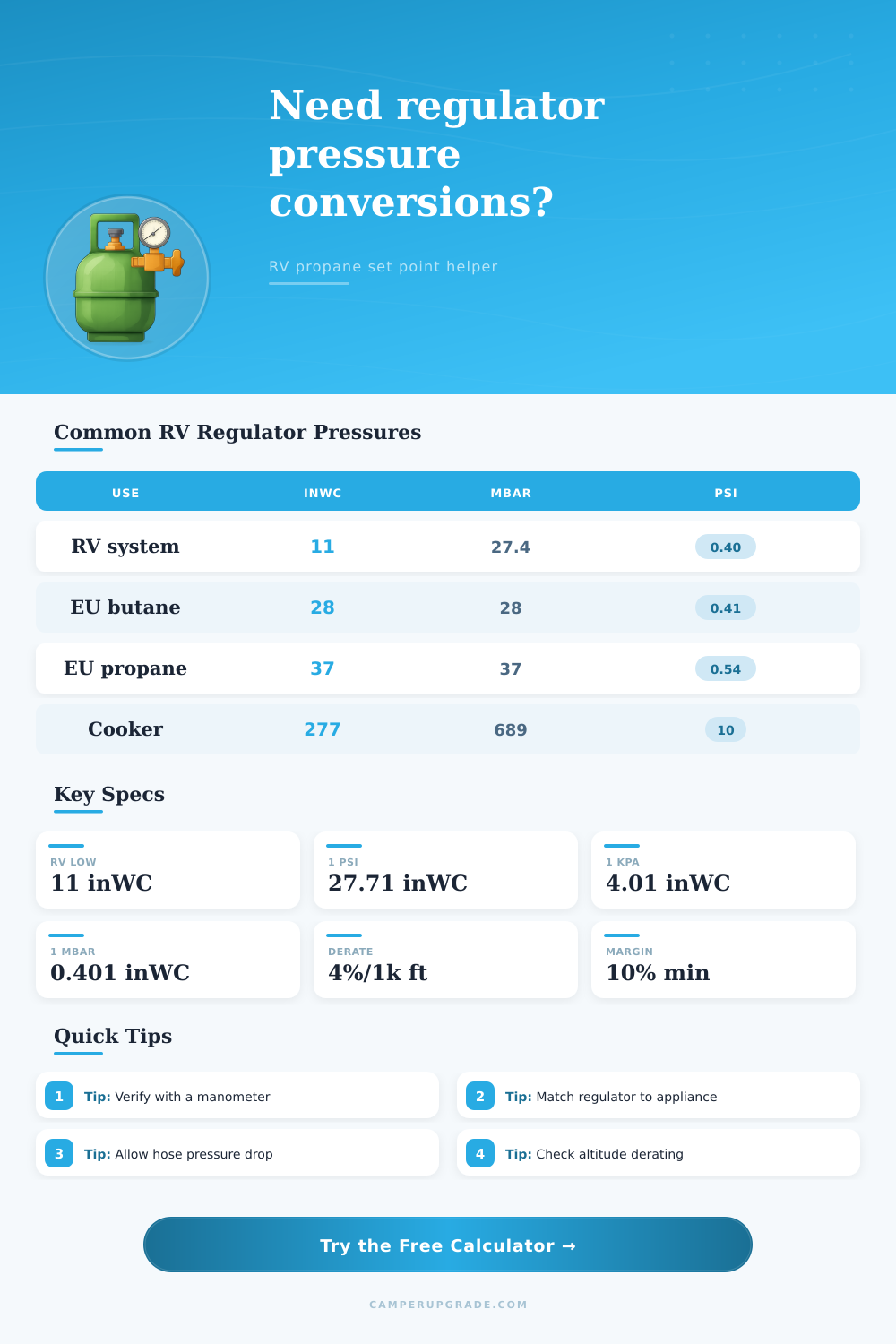
| RV propane appliances | 11 inWC | 0.397 psi / 27.4 mbar | Furnace, fridge, water heater, range | Manometer at test port |
| Natural gas appliance reference | 3.5 inWC | 0.126 psi / 8.7 mbar | Stationary reference only | Appliance manifold tap |
| EU butane caravan regulator | 28 mbar | 11.24 inWC / 0.406 psi | Butane cylinder systems | Rated regulator label |
| EU propane caravan regulator | 37 mbar | 14.85 inWC / 0.537 psi | Propane cylinder systems | Rated regulator label |
| High-pressure camp stove | 10 psi | 277.1 inWC / 689 mbar | Outdoor burners before appliance valve | High-pressure gauge |
| Outdoor cooker regulator | 15 psi | 415.6 inWC / 1034 mbar | Large cast burners and fryers | Gauge at regulator outlet |
| Line Inside Diameter | Short Run Estimate | Medium Run Estimate | Long Run Estimate | Best RV Use |
|---|---|---|---|---|
| 1/4 in | 20k-35k BTU/h | 12k-25k BTU/h | Under 15k BTU/h | Small appliance hose |
| 5/16 in | 35k-55k BTU/h | 25k-40k BTU/h | 15k-28k BTU/h | Portable grill hose |
| 3/8 in | 60k-100k BTU/h | 45k-75k BTU/h | 30k-55k BTU/h | Typical RV branch |
| 1/2 in | 120k-200k BTU/h | 90k-150k BTU/h | 65k-110k BTU/h | Main distribution run |
| 5/8 in | 200k+ BTU/h | 150k+ BTU/h | 110k+ BTU/h | Large manifold feed |
Capacity values are planning estimates for low-pressure vapor service. Final sizing depends on fittings, regulator rating, tubing type, local code, and allowable pressure drop.
| Elevation | Common Derate | 60k BTU/h Load Acts Like | Pressure Concern | Practical Check |
|---|---|---|---|---|
| 0-2,000 ft | 0% | 60,000 BTU/h | Normal regulator setting | Verify nameplate pressure |
| 3,000 ft | 4% | 62,500 BTU/h | Slightly less combustion air | Check flame stability |
| 5,000 ft | 12% | 68,182 BTU/h | More margin needed | Measure under load |
| 7,000 ft | 20% | 75,000 BTU/h | Line drop matters more | Test with appliances running |
| 9,000 ft | 28% | 83,333 BTU/h | Appliance rating may change | Follow appliance manual |
It’s late at night on a chilly evening. You fire up the RV furnace and … you hear nothing. Instead, there’s a faint hissing sound from your propane line. Nine times out of ten it’s not a blown-out part or a depleted fuel tank. It’s pressure. To be precise, there is a difference between the amount your regulator provides and the amount that your appliance require.
For those who tow an RV or live off-the-grid, knowing how to convert regulator pressures becomes less of an academic question and more of a practical one.
Why Propane Pressure Matters
Units of Measurement
There’s a variety of units used for gas systems. Your new inline gauge displays psi. Your old camp stove manual requires ounces per square inch. Your new EU caravan regulator only uses millibars. The service tech measure inches of water column with a manometer. Unless you convert them before mixing them up, there will be errors. Putting an appliance set to ten psi instead of what was expected (eleven inches of water column) not only makes the flame erratic it could also cause a safety hazard and damage the orifice.
Once you enter your units of choice into the calculator above, it does all the math for you, saving you from having to guess at coefficients which vary between butane and propane vapor.
Let’s start with the inputs. Low pressure is a deliberate choice. Keeping the burners steady reduces the chance of flashback which is good for those small appliances like furnaces and refrigerators. But in high-pressure application it skips over that second stage altogether. Items like turkey fryers and large outdoor grills might require up to fifteen psi right off the tank. You can choose this option on the calculator too, because it lets you view what happens if the pressure drops along that hose based off its size and length.
People make the mistake of assuming that their manifold pressure equals their regulator output. That fails to account for the friction loss inside that flexible tubing connecting everything. But there’s one more wrinkle that few folks think about: elevation. When you’re up at altitude, say in a high campsite with no heat, air density decreases. There’s less air available to burn. Because of this, the appliances requires a little bit more gas flow to work well, though it has to remain within a safe operating range on the regulator.
How does the tool account for that? By using a standardized derating factor above two thousand feet. In other words, if you apply this, it ensures your adjusted load doesn’t go beyond what the line will support. You don’t have to remember exactly how much each thousand feet drops off… Only that forgetting about elevation is a recipe for wasted fuel and incomplete combustion.
Now look at your system again, what’s the difference between the regulator output and the appliance requirement (allowing for line drop)? Ideally, there should be some margin, or at least 10 percent or better. That leaves room for running multiple appliances simultaneous. For example, if you have both your water heater and furnace operating at the same time, excessive sag in the pressure may occur if your branch lines aren’t sized properly.
You’ll see from the reference table on that page that they estimate the capacity based on hose diameter, so while pressure might be pushing hard, the hose will limit the flow if it’s too small, such as with a quarter-inch hose on heavy demand system.
And there’s your answer: It’s all about balancing the gas pressure, enough to maintain a consistent, blue flame without wasting fuel or straining the system. The rules apply whether you’re troubleshooting a wobbly pilot light or sizing line for a new construction. Check the set point. Measure for how far the gas will have to go. Observe the laws of nature as they relate to altitude. Get those variables correct, and when you twist that knob at last, the heat would of been on…right when you need it.