🏹 Recurve Bow Length Calculator
Find your ideal recurve bow length using WA/AMO standards — by draw length, discipline & experience
| Your Draw Length: | -- |
| Discipline: | -- |
| Recommended Bow Length: | -- |
| Brace Height Range: | -- |
| Riser / Limb Options: | -- |
| Height Cross-Check: | -- |
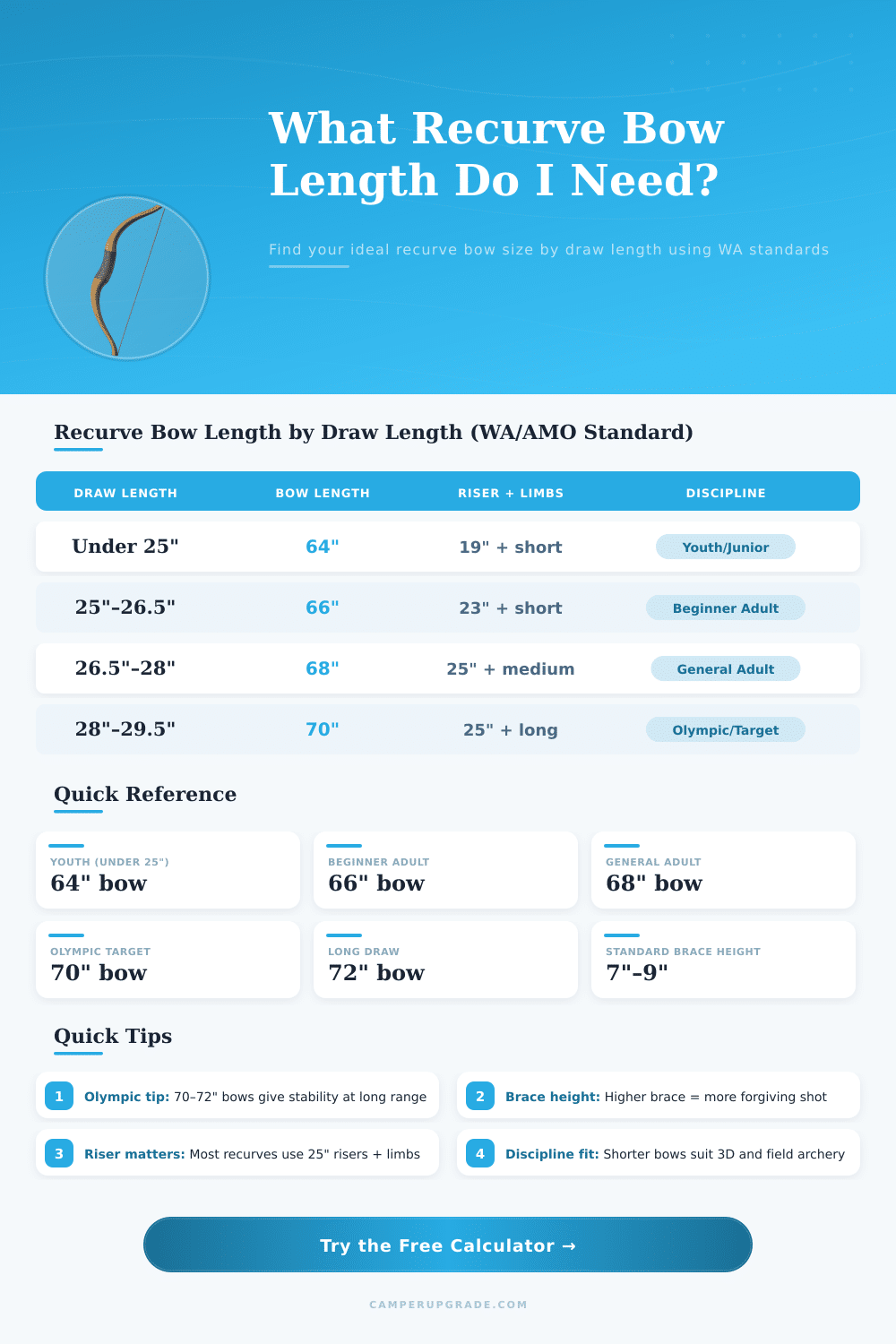
| Draw Length | Recommended Bow Length | Bow Length (cm) | Archer Type |
|---|---|---|---|
| Under 25" | 64" | 163 cm | Youth / Short Draw |
| 25" – 26.5" | 66" | 168 cm | Beginner Adult / Junior |
| 26.5" – 28" | 68" | 173 cm | Average Adult |
| 28" – 29.5" | 70" | 178 cm | Olympic / Tall Adult |
| 29.5" and above | 72" | 183 cm | Long Draw / Very Tall |
| Riser Length | Limb Size | Total Bow Length | Common Use |
|---|---|---|---|
| 17" (Short) | Short Limbs | 62–64" | Youth / Very Short Draw |
| 19" (Short) | Short Limbs | 64" | Youth / Junior |
| 23" (Medium) | Short Limbs | 66" | Beginner Adult |
| 25" (ILF Standard) | Short Limbs | 66–68" | General Adult |
| 25" (ILF Standard) | Medium Limbs | 68" | Most Common Setup |
| 25" (ILF Standard) | Long Limbs | 70" | Olympic / Competitive |
| 27" (Long) | Long Limbs | 72" | Long Draw / Tall Archers |
| Bow Length | Min Brace Height | Max Brace Height | Recommended Range |
|---|---|---|---|
| 64" | 6.0" | 7.5" | 6.5–7.0" |
| 66" | 6.5" | 8.0" | 7.0–7.5" |
| 68" | 7.0" | 8.5" | 7.5–8.0" |
| 70" | 7.5" | 9.0" | 8.0–8.5" |
| 72" | 8.0" | 9.5" | 8.5–9.0" |
Picking the right recurve bow length matters more than many beginners think The bow must fit your draw length and also your body as archer. Draw length is simply how far you can pull the string until full draw.
For most archers, the “sweet spot” is between 66 and 68 inches. A 68-inch bow is a common standard length for many folks, though not for all. If your draw length is about 28 inches, a 68-inch bow works well for Olympic recurve shooting.
How to Pick the Right Recurve Bow Length
As a general rule, the bow is around 40 inches longer than the draw length.
Here is a useful summary based on draw length. If your draw length is under 26 inches, a 64-inch bow usually works. Between 26 and 28 inches, choose 66 inches.
Between 28 and 30 inches, the best choice is a 68-inch bow. And for anything above 30 inches, a 70-inch bow makes senese.
Interestingly is how the “official” length actually works. A 68-inch bow does not necessarily measure 68 inches from tip to tip. The number comes from a standard method defined by AMO.
The AMO bow length is actually three inches longer than the AMO bow string that keeps the bow at the right height.
Takedown recurve bows allow archers to mix risers and limbs to reach different lengths. With a 25-inch riser, short limbs give a 66-inch bow, medium limbs do 68 inches, and long limbs cause 70 inches. If you switch to a 23-inch riser, short limbs give 64 inches, medium give 66, and long give 68.
Such flexibility is really useful.
Target archery and hunting require different lengths. World archery disciplines, such as barebow and Olympic recurve, typically use bows in the 66 to 72-inch range. Hunting recurves tend to be shorter.
For hunting, something in the 62 to 64-inch range commonly works better, because longer bows can be a pain to bear through woods. For bowfishing, even shorter bows around 50 to 54 inches are great, because they have less risk to hit the knee rails on the boat.
Someone with a short draw length, for instance 23 inches, might require a bow as short as 62 inches. Folk with average draw length honestly can shoot almost everything, from a 60-inch hunting recurve to a 70-inch target recurve, just fine. Personal preference here plays a big role.
Beginners should not care too much about bow length, because it is one of the less important specs early. Moreover, draw length can even adjust as your form improves over time.
Finding the best size means a bit of trial and error. A 66-inch bow commonly gives a nice balance between little finger pinch and a solid power draw for many shooters. Finding thebest size takes some trial and error.