🏍 Rake and Trail Calculator
Model motorcycle steering geometry, ride-height changes, and trail targets with instant dual-unit results.
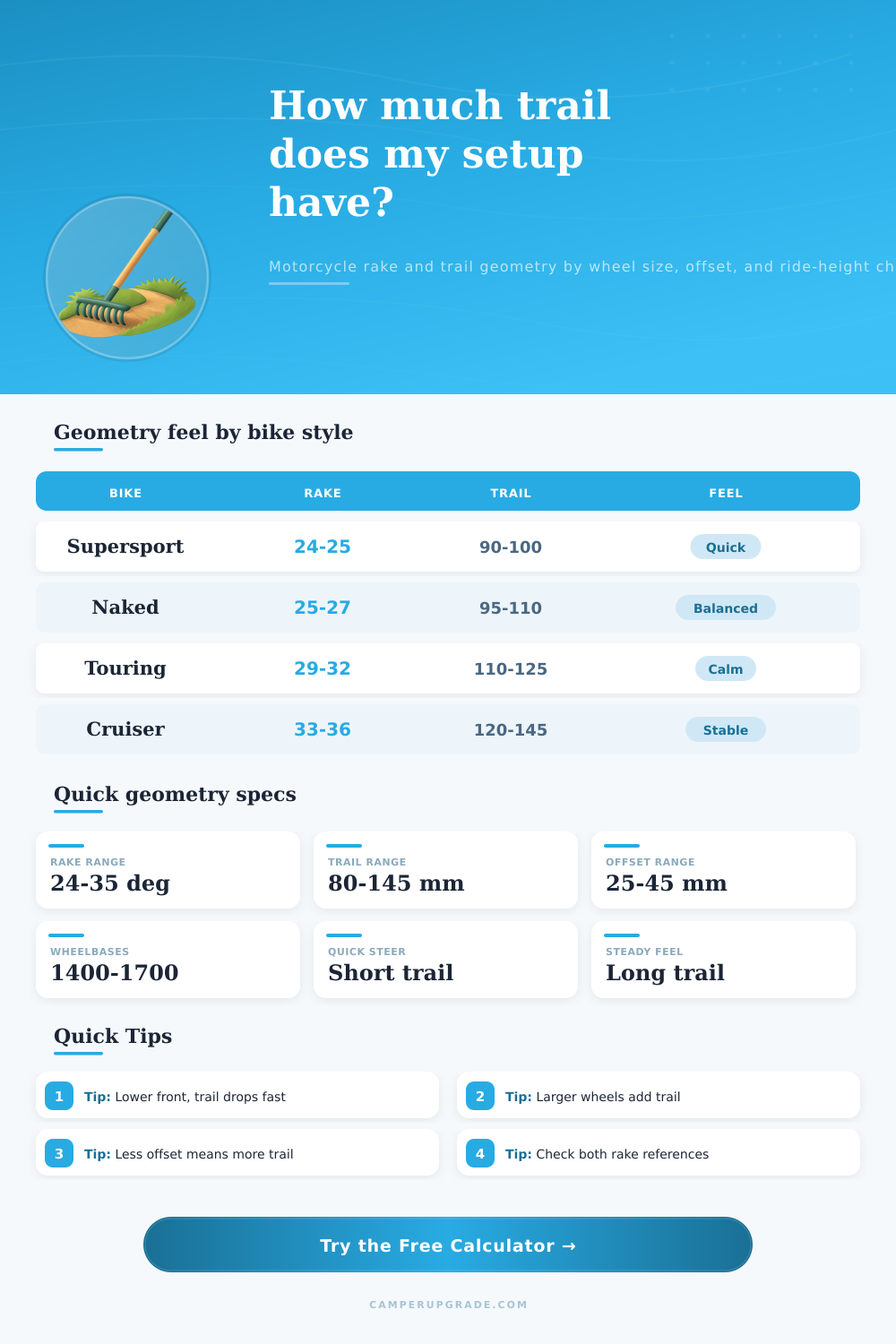
| Bike style | Rake from vertical | Trail range | Handling note |
|---|---|---|---|
| Supersport | 23-25 deg | 90-102 mm | Sharp turn-in |
| Naked roadster | 24-27 deg | 95-110 mm | Balanced feel |
| Sport touring | 26-30 deg | 105-122 mm | Calm at speed |
| Adventure bike | 27-32 deg | 110-128 mm | Stable on mixed surfaces |
| Cruiser | 31-36 deg | 120-150 mm | Strong self-centering |
| Motocross | 26-29 deg | 95-115 mm | Quick direction changes |
| Front wheel | Typical radius | Trail effect | Common use |
|---|---|---|---|
| 17 in | ~300 mm | Lowest of this set | Sport bikes |
| 19 in | ~340 mm | +trail vs 17 in | Road ADV |
| 21 in | ~380 mm | More trail again | Off-road bias |
| 23 in | ~410 mm | Long, calm trail | Custom builds |
| Smaller tire | Lower radius | Trail drops | Quicker steering |
| Taller tire | Higher radius | Trail rises | More stability |
| Change | Trail impact | Rake impact | Typical reason |
|---|---|---|---|
| Less offset | Trail increases | No direct change | More straight-line calm |
| More offset | Trail decreases | No direct change | Faster steering |
| Front higher | Trail increases | Rake relaxes | High-speed stability |
| Front lower | Trail decreases | Rake steepens | Quicker turn-in |
| Rear higher | Trail decreases | Rake steepens | Race-style stance |
| Rear lower | Trail increases | Rake relaxes | Touring comfort |
| Build direction | What to watch | Result to expect | Best for |
|---|---|---|---|
| Steepen rake | Clamp clearance | Quicker response | Track use |
| Relax rake | Fork extension | Greater calm | Loaded trips |
| Reduce offset | Bar effort | More trail | Long highway miles |
| Raise front | Seat height | Stability grows | Touring and ADV |
| Lower front | Ground clearance | Trail falls | Street agility |
| Increase wheel size | Brake reach | Trail rises | Mixed terrain |
Steering geometry are the system of angles and distances on a motorcycle that determines both how it steer and how it remain stable. There are two measurement within the steering geometry of a motorcycle: the rake and the trail. Each of these measurement has a distinct impact on a motorcycle’s performance.
Because these measurements will ultimately determine whether a motorcycle turn quickly or remains stable at high speed, it is essential to understand these measurement. The rake of a motorcycle is the angle of the motorcycles steering head. If the angle of the steering head are increased, the motorcycle will turn more quick.
How Rake and Trail Affect Motorcycle Turning and Stability
By increasing the angle of the steering head to nearly vertical, the front wheel will remain directly under the motorcycle’s frame. Additionally, increasing the angle of the steering head will allow the motorcycle to turn with less effort from a rider. However, if the angle of the steering head is decrease, the motorcycle will be more stable.
A shallower angle of the steering head will allow the motorcycle to remain stable when ridden on the highway, but it will require more effort from the rider to turn the motorcycle. The trail of a motorcycle is the horizontal distance between the point at which the motorcycle’s steering axis hit the ground and the point at which the motorcycle’s front tire touches the ground. If a motorcycle has more trail, it will naturaly resist any turning force and return to its original position.
Conversely, if a motorcycle have less trail, the motorcycle will dive into the turns that it encounters. Thus, trail has a direct impact on the motorcycle’s stability; the more trail a motorcycle has, the more stable the motorcycle will be. However, the less trail the motorcycle has, the more faster the motorcycle will turn.
The rider can change the trail of a motorcycle by altering the motorcycle’s fork offset and front wheel size. Fork offset is the distance between the steering stem of the front wheel and the motorcycle’s front axle. If the fork offset is decrease, the trail will also decrease.
However, if the fork offset is increased, the trail will also increase. Another factor that can alter the trail of a motorcycle is the size of the front wheel. The larger the front wheel of a motorcycle, the more trail the motorcycle will exhibit.
Adventure motorcycles, for example, often have a 21-inch diameter for their front wheel since this will provide them with more trail and, therefore, more stability when traveling over uneven surface. The height on which a motorcycle rides also impact its steering geometry. If the motorcycle’s front end is lowered, the rake of the motorcycle will become steeper and the trail will decrease.
A decrease in trail will make the motorcycle turn more quickly; however, it will also cause head shake at higher speed. Additionally, if the rear of the motorcycle is raised, its steering will tilt forward and its rake will become steeper. However, any alteration to a motorcycle’s height have the potential to drastically impact its steering geometry; even raising or lowering the motorcycle by 10 millimeter will change the rake and trail of the motorcycle.
The wheelbase of a motorcycle also have an impact upon its steering geometry. The wheelbase of a motorcycle is the distance between the front and rear axle of the motorcycle. Motorcycles with longer wheelbase, such as tourers, will naturally mute the effect of alterations in trail and rake.
Motorcycles with short wheelbase will exhibit amplification of alterations of trail or rake. Thus, alterations made to the steering geometry of motorcycles with short wheelbase will have a greater impact upon the motorcycle’s handling than those made to motorcycles with long wheelbase. There are some common error that a rider might make when adjusting the steering geometry of a motorcycle.
One of them is utilizing different reference for the rake of the motorcycle. For example, one reference might use a vertical line as the line from which to measure the angle of the fork, while another might use a horizontal line. Another error is the overlooking of the radius of the tire.
Installing tire with a taller radius will increase the trail. Finally, one of the most common error is ignoring the height of the rear of the motorcycle. Changing the rear height of a motorcycle will change its rake, and changing its rake will change the trail of the motorcycle.
The steering geometry of a motorcycle should ultimately be chosen according to the type of riding that a motorcycle rider will perform. For instance, if a rider plan to ride on smooth asphalt area, a motorcycle with more trail will exhibit less steering stability. However, if a motorcycle rider plans to ride on gravel or rough terrain, the motorcycle will need to have more trail to remain stable while performing those maneuver.
Most motorcycles that are used for street riding will have a trail between 95 and 115 millimeter. However, cruiser motorcycles will have a trail that is greater than 115 millimeter to ensure that they provide a stable ride for the rider. Thus, by choosing steering geometry according to the type of riding that will be performed with the motorcycle, that motorcycle will exhibit behavior that are expected of and desired by the rider.