Rain Catchment Tarp Yield Calculator
Estimate usable water from a camping tarp by size, rainfall, pitch, material runoff, first-flush diversion, and storage capacity.
Use the flat overhead footprint, not the full sloped fabric area.
Rain Catchment Estimate
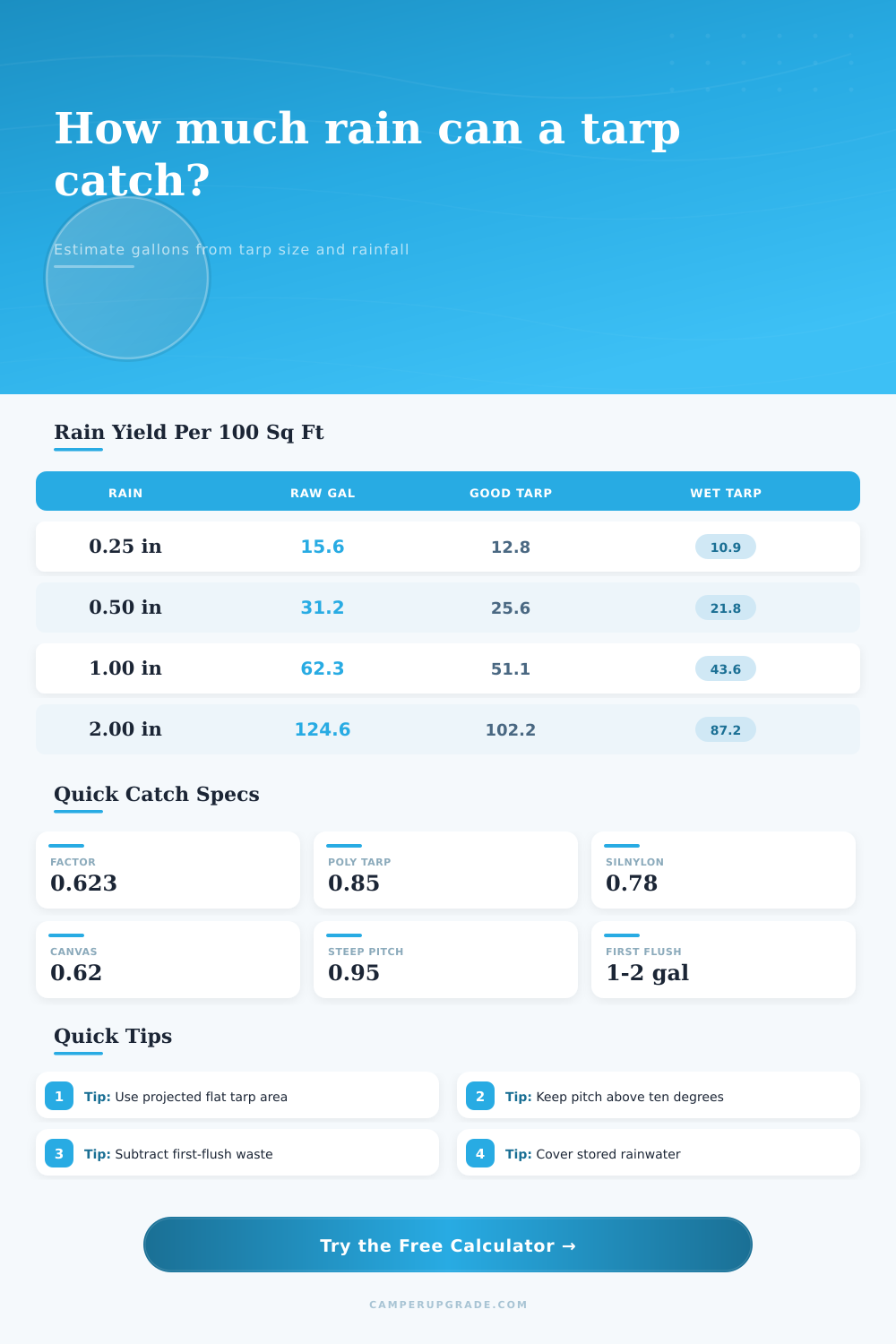
| Rainfall | Raw water per 100 sq ft | After good tarp losses | Metric equivalent |
|---|---|---|---|
| 0.10 in light shower | 6.2 gal | 4.8-5.2 gal | 23.6 L raw |
| 0.25 in small storm | 15.6 gal | 12-13 gal | 59.0 L raw |
| 0.50 in steady rain | 31.2 gal | 24-26 gal | 117.9 L raw |
| 1.00 in heavy event | 62.3 gal | 48-52 gal | 235.8 L raw |
| 2.00 in long storm | 124.6 gal | 96-104 gal | 471.6 L raw |
| Tarp surface | Runoff coefficient | Best use in camp | Yield note |
|---|---|---|---|
| Vinyl coated tarp | 0.90 | Basecamp barrel feed | Sheds water quickly |
| Dyneema composite | 0.88 | Light shelter catchment | Low absorbency surface |
| Woven polyethylene | 0.85 | RV awning or camp kitchen | Common reliable value |
| Silpoly | 0.82 | Backpacking tarp | Good runoff when pitched |
| Silnylon | 0.78 | Small trail shelter | Can sag during rain |
| Waxed canvas | 0.62 | Cook fly or wall tent fly | Absorbs more water |
| Open shade mesh | 0.25 | Emergency shade only | Most rain passes through |
| Pitch / capture setup | Typical efficiency | Why it changes yield | Field check |
|---|---|---|---|
| Nearly flat tarp | 0.70 | Ponding, splash, edge loss | Water pools before draining |
| Low pitch | 0.82 | Some sag and side spill | Drips from several edges |
| Moderate pitch | 0.90 | Reliable runoff path | Most flow reaches one edge |
| Steep pitch | 0.95 | Fast draining surface | Little ponding visible |
| Sealed gutter edge | 0.93-0.98 | Less splash and overshoot | Stream enters container cleanly |
| Common tarp setup | Projected area | Raw yield at 1 in | Usable with 75% net |
|---|---|---|---|
| Solo A-frame 8x10 | 80 sq ft | 49.8 gal | 37.4 gal |
| Camp kitchen 10x14 | 140 sq ft | 87.2 gal | 65.4 gal |
| Family dining 12x16 | 192 sq ft | 119.6 gal | 89.7 gal |
| RV awning zone 8x20 | 160 sq ft | 99.7 gal | 74.8 gal |
| Group canopy 20x24 | 480 sq ft | 299.0 gal | 224.3 gal |
| Specification | Light backpack tarp | Poly utility tarp | Basecamp vinyl tarp |
|---|---|---|---|
| Typical runoff coefficient | 0.78-0.82 | 0.82-0.85 | 0.88-0.90 |
| Pitch sensitivity | High, fabric can sag | Medium, edge support matters | Low, sheds fast |
| Clean water suitability | Rinse before use | Use first flush | Use first flush |
| Best collection edge | Corner cord or small funnel | Clamped gutter or folded edge | Rigid gutter or manifold |
| Most common storage match | 5-10 gal jug | 20-40 gal tote | 55 gal barrel or larger |
When it’s raining onto your tarp, all that rain appears free and plentiful. Seems like it will fill up your containers right away. Guess what? Most of the time it doesn’t. Most of it gets absorbed by the ground, splashes around, or was never positioned well in the first place. So before your water hit the bottom of your container, you’re probably losing half of it.
Enter your tarp size and how much rain fell, and the calculator above do the math for you. You won’t have to guess at conversions and coefficients anymore. It’ll show you just how far off your actual drinking water is from total rain you collected.
How to Calculate Your Rainwater Harvest
The biggest problem with how most people estimate their collection area is that they measure the whole area of fabric instead of just the footprint it would project. For example, if you’re using a A-frame shelter, the sides cover much more area than what’s on the ground. Rain comes down vertically so only what casts a shadow will catch rain. That makes a huge difference in how many liters you’ll collect.
The tool can accepts custom, rectangle, or triangle input depending on your view so you can adjust accordingly. Again, that little detail make a big difference if you want to get the most out of a quick storm.
The kind of material you use will also have a big impact on how much runs off top. Composites made from Dyneema and vinyl are both pretty slick, so they tend to shed water. Mesh setups and waxed canvas rig will allow water to run right through them. They can also absorbs moisture into the fabric, reducing your yield. Each fabric has a specific runoff coefficient listed in the reference table. Keep that in mind, a super thick tarp could appear full but be holding gallons within the fibers. This will become more apparent as it begins to run off after a couple minutes.
Physically, whether it sets up well depend on pitch and edge capture. If there’s too much pitch (like a flat tarp), then water will pool, resulting in overflows and splash loss. Steepening the sides improve drainage by sending water towards a corner or gutter, but it reduces projected area. How fast do you want it flowing? And how large an area should be collecting it?
Do you wish to filter initial runoff? By diverting the first flush, you eliminate the initial dirty water carrying pollen and other dust. This can save gallons, but run the risk of contaminating your supply with hard-to-remove debris.
The last limiting factor in the system is storage capacity. You can catch hundreds of gallon in a heavy storm, but if your barrels only hold thirty, the rest runs to waste. The calculator will cap your usable output based off your tank limit. It reminds you that you need to balance how much you collect with how much you store.
Evaporation occurs in heat and there are always spills when transferring. It’s smart to plan for a safety margin. It grounds your expectations in what you can actualy keep as opposed to what fell from the sky.
Collecting rain is all about keeping it simple, keeping waste down and keeping expectations in check. At once you’re battling impurities, surface tension and gravity. This is where knowing your true harvest can make all the difference: whether to hope for more rain or to pack along some extra water. It’s not guessing anymore; it’s a plan that works.
The next time a storm rolls through, you’ll be able to count on exactly how much you’ve stored up for when it does. That peace of mind counts for something. And so you find yourself standing under the tarp once more; but this time you know where each drop goes.