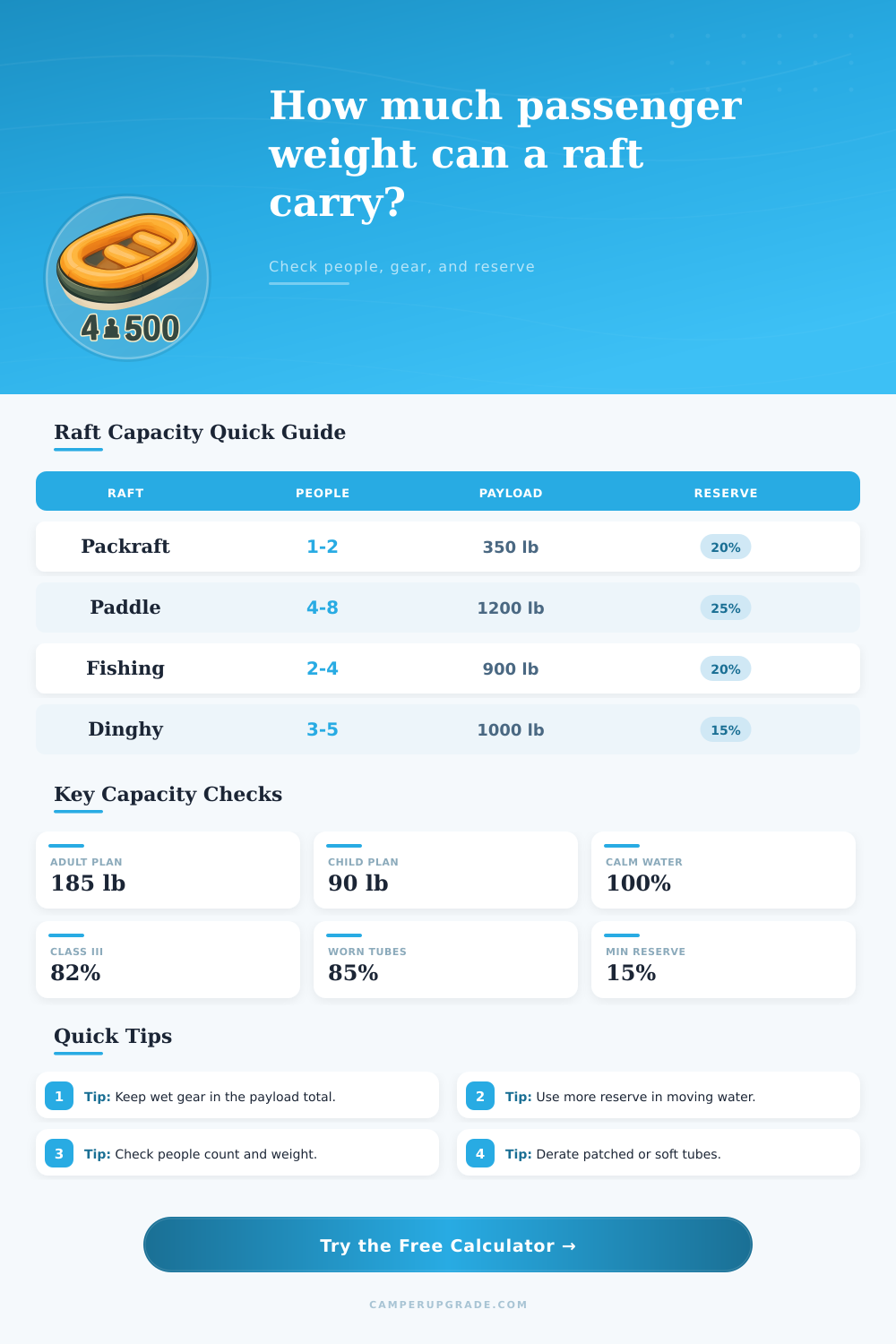
Raft Passenger Weight Capacity Calculator
Check rated payload, passenger weight, gear, motor load, water conditions, and reserve before a float, fishing day, or whitewater run.
🛶Raft Load Presets
⚙Capacity Inputs
📊Raft Type Capacity Grid
📋Raft Payload Reference
| Raft Style | Common Length | Typical Payload Range | Planning Note |
|---|---|---|---|
| Solo packraft | 7-8 ft | 250-350 lb | Count paddle, dry bags, and cold-water layers. |
| Tandem packraft | 10-13 ft | 450-750 lb | Passenger count is usually more limiting than volume. |
| Whitewater paddle raft | 12-14 ft | 900-1500 lb | Use extra reserve for Class III and above. |
| Fishing raft with frame | 12-14 ft | 750-1250 lb | Frame, cooler, anchor, and anglers add up quickly. |
| Inflatable dinghy | 9-12 ft | 800-1400 lb | Motor, battery, fuel, and transom rating must agree. |
| Expedition cargo raft | 14-18 ft | 1800-3500 lb | Rig for trim, not only total payload. |
🌊Water Condition Derating Table
| Condition | Capacity Factor | Reserve Suggestion | Why It Matters |
|---|---|---|---|
| Calm lake or protected bay | 1.00 | 10-15% | Small waves and easy landings need the least derating. |
| Wind chop or mild current | 0.92 | 15-20% | Load shifts and spray reduce useful freeboard. |
| Class II moving water | 0.86 | 20-25% | Small waves and rocks reward lighter trim. |
| Class III whitewater | 0.82 | 25% | Holes, lateral waves, and rapid maneuvers need margin. |
| Class IV, cold, or pushy water | 0.76 | 25-30% | Heavy rafts recover slower and ship more water. |
🧍Passenger Planning Weight Table
| Passenger Group | Planning Weight | Metric Equivalent | Capacity Note |
|---|---|---|---|
| Light adult estimate | 160 lb | 73 kg | Use only when actual group weights are known. |
| General adult estimate | 185 lb | 84 kg | Good default for mixed recreation groups. |
| Large adult estimate | 220 lb | 100 kg | Better for cold-weather clothing and larger riders. |
| Child estimate | 90 lb | 41 kg | Still include PFD, layers, snacks, and water bottle. |
| Guide or rower with kit | 210 lb | 95 kg | Often includes rescue gear, throw bag, and extra layers. |
🎒Gear and Accessory Load Table
| Item | Typical Weight | When To Count It | Planning Note |
|---|---|---|---|
| Fishing frame with seats | 55-110 lb | Fishing rafts | Include lean bars, oar towers, seat plates, and straps. |
| Loaded cooler | 35-120 lb | Day or overnight trips | Ice and drinks can outweigh the cooler itself. |
| Anchor system | 25-55 lb | Fishing setups | Count anchor, rope, pulleys, and stern hardware. |
| Small outboard | 30-90 lb | Dinghy or tender | Check transom rating separately from payload. |
| Battery and fuel | 25-80 lb | Powered inflatables | Place dense weight low and near the centerline. |
| Overnight dry bags | 40-160 lb | Camping trips | Wet tents, ropes, and clothing increase load. |
🔧Material and Spec Comparison
| Material or Spec | Capacity Effect | Best Use | Capacity Planning Note |
|---|---|---|---|
| PVC fabric | Normal payload | Recreation, fishing, tenders | Watch age, folding wear, and pressure loss in heat cycles. |
| Hypalon or CSM | Durable margin | Commercial, hot sun, heavy river use | Still obey the plate rating; fabric durability is not extra payload. |
| TPU packraft fabric | Light payload | Backcountry travel | Packrafts are volume-limited; keep loads compact and balanced. |
| Drop-stitch floor | Better stiffness | Dinghies and fishing platforms | Stiff floors improve trim but do not change rated payload. |
| Multi-chamber tubes | Safety margin | Whitewater and rescue | Redundancy helps flotation after damage, not overloaded handling. |
| Aluminum fishing frame | Consumes payload | Rowing and angling | Subtract frame weight before deciding passenger count. |
💡Capacity Tips
Weight is always starting point for any raft mishap. Six in your party? No problem; your boat has an eight-person rating. It sounds good on paper. However, you have to remember that this rating are the maximum weight possible in perfect conditions with everything on deck completely dry. Add ice chests, fishing frames, wet ropes and waves from whitewater, and your available space diminish rapidly. Don’t rely solely on number of bodies to know how many people your craft will hold.
Weight matter. Know what it takes to keep your raft in the water. Passenger weight plus motor mass plus gear load times environmental derating factors all runs through the calculator above. The result shows the often invisible cost of preparing for a trip. If you’ve got a standard rowing frame with oars, oar towers and seats you’re looking at anywhere from 50-110 pounds without even considering any rods. Add a cooler loaded with ice and drinks and that’s an easy hundred pounds or more. You’ll be halfway into your payload before even getting on the water.
Why Raft Weight Matters for Safety
Most people forget to count anchor system or the battery for their trolling motor until they are already in the water and sitting low. But it asks for specific weights instead of estimates, which help you visualize how it adds up. Capacity planning also depends surprisingly on water conditions. Freeboard increases with moving water because you want to avoid swamping, thus reducing amount of load your raft can carry. A Class III run might require you to derate your usable capacity by eighteen percent compared to an average day on a calm lake.
It’s not that you won’t be comfortable; it’s that you’ll have less stability. That loaded raft sit lower in the water. It is slower to right itself after a wave and harder to turn aside a hole. When you’re running pushy cold water or even Class IV, there is no margin for error. Additional buoyancy provide the ability to fight both drag of wet clothes and the shock of being hit by waves.
The condition of your raft is just as important as its contents. New rafts hold air more secureley than old ones with multiple patches and slow leaks. A lack of rigidity also decrease the volume. To account for this, you can choose the condition of your tubes in the calculator so you’re not counting on a perfect score if your craft has seen some miles. Be conservative on this one as well, slow seeps can make for a manageable amount of water until you hit the end of a long day and your boat becomes a sinking hazard.
Many folks think way too hard about weight, and not enough about trim. Putting all your heavy stuff in the back or off to one side will cause a raft to handle poorly even when it’s under its rated payload. Keep density low and towards the centerline of the boat. The rudder works best that way. The nose stays up, which helps with tracking. When a boat handles well through the water it feels like you have less weight then you do.
Never overload your raft. There’s no room for negotiation when it comes to safety reserves. On calm water, leave at least fifteen percent reserve, more on rivers. That means the difference between a catastrophe and a close call when something unforeseen happens. Someone fell in and climbed back in wet. You picked up some extra water or debris while running. The point is, leaving a buffer is always wise.
Capacity can be thought of as a budget. There is only so much you can carry. Your safety, your gear, and your people all takes up a piece of your carrying capacity. Each one comes with a price tag. Plan for your trip: know what you’ll need ahead of time. Personal layers, dry bags, camping gear; it all adds up fast. Here’s where the reference table on the page come in handy; it breaks down typical range of capacities for different rafts ranging from packrafts to expedition style boats. Know what you want before you go out and rent/buy.
To conclude, Keep it light; keep it right You want a safe trip, right? Your plan shows you’re going to cut it fine? You should of left some stuff at home. You want more freeboard and less gear, not the opposite of that. Don’t push the numbers. That river will always win out. Weigh it, start with a clear mind, and honor the capacity of the water you’re on.