Raft Passenger Capacity Calculator
Estimate passenger count from raft dimensions, tube diameter, rated load, passenger weight, gear load, river class, guide setup, safety reserve, and cooler or drybox floor space.
🛶Raft Capacity Presets
⚙Raft Capacity Inputs
📏Raft Spec Grid
📊Raft Capacity Reference Tables
| River Class | Payload Factor | Floor Target | Use Case |
|---|---|---|---|
| Class I | 100% | 6.0 ft²/person | Flatwater, mild current, high stability margin. |
| Class II | 95% | 6.5 ft²/person | Easy rapids with some maneuvering room needed. |
| Class III | 85% | 7.5 ft²/person | Intermediate rapids where trim and quick movement matter. |
| Class IV | 75% | 9.0 ft²/person | Advanced water with larger reserve and cleaner rigging. |
| Class V | 60% | 11.0 ft²/person | Expert runs; use conservative loads and experienced judgment. |
| Raft Size | Typical Rating | Tube Diameter | Common Crew |
|---|---|---|---|
| 10.5-12 ft | 650-950 lb | 16-18 in | 2-4 paddlers, small day loads. |
| 13-14 ft | 1000-1500 lb | 18-20 in | 4-7 paddlers depending on class and gear. |
| 15-16 ft | 1500-2200 lb | 19-22 in | 6-9 paddlers or oar frame with cargo. |
| 17-18 ft | 2100-3000 lb | 21-24 in | Large day crews or multi-day expedition loads. |
| Cataraft / wide rig | 900-2500 lb | 20-25 in | Depends strongly on frame deck and bay layout. |
| Guide Setup | Weight Used | Space Used | Capacity Effect |
|---|---|---|---|
| No guide space | 0 lb | 0 ft² | Use only for self-guided capacity comparisons. |
| Stern paddle captain | 185 lb | 5 ft² | Small standing or bracing space near stern. |
| Center oar frame | 185 lb | 9 ft² | Rowing station and frame bay reduce passenger floor. |
| Stern frame guide | 185 lb | 7 ft² | Moderate space loss for oars or stern-mounted control. |
| Gear Item | Weight Range | Floor Space | Notes |
|---|---|---|---|
| Small cooler | 40-90 lb | 3-5 ft² | Include ice, food, straps, and frame clearance. |
| Large cooler | 90-180 lb | 5-8 ft² | Often becomes both payload and floor limiter. |
| Drybox | 35-100 lb | 3-6 ft² | Count handles, straps, and aisle space. |
| Overnight dry bags | 20-60 lb each | 1-3 ft² | Soft bags compress, but still block foot placement. |
| Water jugs | 42 lb / 5 gal | 1-2 ft² | Heavy and dense; secure low and balanced. |
🧭Planning Tips
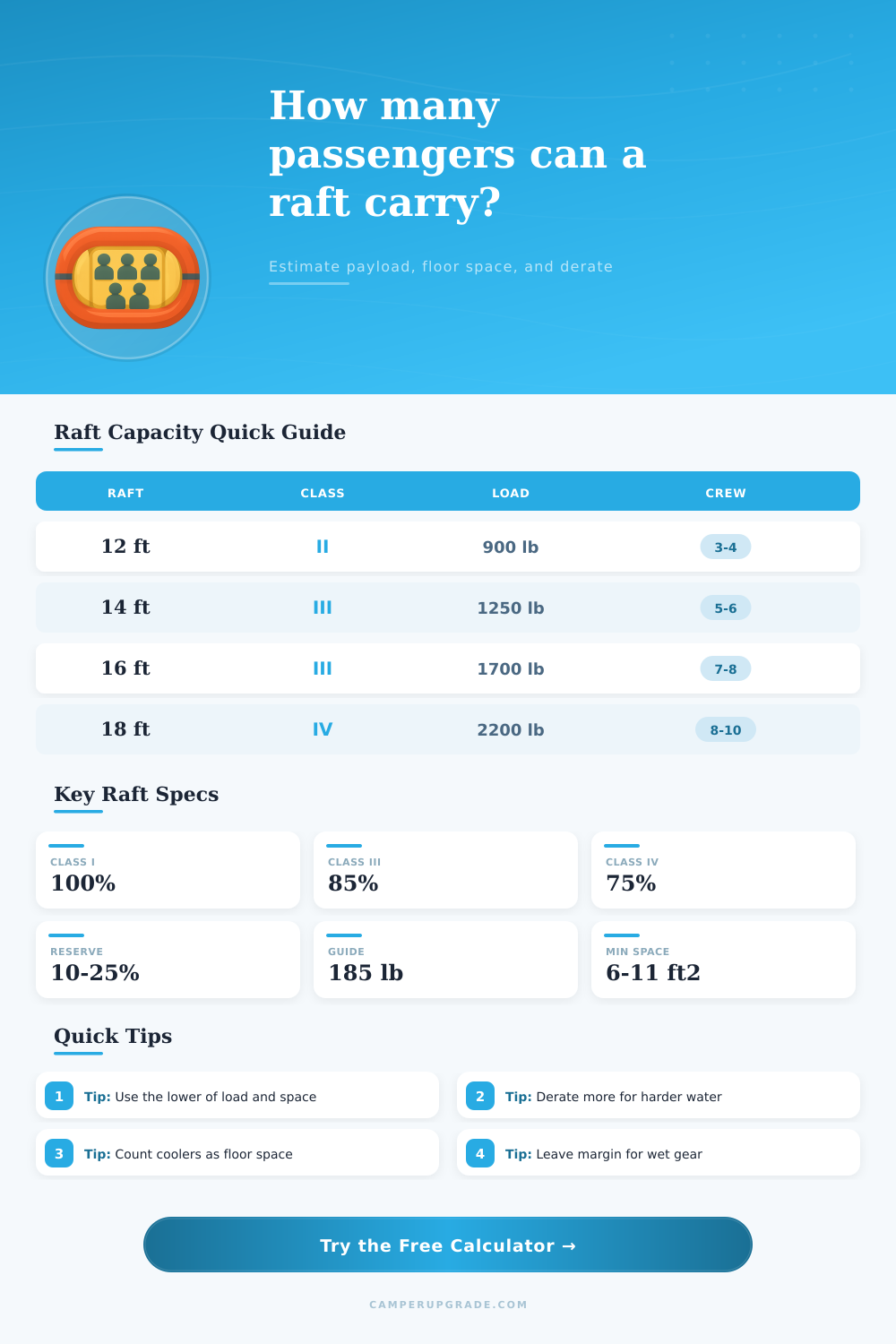
Raft passenger capacity are a measurement of how many people can fit on a raft, but the raft passenger capacity calculation require more than just considering the weight of the raft. Many person make the mistake of only using the weight rating that is provided by the raft manufacturer. However, the manufacturer did not consider the amount of space that each person take up on the raft.
Raft manufacturers provides a weight limit for their rafts, but rafts also has a limited amount of floor space. The tube of the raft and other equipment such as cooler or frames take up this floor space. The dimensions of a raft also matters for calculating the raft passenger capacity.
How to Calculate How Many People Fit on a Raft
The tubes on the sides of a raft take up space, and a person must consider the length, the width, and the diameters of the raft’s tubes. Any equipment that is placed inside the raft will also take up some of the raft floor space. To calculate the raft passenger capacity correct, you should subtract the space taken up by the raft’s equipment from the total floor area of the raft.
Using the raft passenger capacity calculator allow for this calculation so that the number of passengers dont get overcounted. The class of the river also impact the weight that a raft can take. On easy water, a raft can take the full load that was calculated for that raft.
However, on difficult water, the raft must have a reduced load to allow for more stability. The raft passenger capacity calculator will automatically derate the raft based on the class of the river the raft will be traveling on. Additionally, the calculator hold back some of the calculated weight for the raft to ensure that the raft will remain stable on difficult river.
Another factor to consider for raft passenger capacity is the weight and space that the guide will take up on the raft. A raft guide will take up some of the raft’s weight and floor space. The passenger capacity calculation must take into account the weight and the floor space that the guide will take up on the raft.
The raft passenger capacity calculator take into account the weight and the floor space that the guide will take up on the raft to ensure that the passenger count are accurate. Another measurement of raft passenger capacity is the amount of floor space that is provided to each person on the raft. Many person will underestimate the amount of floor space that is required for each passenger on the raft.
Each passenger will need enough floor space to brace their feet against the tube of the raft. If there isnt enough floor space for each passenger, the trip may become uncomfortable for the passengers. The raft passenger capacity calculator will report how much floor space is provided to each passenger on the raft so that the trip organizer can determine whether or not the passengers will have enough room to move on the raft.
People often make mistake when calculating the raft passenger capacity. One of the most common mistake is using only the weight rating provided by the raft manufacturer. Even if the raft can hold 1,700 pounds, it may not be safe for that load.
On the other hand, a raft may be unsafe for a too light load. The load of the raft must be balanced against the floor space for that raft. By balancing the load against the floor space, the person can avoid the mistakes that are often made with raft passenger calculation.
Other external variables will also impact the safety of the raft and the passengers in it. Variables such as the strength of the wind, the water temperature, and the experience level of the raft crew may all have an impact on the raft’s safety. For these variables, a person’s judgment can only be relied upon instead of the raft passenger capacity calculator.
Finally, the raft passenger capacity calculation should of be performed twice to ensure the safety of the raft and the passengers on it. One calculation should be performed for the load that is to be expected for the trip. A second calculation should be performed for the load that would be experienced on a more difficult portion of the trip.
By calculating the raft passenger capacity for both scenario, the trip organizer can gain an understanding of how many passengers they have the flexibility to add or remove from the raft. This will allow them to avoid last-minute change to the passenger count on the raft at the put-in point.